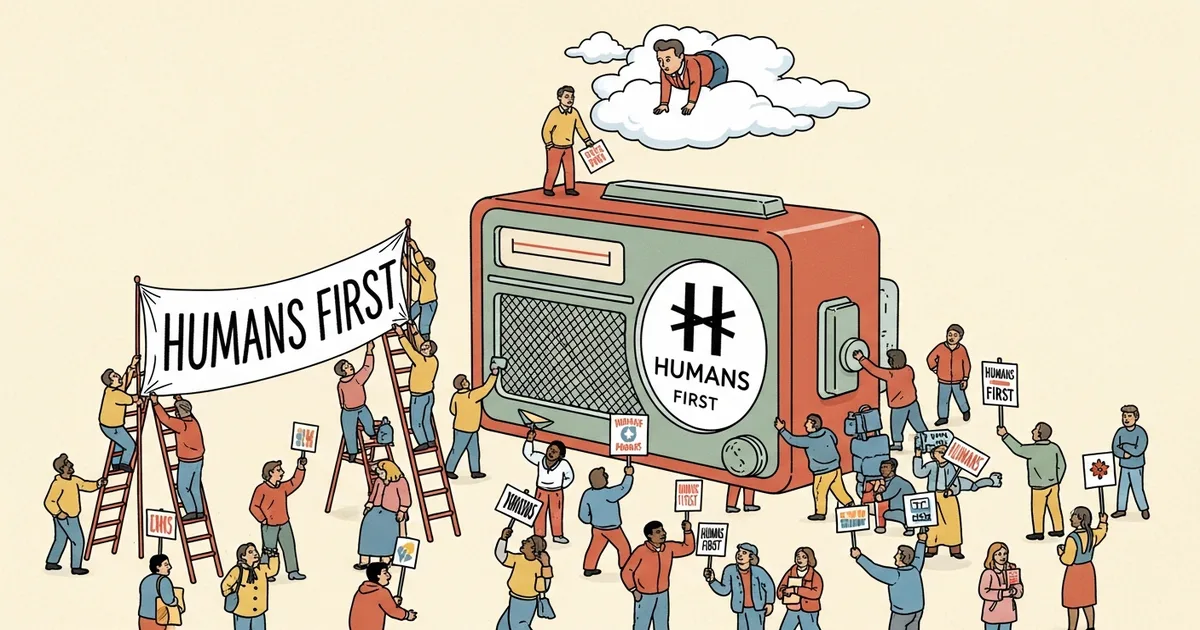
NBC News reports the organization “Humans First” — which hosts small group meetings for people to connect offline in the AI age — has attracted attention from Elon Musk and White House AI Czar David Sacks. What started as informal meetups has become a recognizable counter-movement to AI-driven isolation.
What Humans First Does
The organization hosts in-person meetings — typically 8-15 people — where participants deliberately disconnect from AI tools and focus on human interaction. Meeting formats include:
- No-screen dinners: Group meals where phones and AI devices are left at the door
- Analog problem-solving: Group discussions tackling challenges without AI assistance — whiteboards, sticky notes, human reasoning only
- Skill exchanges: Teaching each other hands-on skills (cooking, woodworking, drawing) that AI can’t replicate through screens
- Reflection sessions: Structured conversations about how AI has changed participants’ daily lives, relationships, and thinking patterns
Why It’s Growing Now
The movement’s growth tracks with several 2026 trends:
- AI everywhere: AI assistants now handle email, scheduling, writing, coding, and decision support — reducing incidental human interaction that previously occurred through these tasks
- Cognitive surrender research: The Wharton study showing 79.8% of users follow AI advice even when wrong has become a touchstone for people uncomfortable with AI dependence
- Workplace AI: 52,000 tech layoffs in Q1 2026 explicitly linked to AI created anxiety that extends beyond the tech industry
Why Musk and Sacks Noticed
Elon Musk — who owns xAI, Neuralink, and Tesla’s AI division — acknowledged the movement publicly, calling it “understandable” while arguing that AI ultimately creates more human connection by freeing time from mundane tasks. White House AI Czar David Sacks described Humans First as a “healthy counterbalance” to AI adoption.
Their attention legitimizes the movement. When the people building and regulating AI publicly acknowledge the counter-movement, it signals that AI-driven isolation is recognized as a real problem, not a fringe concern.
Is This a Cultural Backlash?
Humans First shares characteristics with previous technology resistance movements:
- Slow Food (1989): Counter to fast food industrialization — now a global movement with millions of members
- Digital Detox (2012): Counter to smartphone addiction — influenced screen time features in iOS and Android
- Right to Repair (2018): Counter to manufacturer control — led to legislation in multiple states
Each started as a small counter-movement and grew to influence mainstream behavior and policy. Humans First is following the same trajectory, with the advantage that its core proposition — human connection is valuable and AI can diminish it — is difficult to argue against, even for AI proponents.
What It Means for AI Companies
The existence and growth of Humans First creates a market signal: some consumers will prefer products and services that demonstrate human involvement. “Human-made,” “human-verified,” and “human-guided” may become marketing differentiators the way “organic” and “fair trade” did in food. AI companies that position their tools as enhancing human connection rather than replacing it will resonate better with an audience that’s already choosing to attend no-AI dinner parties on Friday nights.