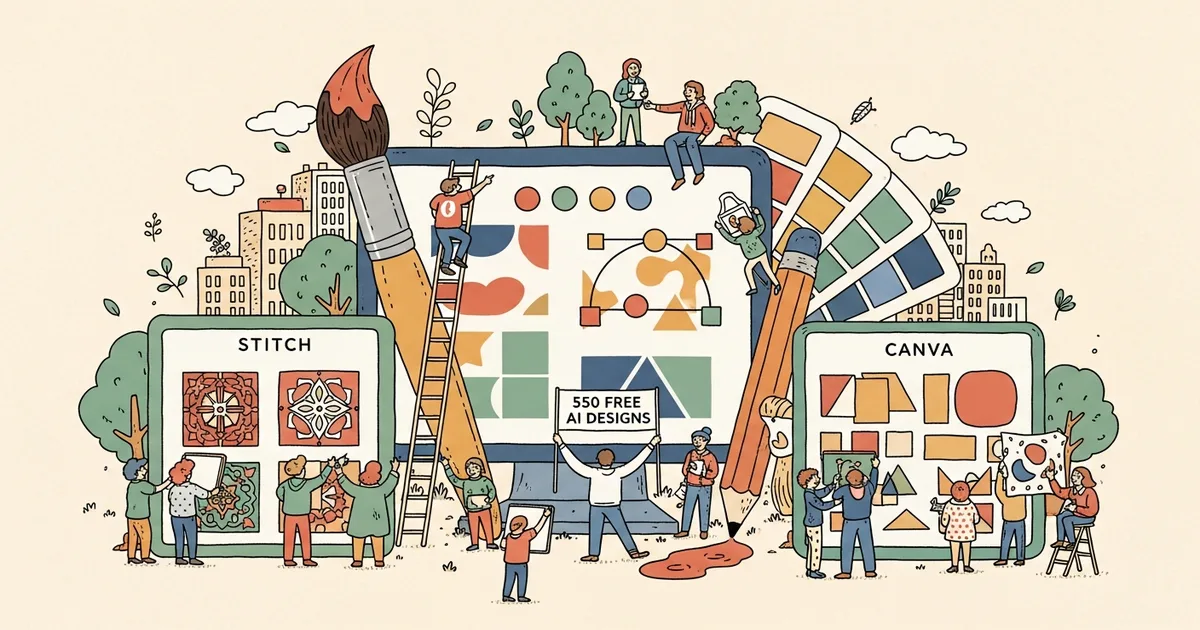
- Google Stitch offers 550 free AI design generations per month during its Google Labs phase — 350 in Standard mode (Gemini 2.5 Flash) and 200 in Pro mode (Gemini 2.5 Pro) — with no credit card required.
- Stitch targets UI/UX and app interface design, while Canva‘s Magic Suite focuses on marketing materials; they are not direct substitutes for most workflows.
- Canva‘s free tier limits users to roughly 10 text-to-image generations per month and 50 total Magic Write uses, making Stitch’s free allowance substantially more generous on paper.
- Google has signalled that Stitch will exit the Labs phase and move to paid plans by Q4 2026, so the current free tier is time-limited.
What Happened
Google launched Stitch as a Google Labs experiment at Google I/O on May 20, 2025, following its acquisition of Galileo AI earlier that year. The tool converts natural-language prompts, uploaded images, and annotated screenshots into high-fidelity UI designs for mobile and web applications, accessible at stitch.withgoogle.com.
On March 19, 2026, Google pushed a platform-level redesign that expanded Stitch’s capabilities significantly. The update introduced an infinite canvas, a voice interaction layer, a DESIGN.md export format, and an MCP server enabling direct integration with coding environments including Claude Code, Cursor, and Gemini CLI. The monthly generation allowance was also raised to 550 — up from an earlier ceiling of 350 for Standard mode only.
According to Google’s official blog, the updated Stitch can generate up to five interconnected screens in a single generation, map user journeys automatically, and export production-ready code in seven frameworks: HTML/CSS, Tailwind, Vue.js, Angular, Flutter, SwiftUI, and React.
Why It Matters
The free generation limit is the headline figure, but context matters. Canva’s free tier gives users approximately 10 text-to-image generations per month and 50 lifetime Magic Write uses before hitting a paywall, according to Canva’s own help documentation. Even Canva Pro subscribers receive roughly 500 AI generations per month — slightly below what Stitch provides entirely free.
The gap widens when you factor in how Stitch counts usage. A single generation that produces five interconnected screens — complete with navigation flows and component states — still counts as one generation. This means the 550-generation monthly allowance stretches further than a raw comparison with per-image tools like Canva’s Magic Media would suggest.
Figma’s pricing adds another layer of contrast. A 20-person team on Figma’s professional plan costs approximately $13,200 per year, while Stitch remains free for the same team size during the Labs phase.
Technical Details
Stitch runs on two distinct Gemini 2.5 model tiers. Standard mode uses Gemini 2.5 Flash and accounts for 350 of the monthly 550 generations; Pro mode uses Gemini 2.5 Pro for higher-quality output and covers the remaining 200 generations, per NxCode’s pricing breakdown. Users select which mode to use per generation depending on output quality requirements.
The March 2026 update introduced DESIGN.md, a structured markdown file format that captures design tokens, spacing rules, and component patterns from a Stitch project. This file can be exported from Stitch and imported into external coding tools via the Stitch MCP server, removing the manual step of translating design decisions into developer documentation. The voice canvas feature allows spoken prompts to trigger real-time design changes, design critiques, and iterative screen variants without switching to a text input.
Code export covers seven frameworks in the current release: HTML/CSS, Tailwind CSS, Vue.js, Angular, Flutter, SwiftUI, and React, as documented on the Google Developers Blog. Designs can also be exported as Figma files, letting teams that already use Figma adopt Stitch as an upstream ideation layer.
Who’s Affected
Stitch and Canva serve overlapping but distinct audiences. Canva’s core users are marketers, social media managers, and non-technical creators producing graphics, presentations, and promotional materials. Stitch is built for product designers, developers, and product managers who need app interface mockups and working prototypes. According to ToolsCompare.AI’s head-to-head analysis, the tools compete most directly when users need simple landing pages or web layouts — a segment where both produce usable output from natural language.
Figma faces a more direct challenge. Stitch’s MCP server, DESIGN.md format, and multi-framework code export replicate several capabilities that previously required Figma’s paid ecosystem. However, analysts at MindStudio note that Figma retains advantages in design system management and component-level consistency for teams with established brand guidelines. The current consensus from practitioners is a hybrid workflow: Stitch for initial ideation, Figma for polish and handoff.
Freelancers and solo developers working on tight budgets are the most immediate beneficiaries. The combination of voice input, multi-screen generation, and code export in a zero-cost tool removes several paid tools from a typical early-stage product workflow.
What’s Next
Google has indicated that Stitch will exit the Labs phase and launch as a commercial product by Q4 2026. Industry observers cited by NxCode expect paid tiers to be priced 30–50% below comparable Figma plans, with a reduced-limit free tier remaining available after launch.
To access Stitch now at no cost, visit stitch.withgoogle.com and sign in with a Google account. No credit card or waitlist is required during the Labs phase. Users who want to preserve their current project state before the commercial transition should export their DESIGN.md files and any framework-specific code now, as generation history and project files may not carry over to paid accounts without manual migration.
Canva has not publicly responded to Stitch’s updated free tier. Figma’s most recent AI feature announcement, its Skills system for agent-based design, predates the March 2026 Stitch update. Both companies are expected to update their free tier offerings ahead of Stitch’s commercial launch later this year, according to Fast Company’s coverage of the competitive landscape.