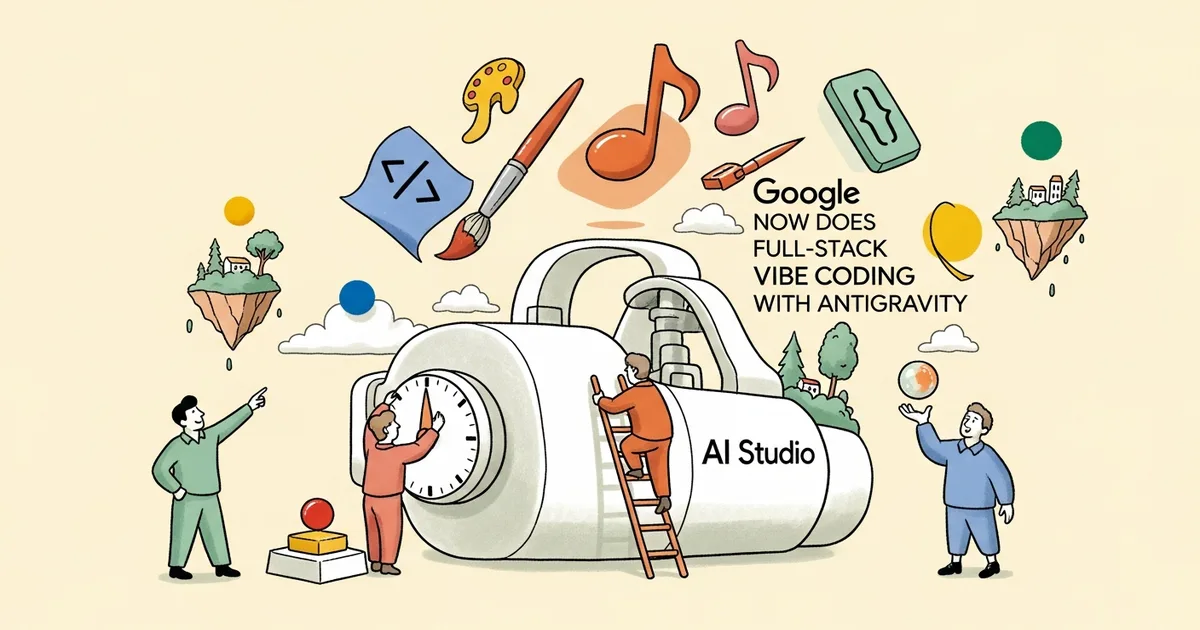
- Google AI Studio now includes the Antigravity coding agent, which turns text prompts into full-stack web applications with backend services built in.
- Firebase integration enables automatic setup of databases, authentication, and cloud functions directly from natural-language descriptions.
- The platform supports React, Angular, and Next.js, along with multiplayer and real-time features powered by Firestore.
- AI Studio remains free for prototyping, but production deployment through Gemini API or Vertex AI incurs token-based costs.
What Happened
On March 18, 2026, Google introduced a full-stack vibe coding experience inside Google AI Studio. The update centers on the Antigravity coding agent, which converts conversational prompts into working web applications complete with backend infrastructure. Ammaar Reshi, the post’s author, described it as a way to “start building real apps for the modern web” without leaving the AI Studio environment.
The release also includes native Firebase integration, meaning developers can provision databases, set up user authentication, and deploy cloud functions in a single workflow. Google positions the tool as a bridge between rapid prototyping and production-ready code, aimed at developers who want to move from idea to deployed application without switching between multiple platforms.
Why It Matters
Vibe coding, the practice of describing software in plain language and letting an AI agent generate it, has been gaining traction since early 2025. Google’s entry raises the stakes by bundling a code-generation agent with backend services and deployment infrastructure in one interface. Until now, most vibe coding tools focused on frontend output, generating HTML, CSS, and JavaScript without handling the server-side components that production applications require.
For solo developers and small teams, the combination removes several steps from the typical build-deploy cycle. Instead of configuring a database, writing authentication logic, and setting up hosting separately, the Antigravity agent handles each layer when it detects the need from the user’s prompt. That lowers the barrier for people who can describe what they want but lack deep infrastructure experience.
The timing also matters. Google is competing directly with Replit, Lovable, and Bolt, all of which raised significant funding in 2025 on the promise of AI-generated applications. By bundling its own agent with free prototyping and a path to its cloud infrastructure, Google leverages its existing ecosystem in ways that standalone startups cannot easily replicate.
Technical Details
The Antigravity agent monitors prompts for cues that indicate backend requirements. When it detects a need for data storage or user identity, it offers to provision Firestore and Firebase Authentication automatically. Clicking “Enable Firebase” sets up the project, connects the codebase, and configures security rules without requiring the developer to visit the Firebase console separately.
Framework support currently includes React, Angular, and Next.js. The platform also handles multiplayer and real-time features, with Firestore syncing state across connected clients. Developers can use libraries like Framer Motion for animation within generated projects. The underlying model powering code generation is Gemini, Google’s multimodal AI model.
Google plans to add Workspace integrations, allowing apps to connect to Drive and Sheets, and a one-click deployment path from AI Studio to Google Antigravity hosting. The agent is designed to execute complex actions with simpler prompts, iterate faster on changes, and make multi-step code edits across multiple files in a single operation.
Who’s Affected
Frontend and full-stack developers who already use Google’s ecosystem stand to benefit the most, particularly those building internal tools, prototypes, or MVPs. Non-technical founders and product managers may also find the tool useful for creating functional demos without hiring a developer. Educators and students gain access to a free environment for learning full-stack development with AI assistance.
Competing platforms like Replit, Lovable, and Bolt face increased pressure, since Google bundles free prototyping with its own cloud infrastructure. Established IDE makers, including those integrating AI assistants into VS Code and JetBrains, now compete with a browser-based tool that handles both code generation and deployment in one workflow.
What’s Next
Google has signaled that Workspace integrations and a streamlined Antigravity deployment button are in progress but has not announced a timeline for those features. AI Studio remains free for prototyping and testing, but any production workload running through the Gemini API or Vertex AI will incur standard token-based charges. For high-traffic applications, those costs could scale quickly, and Google has not published pricing benchmarks for Antigravity-generated applications in production environments.