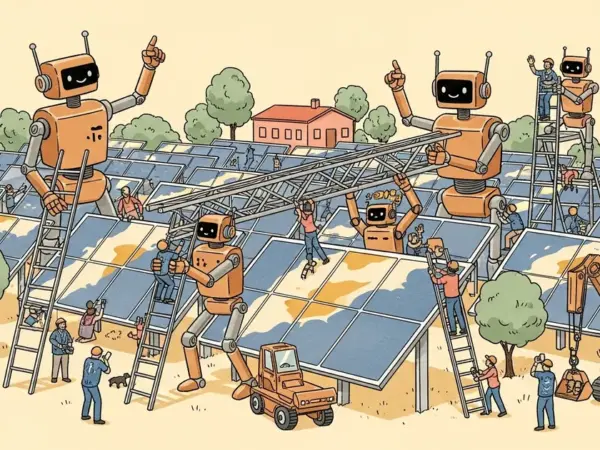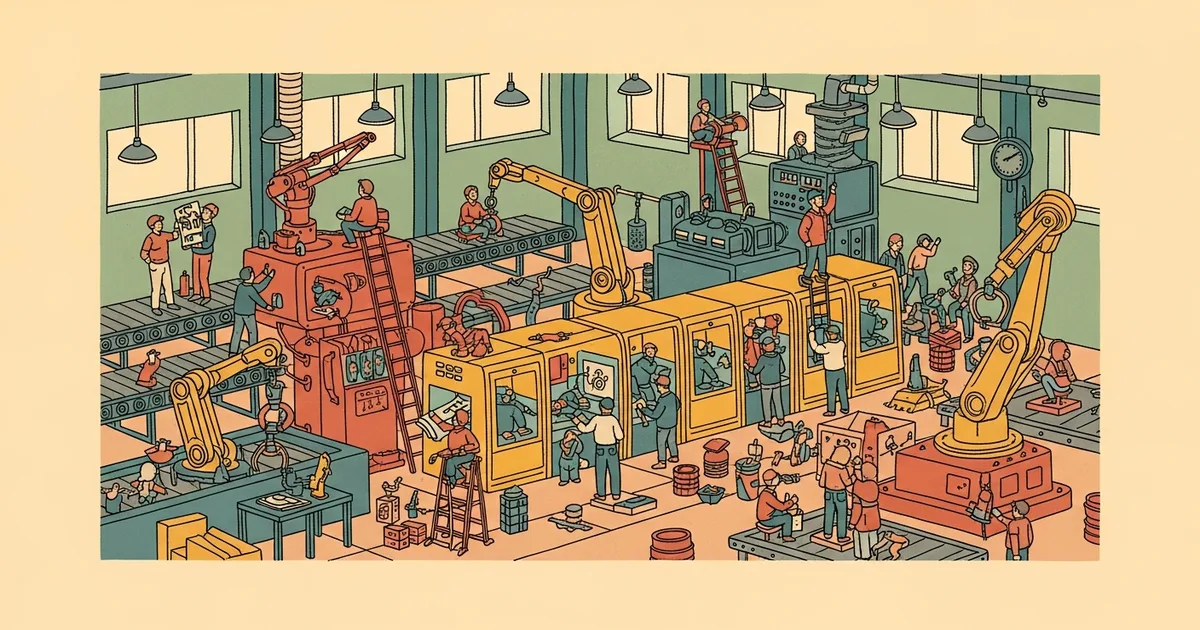
- China has funded over 40 robot training centers where human workers wearing VR headsets and arm exoskeletons teach humanoid robots everyday tasks through teleoperation.
- UBTech Robotics sold 566 million yuan ($80 million) worth of humanoid robots to three data collection centers, reflecting the scale of state investment in physical AI training data.
- Beijing identified “embodied intelligence” as one of six future industries in its new five-year plan, betting that physical-world data will determine which country leads in robotics.
- Western competitors like Figure AI, Boston Dynamics, and Tesla rely primarily on simulation-based training — a fundamentally different approach to the same problem.
What Happened
China has built a national network of over 40 state-funded robot training centers where human workers wearing VR headsets and arm exoskeletons spend eight-hour shifts teaching humanoid robots to perform everyday tasks, Rest of World reported. Reporters Viola Zhou and Kinling Lo documented facilities across Shanghai, Beijing, Hubei, and several other provinces where hundreds of young graduates work as full-time robot trainers. Approximately 24 of the announced centers are already operational.
At a facility in Wuhan’s East Lake High-tech Development Zone — dubbed the “Optics Valley of China” — robots practice folding laundry, serving food, and wiping tables in carefully designed living rooms and factory workshops. A 20-year-old computer science student identified as Kim described his work in Shanghai: wearing VR gear and exoskeletons, repeating movements like opening a microwave door and stacking blocks hundreds of times daily while cameras and sensors capture every motion.
Why It Matters
Physical-world training data is the bottleneck for robotics development. Unlike language AI — where the internet provides effectively unlimited text — robot training data must be generated through physical interaction, making it expensive, slow, and geographically concentrated. China is betting that whoever accumulates the most physical training data first will dominate the humanoid robotics industry.
Beijing identified “embodied intelligence” as one of six future industries in its new five-year plan, with Li Chao of the National Development and Reform Commission signaling sustained government backing. The global humanoid robot market is estimated to reach $38 billion by 2035, with 250,000 unit shipments expected by 2030.
Technical Details
The training centers use teleoperation — human workers physically perform movements that are recorded and used to train robot control models. A Hubei province facility operates nearly 100 humanoid robots controlled by human trainers repeating movements hundreds of times per day. Beijing’s Shijingshan facility spans over 10,000 square meters with 16 different training scenarios.
UBTech Robotics sold 566 million yuan ($80 million) worth of humanoid robots to three data collection centers in Jiangxi, Guangxi, and Sichuan provinces. State-owned telecom China Mobile placed orders worth 124 million yuan ($17.6 million). Companies involved include Leju, Unitree Technology, Galbot, and AgiBot, among more than 150 humanoid companies currently operating in China.
Ken Goldberg, a robotics researcher at UC Berkeley, cautioned about the pace: “It’s slow. Even if you have hundreds of people working, it’s going to take a long time.” Marco Wang, an analyst at Interact Analysis, warned: “There are some potential bubbles.”
Who’s Affected
Western robotics companies — including Figure AI, Boston Dynamics, 1X, and Tesla — face a strategic divergence. They rely heavily on simulation-based training, generating synthetic movement data in virtual environments. China’s approach bets that physical-world data from human teleoperation produces more robust and transferable robot behavior than simulation alone. Pavlo Zvenyhorodskyi of the Carnegie Endowment for International Peace noted the geopolitical dimension of this data race.
Hundreds of young Chinese graduates now work as robot trainers — an entirely new occupational category. With approximately 24 centers operational and more planned, the workforce implications extend to both the trainers themselves and the manufacturing workers whose jobs these robots are ultimately designed to replace.
What’s Next
The fundamental question remains unresolved: does physical teleoperation data produce better robots than simulation? If China’s approach proves superior, its multi-year head start in data collection infrastructure — spanning more than 40 centers across dozens of provinces — will be extremely difficult to replicate. If simulation-based methods close the gap, the massive investment in human-operated training centers could prove wasteful.
Time magazine described China as “dominating the physical AI race,” but the technology is still early enough that neither approach has conclusively won. The next two years of benchmark results from both teleoperation-trained and simulation-trained robots will likely determine which strategy the rest of the industry follows.
Related Reading
- Shopify Agentic Storefronts: How to Sell Inside ChatGPT and Gemini
- AI Agents on a Reddit Clone Tried to Create Their Own Secret Language
- DeepSeek V4: China’s First Frontier Model Built for Chinese Chips
- Midjourney Makes More Money Than Companies With 10x Its Traffic — Here’s Their Secret
- OpenAI’s Secret ‘Adult Mode’ for ChatGPT Just Got Killed