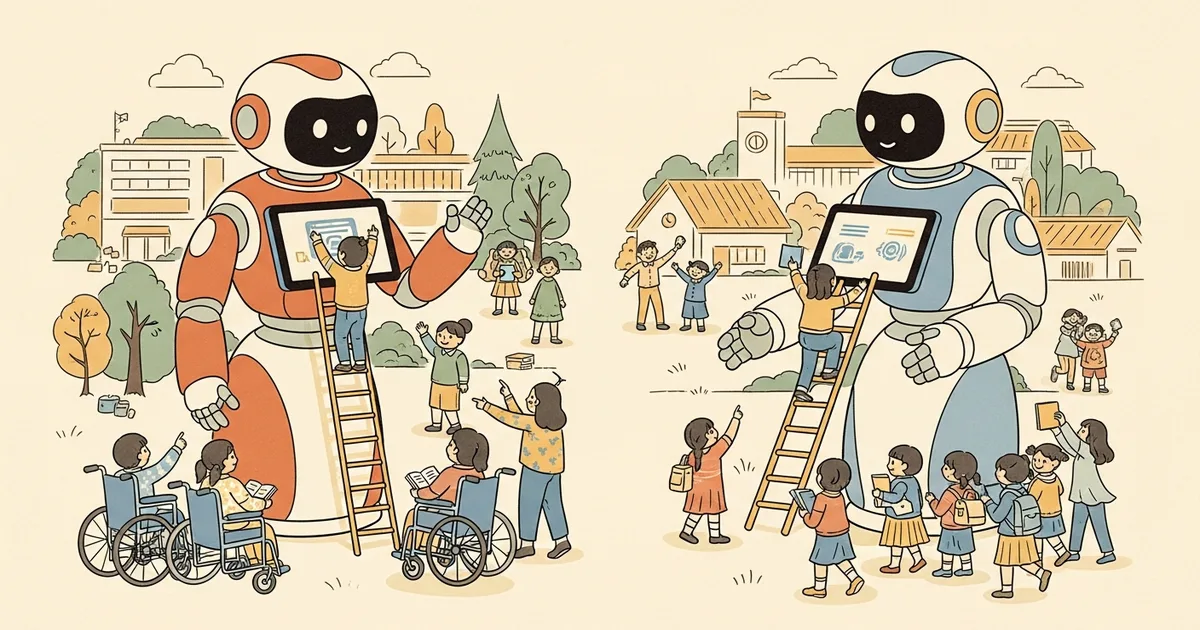
- China’s Ministry of Education is rolling out AI tutors, teaching assistants, and accessibility tools across K-12 schools as part of a centralized national strategy, not a patchwork of local experiments.
- The initiative prioritizes rural schools facing chronic teacher shortages and students with disabilities who lack specialized support infrastructure.
- Chinese AI education platforms including Squirrel AI and iFlytek are deploying adaptive learning systems trained on millions of student interactions, with the government funding deployment to underserved regions.
- The US and EU have no comparable national-level AI education strategy; deployment in Western countries remains fragmented across individual districts and private vendors.
What Happened
China is executing a top-down national rollout of artificial intelligence tools across its K-12 education system, with explicit priority given to rural schools and students with disabilities. As detailed in a ChinaTalk deep dive, the Ministry of Education has formalized AI integration into its education modernization plan, directing funding and infrastructure toward deploying AI tutors, AI-assisted grading systems, and AI-powered accessibility tools in classrooms serving hundreds of millions of students.
The strategy is not experimental. Provincial education bureaus are receiving mandates and budgets to deploy AI systems from approved domestic vendors, with the stated goals of reducing teacher workloads, equalizing educational quality between urban and rural areas, and providing assistive technology for students with visual, hearing, and cognitive disabilities.
Why It Matters
China’s approach stands in sharp contrast to how the United States and European Union have handled AI in education. In the US, AI adoption in schools is driven by individual districts purchasing tools from companies like Khan Academy (which launched Khanmigo with GPT-4 in 2023) or Duolingo, with no federal coordination. The EU has focused primarily on regulation through the AI Act rather than deployment strategy. China is treating AI education infrastructure the way it treated broadband expansion a decade ago: as a national project with centralized planning and execution.
The rural education angle is particularly significant. China has approximately 2.3 million rural schools, many of which face severe teacher shortages in subjects like English, science, and mathematics. The teacher-to-student ratio in rural western provinces can be two to three times worse than in coastal cities like Shanghai or Shenzhen. AI tutoring systems are being positioned not as supplements to qualified teachers but as partial substitutes where qualified teachers simply do not exist.
Technical Details
Several domestic Chinese AI companies are central to the rollout. Squirrel AI, founded by Derek Li, operates an adaptive learning platform that uses knowledge-graph-based models to diagnose individual student weaknesses and generate personalized problem sets. The company claims its system has been trained on data from over 20 million student learning sessions across more than 2,000 learning centers. iFlytek, one of China’s largest speech recognition companies, provides AI-powered language learning tools and real-time speech-to-text transcription used in accessibility applications for hearing-impaired students.
The AI teaching assistants being deployed handle specific teacher tasks: automated essay scoring with feedback generation, homework correction with error-pattern analysis, and classroom engagement monitoring through computer vision. Teacher workload studies cited by ChinaTalk indicate that Chinese K-12 teachers spend an average of 15-20 hours per week on grading and administrative tasks. The AI systems are designed to reduce that by 30-50%, freeing time for direct instruction and mentorship.
For disability accessibility, the Ministry of Education has partnered with Baidu and iFlytek to deploy screen readers using natural language processing, sign language translation systems using computer vision models, and text-to-speech tools optimized for Mandarin Chinese. These tools are being distributed through a centralized education cloud platform accessible to all registered schools.
Who’s Affected
The most immediate beneficiaries are students in China’s rural provinces, particularly in western and central regions like Guizhou, Yunnan, and Gansu, where educational resource disparities are most acute. Students with disabilities in the Chinese school system, estimated at over 8 million according to the China Disabled Persons’ Federation, stand to gain access to assistive technologies that were previously available only in well-funded urban schools.
Chinese teachers face a dual impact: reduced administrative burden on one hand, and increased monitoring and standardization on the other. Several reports have noted that AI classroom tools also collect data on teacher performance, raising concerns among educators about surveillance and algorithmic evaluation of their work. International education technology companies like Pearson, McGraw-Hill, and Google Classroom face a market in which the Chinese government is actively directing schools toward domestic AI vendors, further closing the door on foreign ed-tech in China’s school system.
What’s Next
The Ministry of Education has set 2027 as the target date for AI tools to be available in every K-12 school in China, including the most remote rural institutions. Provincial pilot results from Zhejiang and Guangdong are expected to inform the next phase of national standards for AI-assisted teaching, including guidelines on data privacy for minors and limits on automated decision-making in student assessment. Whether the US Department of Education or any EU member state will develop a comparable centralized strategy remains an open question, though the bipartisan RAISE Act introduced in the US Congress in 2024 has yet to advance beyond committee review.