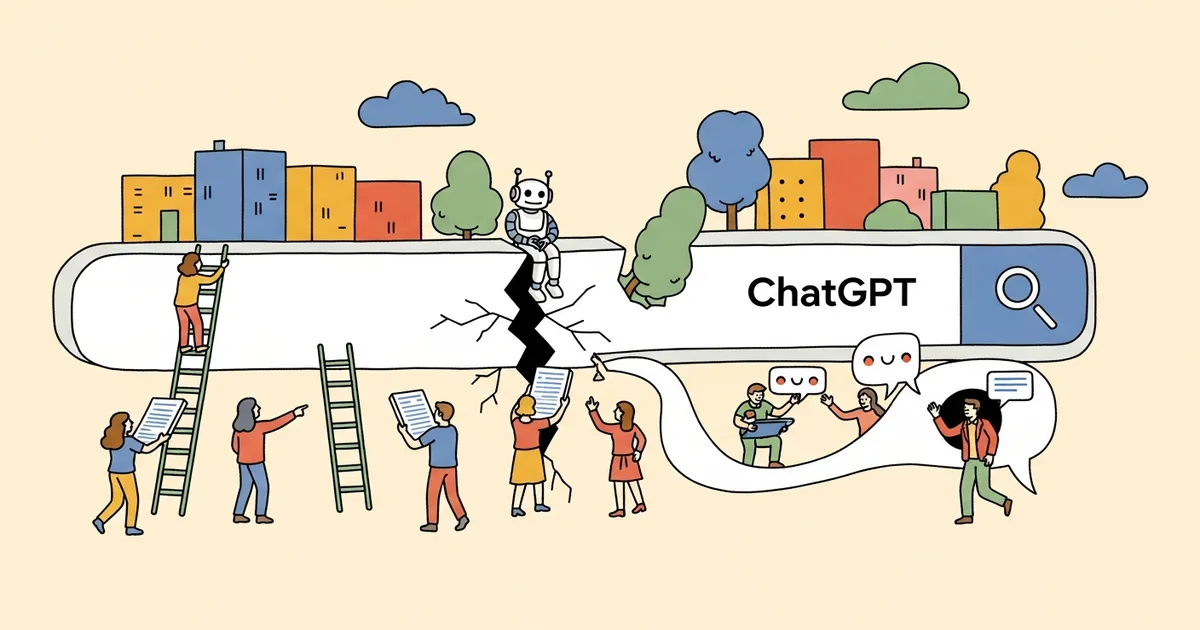
- ChatGPT now accounts for 20% of search-related traffic worldwide and 12% in the US, according to Graphite’s March 2026 analysis.
- Monthly AI assistant sessions have reached 45 billion globally — 56% the size of traditional search engine volume.
- “Gemini” is the number-one searched keyword in the US, and “ChatGPT” search volume grew over 115% year-over-year, making it the biggest mover in Google’s own top keyword rankings.
- Google’s global traffic share has dropped from 89% in 2023 to 71% in Q4 2025, though total search activity across all platforms grew 26% in the same period.
What Happened
Graphite CEO Ethan Smith published a detailed analysis in March 2026 showing that AI tools now generate roughly 45 billion monthly sessions worldwide. That figure represents about 56% of traditional search engine volume globally and 34% in the United States.
When narrowed to search-like prompts — queries where users seek specific information rather than using AI for coding, writing, or brainstorming — AI activity equals 28% of global search volume and 17% in the US. By Graphite’s broader measure, ChatGPT alone now handles 20% of all search-related traffic on Earth.
Meanwhile, Similarweb’s top keyword data shows “Gemini” as the most-searched term in the US, while “ChatGPT” search volume grew over 115% year-over-year — the biggest mover in Google’s own top-50 keyword list. Users are literally searching Google to find its competitors.
Why It Matters
For two decades, Google held roughly 90% of global search traffic. That number is now closer to 71%, with ChatGPT claiming the single largest share of the difference. This is the first time any platform has broken into double-digit territory against Google since the search engine consolidated its dominance in the mid-2000s.
The shift does not mean traditional search is shrinking. Graphite’s data shows total usage across AI assistants and search engines has grown 26% worldwide since Q1 2023. The pie is getting bigger; Google is just getting a smaller slice of it. Users are not abandoning search — they are supplementing it with AI tools for certain categories of queries.
Publishers, however, face a structural problem. Ahrefs found that while ChatGPT has 12% of Google’s search volume, Google still sends 190 times more traffic to websites. AI tools answer queries directly without sending users to external pages. For content-dependent businesses, traffic from the fastest-growing search channel is nearly nonexistent.
Technical Details
Graphite’s methodology combines web traffic data with mobile app usage across major AI platforms including ChatGPT, Gemini, Claude, Copilot, and Perplexity. Smith argues that previous estimates of AI search share — often cited at 3–5% — dramatically undercount actual usage because most AI interactions happen in mobile apps, which traditional web analytics tools do not measure.
The 56% figure includes all AI sessions, not just search-equivalent ones. When filtered to information-seeking prompts only, the ratio drops to 28% globally. This distinction matters: a user asking ChatGPT to debug Python code or draft an email is not performing a search-equivalent action, even though it counts as an AI session.
On the keyword front, Google’s own data tells a revealing story. The term “ChatGPT” now appears consistently in Google’s top-10 US keywords, with year-over-year growth exceeding 115%. Google’s 2025 Year in Search report confirmed “Gemini” as its top trending term, indicating that even Google’s own users are actively seeking AI alternatives through traditional search.
Who’s Affected
The industries facing the largest impact are those built on informational content. B2B SaaS, healthcare information, financial services, and legal publishers are seeing the steepest declines because their content — definitions, how-to guides, comparisons — is exactly what AI tools handle well without sending users to a website.
Press Gazette reports that global publisher traffic from Google dropped by a third in 2025. Lifestyle and utility publishers (weather, TV guides, recipes) were hit hardest because their content is easily summarized by AI overviews and chatbots alike.
E-commerce and local services remain more resilient. Transactional queries (“buy running shoes”) and local searches (“plumber near me”) still flow primarily through Google because they require real-world fulfillment that AI cannot provide. Gartner’s 2024 prediction that search engine volume would drop 25% by 2026 appears to be tracking accurately for informational queries, though transactional search remains relatively stable.
What’s Next
News publishers expect search traffic to drop 43% by 2029, according to industry surveys. If AI tools continue growing at their current rate while sending minimal referral traffic to websites, the economic model that supports most online publishing — ad revenue tied to pageviews from search — will need to be replaced.
The counterargument is that AI growth is expanding the total information market rather than cannibalizing it. Graphite’s 26% growth figure suggests users are asking more questions than ever; they are just asking them in new places. Whether publishers can monetize those new places remains the open question.
For now, the data is clear on one point: Google’s search monopoly, while still dominant, has its first real crack. What fills that crack — and who profits from it — is still being determined.