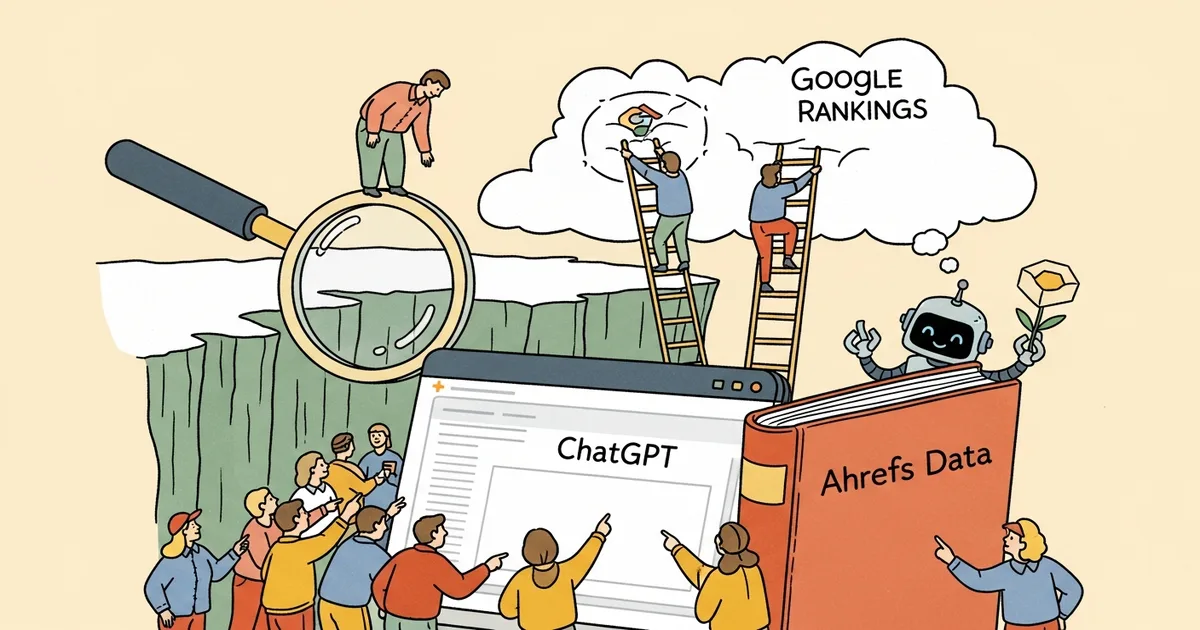
- Ahrefs data shows that 80% of URLs cited by ChatGPT, Gemini, and Copilot do not rank anywhere in Google’s top 100 for the original query.
- Only 12% of AI-cited URLs appear in Google’s top 10, and 28.3% of ChatGPT‘s most-cited pages have zero organic search visibility.
- 67% of ChatGPT‘s top 1,000 cited sources are reference pages, organizational sites, and other pages that marketers cannot realistically influence through traditional SEO.
- The data suggests that ranking in Google and getting cited by AI assistants are becoming two functionally separate disciplines.
What Happened
Ahrefs published a series of studies analyzing millions of URLs cited by AI assistants including ChatGPT, Gemini, Copilot, and Perplexity. The research, led by data scientist Xibeijia Guan and content marketer Louise Linehan, used data from Ahrefs’ Brand Radar tool covering roughly 17 million cited URLs.
The central finding: more than 80% of pages cited by ChatGPT, Gemini, and Copilot do not rank anywhere in Google’s top 100 results for the same query. Only 12% of AI-cited URLs appear in Google’s top 10. The overlap between what Google ranks and what AI tools cite is far smaller than most SEO professionals assumed.
A separate Ahrefs study of ChatGPT’s top 1,000 most-cited pages found that 28.3% of them have zero organic visibility in Google. As Ahrefs CMO Tim Soulo wrote on X: “28% of ChatGPT’s most-cited pages have ZERO organic visibility in Google! This is rather counterintuitive, no? Given that ChatGPT has to perform web searches to look up information.”
Why It Matters
For years, SEO professionals operated on the assumption that ranking well in Google would translate to visibility across AI-powered search tools. These findings dismantle that assumption with hard data.
The implications are structural. If 80% of what ChatGPT cites does not appear in Google’s top 100, then optimizing for Google and optimizing for AI citation are functionally different tasks. A page can rank first in Google for a query and never be cited by ChatGPT. Conversely, a page with no organic traffic at all can become one of ChatGPT’s most-referenced sources.
This matters for any business that relies on search-driven traffic. The audience finding information through AI assistants is growing, but the content those assistants surface follows different selection criteria than Google’s ranking algorithm. Companies now face a choice: optimize for one channel, or invest in both as separate workstreams.
Technical Details
The divergence stems from how AI assistants retrieve and select sources. Even though ChatGPT uses web search (via Bing’s index) to find information, its retrieval pipeline queries search indexes differently than a traditional search engine results page. The AI does not simply return the top-ranked pages. Instead, it evaluates content for direct answer relevance, factual density, and recency.
Ahrefs found that ChatGPT’s most-cited pages skew heavily toward freshness: 76.4% of the top 1,000 cited pages were updated within the last 30 days. Domain authority also plays a disproportionate role. Among ChatGPT’s top citations, 65.3% come from sites with a Domain Rating (DR) of 81 or higher, with a median DR of 90. Individual page authority, however, matters far less.
Perplexity is the outlier among AI tools. Nearly 1 in 3 of Perplexity’s citations point to pages that rank in Google’s top 10, compared to roughly 1 in 10 for ChatGPT and Gemini. This is because Perplexity operates its own search index via its PerplexityBot crawler, rather than relying on Google or Bing.
Another finding complicates the picture further: 86% of top-mentioned sources are not shared across ChatGPT, Perplexity, and AI Overviews. Each AI platform favors different sources, meaning there is no single optimization strategy that works across all AI assistants.
Who’s Affected
SEO teams and content marketers are the most directly affected. The traditional workflow of keyword research, on-page optimization, and link building still works for Google rankings, but it does not reliably produce AI citations. Teams that have been reporting AI visibility as a byproduct of strong SEO performance may be overstating their actual reach.
Publishers and media companies face a particular challenge. The Ahrefs data shows that 67% of ChatGPT’s top 1,000 citations are “off-limits” to marketers — they point to Wikipedia, government sites, academic institutions, and organizational reference pages that cannot be influenced through outreach or content marketing. For the remaining 33%, the competitive dynamics are entirely different from traditional search.
Enterprise brands with large SEO investments should audit their AI visibility independently. A strong Google presence does not guarantee AI citation, and the two channels may require different content formats, update cadences, and authority signals.
What’s Next
The emergence of Generative Engine Optimization (GEO) as a distinct discipline is accelerating. Ahrefs has built specific tools — Brand Radar and AI search tracking — to monitor AI citations separately from organic rankings, and competitors like Semrush and SE Ranking are following.
The practical limitation is that AI citation algorithms remain opaque. Unlike Google, which has decades of documented ranking factors and a mature testing ecosystem, AI assistants provide no equivalent of Search Console or ranking transparency. Marketers can observe correlations — high DR, fresh content, factual density — but cannot yet run controlled experiments the way they can with traditional SEO.
For now, the actionable step is straightforward: treat AI search visibility as a separate channel with its own tracking, its own KPIs, and its own optimization strategy. The Ahrefs data makes clear that assuming Google rankings will carry over to AI citations is no longer a defensible position.