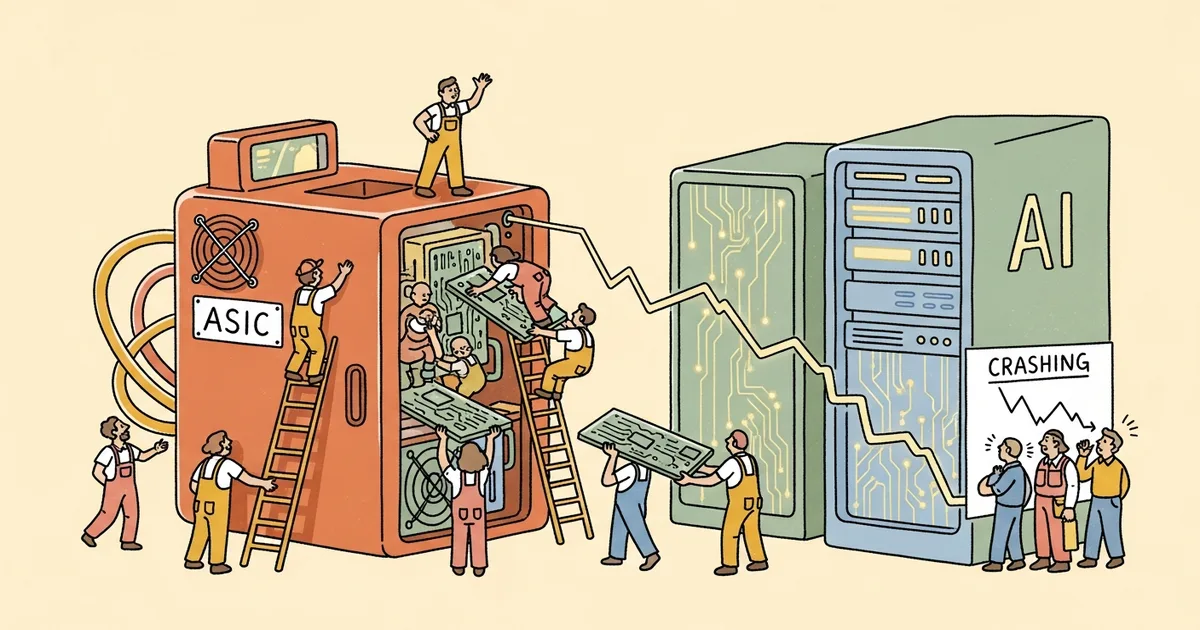
- Major public Bitcoin mining companies have collectively signed over $70 billion in AI and high-performance computing contracts, redirecting GPU capacity and data center infrastructure away from mining.
- Bitcoin’s network hash rate has dropped from a peak of 1,160 EH/s to approximately 920 EH/s, a 21% decline that represents the largest sustained hash rate reduction since China’s mining ban in 2021.
- AI revenue is projected to account for 70% of total income for the largest publicly traded mining firms by the end of 2026, up from under 10% in 2024.
- Miners have collectively liquidated over 15,000 BTC as mining economics deteriorate, with production costs exceeding market price by roughly $19,000 per coin for many operators.
What Happened
The largest publicly traded Bitcoin mining companies are executing a rapid pivot from cryptocurrency mining to AI infrastructure services. According to filings compiled by The Block and corroborated by SEC quarterly reports, firms including Marathon Digital (MARA), Riot Platforms (RIOT), Core Scientific (CORZ), Hut 8 (HUT), and CleanSpark (CLSK) have signed AI and high-performance computing hosting contracts with a combined value exceeding $70 billion over multi-year terms.
Core Scientific has led the transition, signing a 12-year, $8.7 billion contract with CoreWeave for AI compute hosting announced in late 2025, and expanding it by an additional $6.7 billion in early 2026. Marathon Digital disclosed in its Q1 2026 filing that it is converting 40% of its mining capacity to AI compute. Riot Platforms has begun leasing data center space to AI training companies at its Corsicana, Texas facility, which was originally built exclusively for Bitcoin mining.
Why It Matters
The mining-to-AI pivot reflects a fundamental economic reality. After the April 2024 Bitcoin halving reduced the block reward from 6.25 BTC to 3.125 BTC, the economics of Bitcoin mining deteriorated sharply for all but the most efficient operators. With Bitcoin trading in the $62,000-$68,000 range during Q1 2026 and all-in production costs (including energy, hardware depreciation, and overhead) averaging $81,000-$87,000 per BTC for mid-tier miners, many operators are losing approximately $19,000 on every Bitcoin mined.
Meanwhile, AI compute demand has created an extreme seller’s market for data center capacity. A single rack of NVIDIA H100 GPUs generates approximately $180,000-$250,000 in annual revenue when leased for AI training, compared to the equivalent mining revenue of $40,000-$60,000 from the same power draw. The arbitrage is straightforward: same facility, same power infrastructure, three to five times the revenue.
Technical Details
The hash rate decline tells the quantitative story. Bitcoin’s network hash rate peaked at approximately 1,160 exahashes per second (EH/s) in December 2025, according to data from Blockchain.com. As of late March 2026, it has fallen to approximately 920 EH/s, a 21% reduction. This is the most significant sustained decline since China banned crypto mining in mid-2021, which caused a temporary 50% hash rate crash.
The decline is not uniform. Chinese-manufactured Bitmain Antminer S19 and S19 Pro units, which dominated the 2021-2023 mining era, are being decommissioned in large numbers because their energy efficiency (approximately 30-34 joules per terahash) makes them unprofitable at current Bitcoin prices and difficulty levels. Newer S21 and Whatsminer M60 units remain marginally profitable at electricity costs below $0.04/kWh, but many operators are choosing to sell the power allocation to AI tenants instead.
The 15,000+ BTC liquidation figure represents cumulative on-chain sales by known mining pool wallets and publicly disclosed treasury sales. Marathon Digital sold 2,500 BTC in January 2026, reversing its prior “HODL” strategy. CleanSpark sold 1,800 BTC in Q1 2026. Smaller miners have collectively sold the remainder. This selling pressure has contributed to Bitcoin’s muted price action in Q1 2026 despite broader market strength.
Who’s Affected
Bitcoin’s security model depends on hash rate. The 21% decline has reduced the estimated cost of a theoretical 51% attack from approximately $12 billion (at peak hash rate) to roughly $9.5 billion in hardware and energy costs, according to estimates from Crypto51. While still prohibitively expensive for any known actor, the directional trend concerns Bitcoin security researchers. If hash rate continues declining as more miners pivot, the security margin narrows further.
AI companies are direct beneficiaries. CoreWeave, Lambda Labs, and several hyperscalers are acquiring data center capacity at favorable rates from mining operators who have already built out power infrastructure, cooling systems, and network connectivity. Mining facilities in Texas, Wyoming, and the Nordic countries are particularly attractive because of their access to low-cost power, which translates directly to lower AI training costs.
Bitcoin mining hardware manufacturers like Bitmain and MicroBT face a shrinking addressable market. Both companies have begun developing AI inference chips to diversify, but neither has shipped a competitive product yet. The pivot timeline matters: if mining economics do not recover within 12-18 months, the specialized ASIC mining hardware market may permanently contract.
What’s Next
The convergence of mining and AI infrastructure is accelerating. Analysts at JPMorgan estimated in a March 2026 research note that AI revenue could represent 70% of total revenue for publicly traded mining companies by Q4 2026. The Bitcoin network’s difficulty adjustment mechanism will partially compensate for the hash rate decline by reducing mining difficulty, which may restore profitability for the remaining miners. However, if Bitcoin’s price does not recover above all-in production costs, the exodus to AI compute is likely to continue.
Related Reading
- Oracle Started Firing 30,000 People This Week — To Buy More AI Servers
- Anthropic Secretly Doubled Its Compute Power — The AI Arms Race Is Now a Hardware War
- Meta Just Announced 4 AI Chips in One Day — The NVIDIA Monopoly Has an Expiration Date
- NVIDIA Just Spent $2 Billion on a Company You’ve Never Heard Of