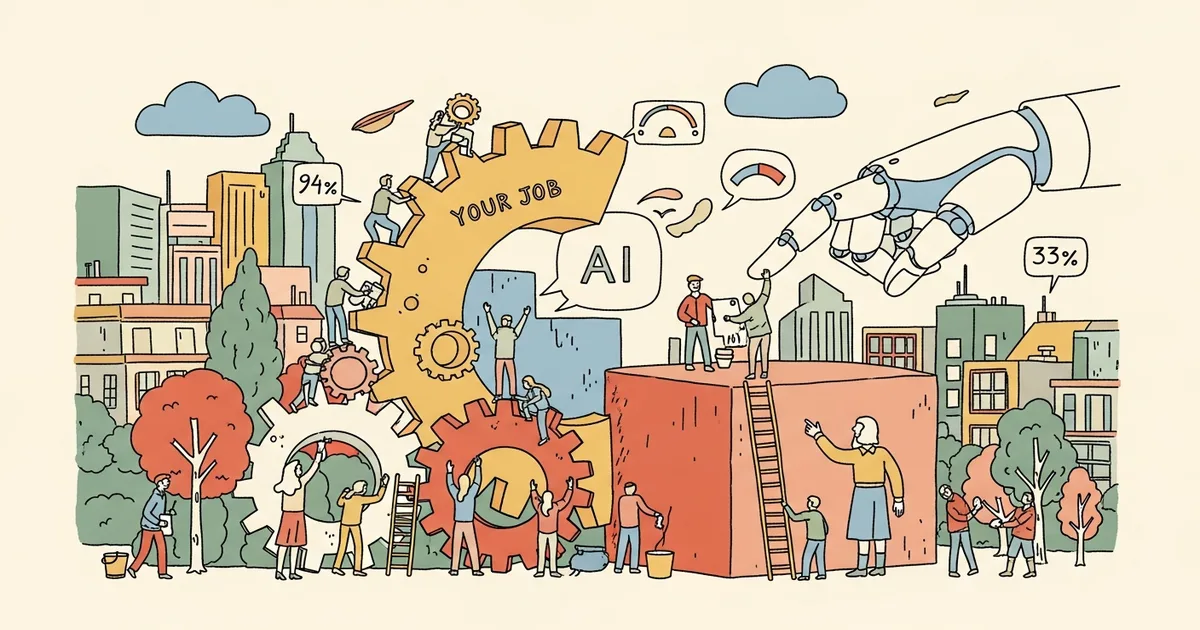
- Anthropic research finds AI could theoretically accelerate 94% of tasks in computer and math occupations, but currently covers only 33%.
- Computer programmers have the highest observed AI exposure at 75%, while 30% of workers have zero AI exposure.
- No systematic increase in unemployment has been detected for AI-exposed workers, though early-career job seekers (ages 22-25) show a 14% reduction in job-finding rates.
- Highly exposed workers tend to be more educated, earn 47% more on average, and are 16 percentage points more likely to be female.
What Happened
Researchers Maxim Massenkoff and Peter McCrory at Anthropic published a study on AI’s labor market impacts that introduces a new measurement called “observed exposure.” The metric combines theoretical large language model capability with real-world Claude usage data to gauge how much AI is actually being used across 800 U.S. occupations cataloged in the O*NET database.
The central finding is a wide gap between what AI can do and what it is doing. In computer and math roles, LLMs could theoretically speed up 94% of tasks. In practice, Claude currently covers just 33% of those tasks. Office and administrative roles show a similar pattern, with 90% theoretical capability but far lower real-world adoption.
The study represents one of the first large-scale attempts to measure actual AI usage patterns against occupational task structures, moving beyond the hypothetical assessments that have dominated the AI labor debate since ChatGPT launched in late 2022.
Why It Matters
The study shifts the AI labor conversation from speculation to measurement. Most prior analyses relied on theoretical assessments of which jobs AI could disrupt. Massenkoff and McCrory’s approach uses actual usage logs to determine which occupations are already being affected and how deeply.
The gap between potential and adoption suggests that automation is proceeding more slowly than many forecasts assume. Employers, workers, and policymakers have more time to prepare than worst-case scenarios imply, but the trajectory is clear: coverage is expanding as organizations build integration workflows and AI tools improve.
At the occupation level, computer programmers already show 75% AI task coverage. Data entry keyers sit at 67%. Customer service representatives also rank among the most exposed. These roles involve structured, text-heavy tasks that map well onto LLM capabilities. The pattern suggests that AI adoption follows the path of least resistance, automating tasks that are already digital and language-based before moving into more complex territory.
Technical Details
The researchers combined three data sources: the O*NET occupational database, Anthropic’s Economic Index usage data from Claude, and the theoretical capability measures established by Eloundou et al. in 2023. The methodology prioritized automated applications over augmentative ones, focusing on tasks where AI works independently rather than assisting a human operator.
Employment projections carry a measurable signal. For every 10 percentage point increase in AI coverage, Bureau of Labor Statistics employment growth projections drop by 0.6 percentage points. The team used Current Population Survey data and difference-in-differences analysis to track unemployment trends since 2016, establishing a pre-AI baseline for comparison.
The demographic profile of exposed workers is specific. They earn 47% more than the average worker, are more educated, and are 16 percentage points more likely to be female. This pattern reflects the concentration of AI exposure in white-collar, knowledge-intensive roles rather than in manual labor or service occupations.
Who’s Affected
Three groups face the highest near-term exposure: computer programmers, customer service representatives, and data entry keyers. These occupations involve repetitive, language-based tasks that current LLMs handle well. Workers in these roles are not necessarily losing jobs today, but the nature of their day-to-day work is shifting as AI takes over routine subtasks.
Young workers entering the job market appear most vulnerable to indirect effects. The study found suggestive evidence of a 14% reduced job-finding rate for workers aged 22-25 in exposed occupations, though the researchers noted this effect is “indistinguishable from zero” across the broader workforce. Entry-level positions that once served as training grounds may be the first to contract.
Meanwhile, 30% of U.S. workers have zero measurable AI exposure. Occupations involving physical labor, interpersonal care, and unstructured environments remain largely outside current LLM capabilities.
What’s Next
The 33% coverage figure represents a snapshot, not a ceiling. As AI tools improve and organizations build integration workflows, the gap between theoretical and observed exposure will narrow. The study’s framework provides a repeatable method for tracking this shift over time, offering a baseline that future researchers can update.
One limitation: the research measures Claude usage specifically and may not capture the full scope of AI adoption across competing platforms like ChatGPT, Gemini, and open-source models. The actual coverage rate across all AI tools could be higher than reported.