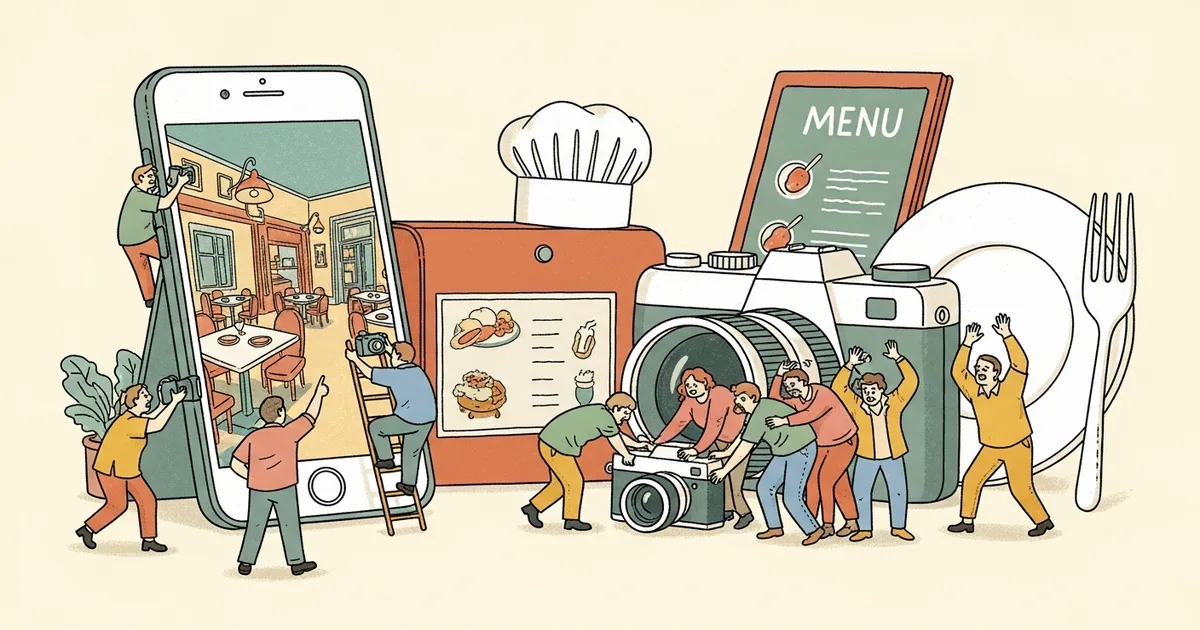
- Alibaba’s mapping unit Amap launched an AI service using the “Tongyi Wanxiang” visual generative model that creates immersive 3D restaurant showcases from standard phone photos or short videos.
- The service eliminates the need for professional photography or 3D scanning equipment, reducing the cost of creating a restaurant digital showcase from approximately 2,000 yuan to near zero.
- The technology is a strategic move in Alibaba’s competition with Meituan for dominance in China’s local services and food delivery market.
- Early results from pilot merchants show a 23% increase in click-through rates for restaurant listings with AI-generated 3D tours compared to static photo galleries.
What Happened
Amap (Gaode Maps), Alibaba Group’s mapping and navigation platform, launched an AI-powered service on March 31, 2026 that generates immersive 3D digital showcases of restaurant interiors using only standard smartphone photos or short video clips. The service uses Alibaba’s “Tongyi Wanxiang” visual generative AI model to reconstruct three-dimensional environments from two-dimensional inputs, producing interactive walkthrough experiences that users can explore within the Amap and Ele.me apps.
Amap product lead Zhang Wei announced the feature at Alibaba’s local services press event in Hangzhou, stating that “any restaurant owner with a phone can now create what previously required a 2,000-yuan professional shoot.”
Why It Matters
This launch is a calculated move in the intensifying competition between Alibaba and Meituan for control of China’s local services market. Meituan has dominated food delivery and restaurant discovery in China for years, with an estimated 67% market share in online food delivery as of Q4 2025. Alibaba’s Ele.me platform holds roughly 28%. One of Meituan’s competitive advantages has been its extensive merchant content ecosystem — professional photos, user reviews, and curated listings that drive consumer engagement.
By dramatically lowering the barrier for merchants to create rich visual content, Alibaba is attempting to neutralize that advantage. If any small restaurant can generate a 3D tour for free through Amap, the content gap between Ele.me and Meituan listings narrows significantly.
Technical Details
The Tongyi Wanxiang model powering the service combines two AI techniques. The first is neural radiance field (NeRF) reconstruction, which builds a 3D spatial representation from multiple 2D images taken at different angles. Restaurant owners are prompted to capture 15-30 photos or a 60-second video panning across their interior. The model uses these inputs to generate a complete 3D mesh of the space.
The second technique is generative infill, where the model fills in gaps, occlusions, and low-quality areas using its training data of restaurant interiors. If a corner of the restaurant is poorly lit or partially blocked in the source photos, the model generates plausible visual content for those regions based on contextual cues — floor material, wall color, lighting patterns. Zhang Wei noted that the model was trained on over 8 million restaurant interior images collected from Amap’s existing merchant database.
Processing time is approximately 4-7 minutes per restaurant on Alibaba Cloud’s GPU infrastructure, and the resulting 3D tour is delivered as a lightweight web-based experience that loads in under 3 seconds on 4G connections. The output quality, while not matching professional Matterport-style 3D scans, is described by early testers as “sufficient for consumer decision-making” — a distinction that matters for a service targeting millions of small merchants who would never pay for professional 3D scanning.
Pilot data from 3,200 merchants in Shanghai and Hangzhou who used the service during a two-month beta showed a 23% increase in listing click-through rates and a 14% increase in order conversion compared to listings with standard photo galleries.
Who’s Affected
Small and medium restaurant owners in China stand to benefit most directly. Professional restaurant photography in Chinese cities typically costs 1,500-3,000 yuan ($200-$400) per shoot, with 3D scanning services running 5,000-10,000 yuan. The AI-generated alternative costs the merchant nothing — Alibaba absorbs the compute costs as a platform investment.
Professional photographers and 3D scanning companies serving the restaurant and hospitality sectors face direct displacement. The China Commercial Photography Association estimated that restaurant and food photography accounts for approximately 12% of commercial photography revenue in tier-1 Chinese cities. While high-end restaurants will likely continue using professional services, the long tail of small restaurants — which represents the majority of the market by volume — now has a free alternative.
Meituan is the most significant competitive casualty. The company has invested heavily in its merchant content tools but has not publicly announced an equivalent AI 3D tour capability. Meituan’s stock declined 3.2% on April 1 following the Amap announcement, though analysts at Goldman Sachs noted in a research note that Meituan’s delivery logistics network remains its primary competitive moat and is not threatened by this feature.
What’s Next
Alibaba plans to expand the 3D tour service to all merchant categories on Amap by Q3 2026, including hotels, retail stores, and entertainment venues. The company is also integrating the feature into its Taobao Live commerce platform, where 3D product and store tours could enhance livestream shopping experiences. A key limitation is accuracy: the generative infill component can produce visual artifacts or incorrect spatial relationships, particularly in unusually shaped or heavily decorated interiors. Zhang Wei acknowledged this, stating that “the model works best in standard rectangular spaces” and that the team is working on improved handling of complex geometries. Meituan is expected to respond, though whether with an in-house solution or an acquisition remains unclear.