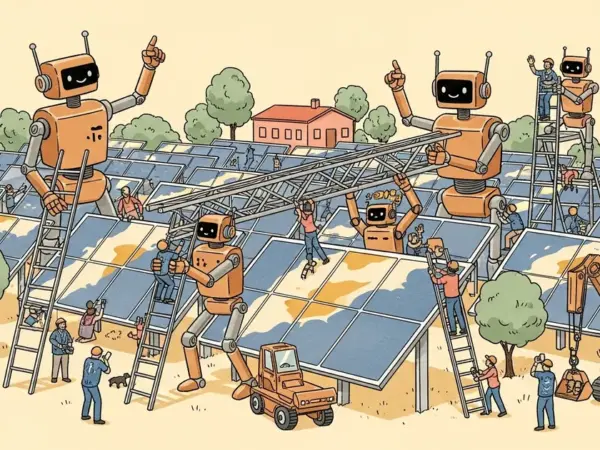
The global AI infrastructure buildout could require up to $7 trillion in total investment, according to estimates from industry leaders cited by Reuters in April 2026 — a figure that surpasses the combined GDP of France and Germany, two of Europe’s three largest economies. Single-gigawatt data centers are now active construction targets from Elon Musk’s xAI to Meta Platforms. The bottleneck on AI progress has shifted: it is no longer algorithmic — it is physical.
The companies that control compute at this scale will control which AI applications are economically viable. Those that do not are already operating on borrowed infrastructure, borrowed time, or both.
The Trillion AI Infrastructure Estimate, Explained
The $7 trillion figure encompasses planned data center construction, electrical power infrastructure, cooling systems, networking hardware, and land acquisition required to support next-generation AI workloads across a multi-year horizon. To calibrate the scale: the entire U.S. federal budget for fiscal year 2025 was $6.75 trillion. The AI infrastructure estimate exceeds it.
The number is not speculative boosterism. Goldman Sachs projected in 2024 that data center capital expenditure alone would reach $1 trillion by 2027. The $7 trillion estimate extends that trajectory through the end of the decade as inference demand compounds on top of training demand — and as every digital service embeds AI-driven functionality that must run somewhere, at some cost, at all times.
Reuters’ April 2026 report reflects a convergence of top-down planning estimates from major builders, not a single analyst projection. When the companies actually constructing these facilities agree on the magnitude, the number carries operational weight that financial models do not.
What a Single-Gigawatt Data Center Actually Costs
A conventional hyperscale data center — the kind Amazon Web Services or Google has operated for a decade — runs between 100 and 500 megawatts of power capacity. A single-gigawatt facility is 2x to 10x that scale. Construction costs for gigawatt-class facilities run $10 billion to $25 billion per site, depending on geography, power sourcing, and cooling architecture.
xAI’s Memphis facility, which came online in late 2024, reached 100,000 NVIDIA H100 GPUs consuming approximately 150 megawatts. Elon Musk has publicly stated targets of 1 gigawatt for xAI’s full infrastructure footprint — a roughly 7x expansion from that baseline. Meta’s Louisiana data center, announced in January 2025, will span 3.7 million square feet at an estimated cost of $10 billion, and that facility is not yet at gigawatt scale.
The cost per megawatt of data center construction has risen approximately 20% annually since 2022 as demand for specialized power delivery, liquid cooling, and high-density GPU racks has outpaced the construction industry’s capacity to supply them. Cost escalation is already embedded in every forward estimate.
Which Companies Are Spending the Most
Five companies dominate the buildout: Microsoft, Amazon, Google, Meta, and xAI. Their combined capital expenditure commitments for AI infrastructure in 2025 exceed $300 billion — a figure that would rank as one of the largest coordinated capital deployments in industrial history outside wartime mobilization.
| Company | 2025 AI Capex Commitment | Primary Use Case |
|---|---|---|
| Microsoft | $80 billion | Azure AI, OpenAI hosting |
| Amazon | ~$75 billion | AWS expansion, Trainium clusters |
| ~$75 billion | Gemini training, TPU infrastructure | |
| Meta | $65 billion | Llama training and inference |
| xAI | $10+ billion | Grok model training |
NVIDIA (NASDAQ: NVDA) sits at the center of this buildout not as a builder but as the primary toll road. At $30,000–$40,000 per H100 GPU and higher pricing for the Blackwell B200 architecture, a 100,000-GPU cluster represents a $3 billion hardware purchase before the building exists. NVIDIA’s data center revenue reached $47.5 billion in fiscal year 2024 — up from $15.0 billion the prior year, a 217% increase driven almost entirely by AI training and inference demand.
Energy: The Constraint That Capital Cannot Immediately Solve
Every gigawatt of computing infrastructure requires a gigawatt of power — delivered reliably, 24 hours a day, 365 days a year. The U.S. electrical grid was not designed for this demand profile. Data centers currently consume approximately 4% of U.S. electricity, according to the Department of Energy. The Electric Power Research Institute projects that share could rise to 9% by 2030 under high-growth scenarios — more than doubling the current AI compute load in under a decade.
The lead time for new electrical generation and transmission infrastructure ranges from 3 to 10 years. Data center construction timelines run 3–5 years. Virginia’s Loudoun County — the world’s largest data center market by installed capacity — has seen utility providers warn that power grid constraints may delay new construction permits. The bottleneck is not compute; it is electrons.
Nuclear power has become the preferred institutional response. Microsoft signed a 20-year agreement with Constellation Energy to restart Three Mile Island Unit 1, providing 835 megawatts of carbon-free baseload power. Amazon acquired long-term capacity from the Susquehanna Nuclear Power Station for AWS workloads. Google contracted for small modular reactor (SMR) output from Kairos Power. The pattern is consistent: hyperscalers are vertically integrating into energy generation because the commercial grid cannot pace compute demand.
Geography is now a strategic variable. Nebius Group’s planned $10 billion data center in Finland reflects a deliberate calculation: Nordic ambient temperatures reduce cooling energy costs by an estimated 30–40% compared to facilities in warmer climates. Cooling alone accounts for 30–40% of a data center’s total power draw — and in hot climates, that figure rises further, directly scaling operational costs with every degree of ambient temperature.
Who Can Actually Afford This Scale
The five largest U.S. technology companies — Microsoft, Apple, Google, Amazon, and Meta — collectively hold over $300 billion in cash and equivalents. They can absorb $7 trillion in infrastructure investment distributed across a decade. The financial profile of everyone else in AI tells a materially different story.
OpenAI carries a $300 billion valuation and has pursued aggressive revenue diversification — including a reported $1 billion content agreement with Disney — but does not own its training infrastructure at hyperscale. It runs on Microsoft Azure. That dependency becomes structurally more expensive as infrastructure costs rise and hyperscalers price cloud access to reflect their own multi-year capex commitments.
Anthropic raised $7.3 billion from Google and Amazon in tranches that arrived with cloud credit agreements attached — the capital came bundled with compute access rather than as free cash. Mistral AI, valued at approximately $6 billion, remains entirely dependent on external cloud providers. The independent AI lab, as a business model, faces capital pressure that a $7 trillion infrastructure race will only intensify.
Smaller AI Players Face a Compute Moat, Not a Model Gap
Training a frontier model requires tens of millions in compute. Running one at consumer or enterprise scale — inference at sustained volume — requires far more, sustained indefinitely. As models grow more capable, inference costs per query rise unless offset by custom silicon (Google’s TPUs, Amazon’s Trainium) or scale economies unavailable to smaller operators.
A startup running inference on rented GPU clusters at $2–$4 per GPU-hour faces a cost structure that makes profitability at competitive pricing nearly impossible without millions of active users. MegaOne AI tracks 139+ AI tools across 17 categories, and the trend is visible across the market: AI application developers increasingly depend on one of a handful of infrastructure providers showing pricing restraint — a constraint those providers have no structural incentive to maintain as their own capex commitments compound.
The consolidation dynamics extend beyond pricing. Acquisition activity across the AI sector increasingly reflects infrastructure dependency — companies without their own compute are acquisition candidates, not independent actors. Infrastructure ownership translates directly into the power to define market terms.
The Infrastructure Race Has No Near-Term Ceiling
Compute requirements for frontier AI models are not stabilizing. GPT-4 class models required approximately 1024 FLOPs to train. Next-generation frontier models are projected to require 1026 to 1028 FLOPs — a 100x to 10,000x increase in compute demand over three to four model generations. Infrastructure decisions made in 2026 determine what models are technically and economically feasible in 2029 and 2030. The facilities being permitted today are the computational environment of models that do not yet exist.
Community and political opposition to AI’s resource consumption is growing alongside the buildout — regulatory scrutiny of power procurement contracts, zoning resistance to data center construction, and labor concerns about AI displacement all add non-financial friction costs that the $7 trillion estimate does not fully price in. These factors have yet to measurably slow capital deployment, but they represent a compounding risk layer in every multi-year planning horizon.
The $7 trillion figure is not a warning about excess — it is a structural description of where AI’s competitive leverage is migrating. Infrastructure has replaced model quality, talent density, and proprietary data as the primary moat in AI. The companies that control compute at gigawatt scale determine which AI applications are economically viable and which are not. For any organization building on AI without owning infrastructure, that dependency is the most important strategic risk to quantify in 2026.