- Developer Lalit Maganti published a widely shared essay describing how he spent eight years wanting to build a project but lacked the specialized skills, then completed it in three months using AI coding tools.
- The essay has been called one of the best pieces on agentic engineering published in 2026, capturing a pattern where experienced developers use AI to bypass skill gaps and ship long-deferred ideas.
- Maganti’s workflow combined AI coding assistants for unfamiliar domains (frontend, design) with his own expertise for architecture and systems work, illustrating the emerging model of human-AI collaboration in software development.
What Happened
Lalit Maganti, a software engineer known for his work on performance tooling, published an essay in late March 2026 titled “Eight years of wanting, three months of building with AI.” The piece describes a project he had been thinking about since roughly 2018 but never built because it required skills outside his core competency — frontend development, UI design, and several specialized domains he had not invested years in learning.
In late 2025, Maganti began using AI coding tools to tackle the parts of the project he could not do himself. Over three months of focused work, he shipped a functional product. The essay details his workflow, the tools he used, the places where AI excelled, and the points where it failed and required human judgment to course-correct.
The essay circulated widely among software developers and AI researchers, with many calling it one of the most honest and technically detailed accounts of agentic engineering workflows published so far in 2026.
Why It Matters
Maganti’s experience illustrates a pattern that is becoming increasingly common: experienced developers with years of domain knowledge in one area using AI to bridge gaps in adjacent skills. This is distinct from the “vibe coding” narrative, where non-programmers generate entire applications through prompting alone. Maganti is a skilled engineer who used AI as a force multiplier, not a replacement for engineering judgment.
The essay matters because it provides a detailed, credible account of what this workflow actually looks like in practice. Most discussions of AI-assisted coding are either vendor marketing (“build an app in 5 minutes”) or dismissive skepticism (“AI code is all garbage”). Maganti’s account occupies the middle ground: AI handled the tedious and unfamiliar parts effectively, but architectural decisions, debugging complex issues, and maintaining code quality still required human expertise.
The “eight years of wanting” framing resonates because it describes a situation familiar to many experienced developers. Most senior engineers carry a mental list of projects they would build if they had infinite time and every relevant skill. AI coding tools are beginning to make those projects feasible — not by eliminating the need for expertise, but by reducing the activation energy required to start.
Technical Details
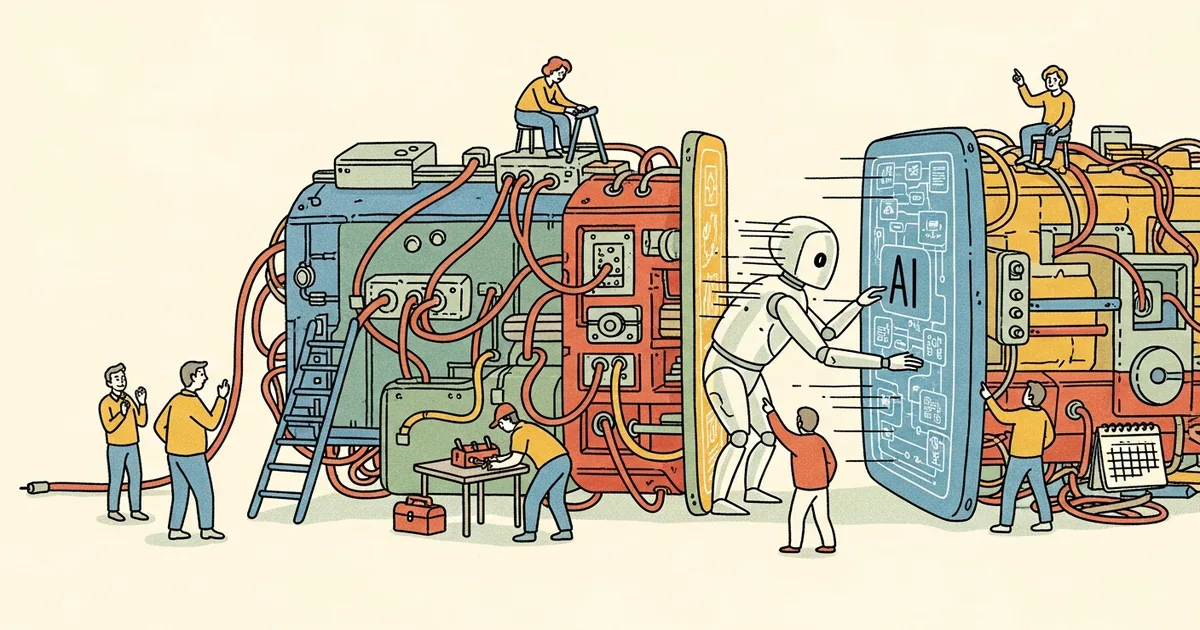
Maganti’s essay describes a workflow that combined multiple AI tools for different parts of the development process. For frontend work and UI implementation — areas where he had limited experience — he relied heavily on AI coding assistants to generate React components, handle CSS layouts, and implement design patterns he could describe but not code fluently.
For systems-level work in his area of expertise, Maganti used AI differently: as a pair programmer that could handle boilerplate, suggest optimizations, and accelerate implementation of designs he had already worked out mentally. The distinction is significant. In unfamiliar domains, he delegated more to the AI and reviewed outputs. In familiar domains, he directed the AI more precisely and used it to accelerate rather than replace his own coding.
The essay notes several failure modes. AI-generated frontend code often worked on initial render but broke under edge cases — responsive layouts, accessibility requirements, and complex state management required manual intervention. Maganti also found that AI tools performed poorly when asked to maintain consistency across a large codebase over time; they would solve individual problems effectively but introduce subtle inconsistencies that accumulated.
His solution was to treat AI outputs as first drafts that needed human editing and integration, rather than finished code. This is a workflow pattern that multiple experienced developers have independently converged on.
Who’s Affected
The essay speaks most directly to experienced software engineers — the demographic most likely to have both the technical judgment to evaluate AI outputs and a backlog of un-built projects constrained by skill gaps or time. This group, sometimes called “lapsed builders,” represents a large potential market for AI coding tools.
Tool makers — companies building AI coding assistants like Cursor, GitHub Copilot, Windsurf, and Claude Code — benefit from accounts like Maganti’s because they validate the core value proposition: AI does not need to write perfect code to be enormously useful. It needs to reduce friction enough that projects move from “someday” to “shipped.”
The essay also has implications for how companies think about team composition. If a senior backend engineer can ship a reasonable frontend using AI assistance, the calculus around hiring specialists versus upskilling generalists shifts. This does not eliminate the need for frontend expertise — Maganti is clear that the AI-generated frontend required significant cleanup — but it changes the threshold at which a project becomes viable.
What’s Next
Maganti’s essay will likely become a reference point in ongoing debates about AI’s impact on software development. Its value lies in specificity: rather than making sweeping claims, it documents a single project in enough detail for other developers to evaluate and adapt the workflow.
The broader pattern — experienced professionals using AI to expand their effective skill set rather than replace core competencies — is likely to accelerate. As AI coding tools improve at maintaining codebase-wide consistency and handling edge cases (two weaknesses Maganti identified), the range of projects that a single skilled developer can ship will continue to expand.
The essay is available on Maganti’s personal site and has been archived across several developer communities. For engineers carrying their own list of eight-year-old project ideas, it offers a practical template for how to start.