Key Takeaways
- Anthropic’s Model Context Protocol (MCP) handles how AI models connect to tools and data sources, hitting 97 million monthly SDK downloads by March 2026.
- Google’s Agent2Agent (A2A) protocol enables peer-to-peer communication between autonomous agents, now backed by over 150 organizations including Salesforce, SAP, and Adobe.
- IBM’s Agent Communication Protocol (ACP) merged into A2A in August 2025, consolidating the agent-to-agent layer under the Linux Foundation.
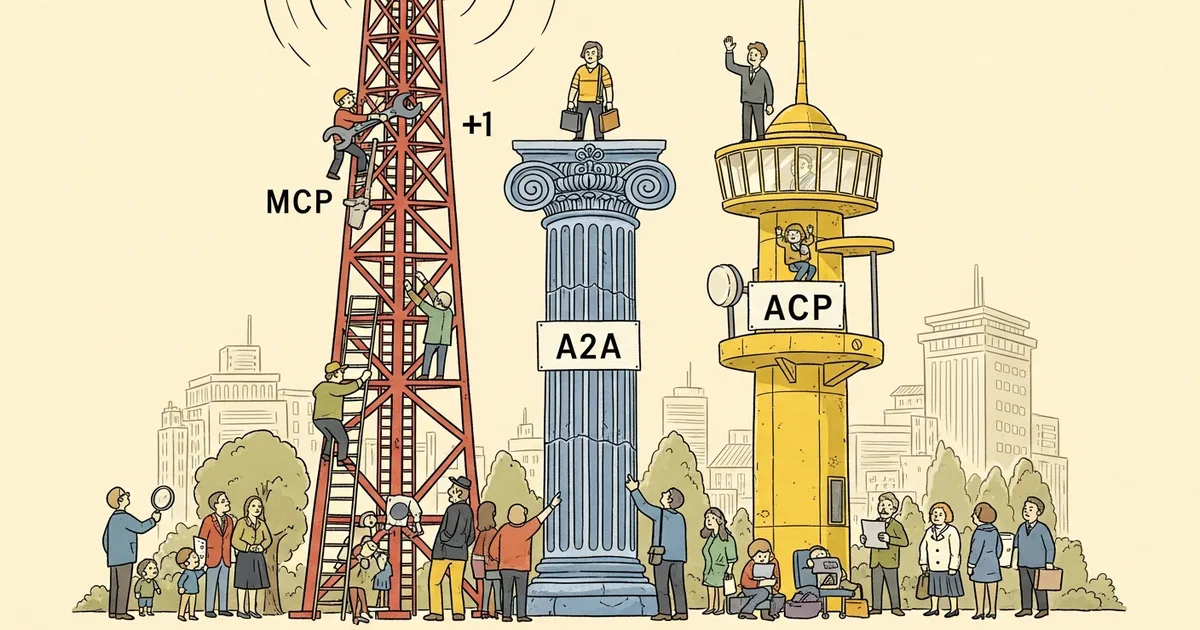
- The three protocols solve different layers of the AI agent stack: MCP for tool access, A2A for agent coordination, and ACP’s contributions now live inside A2A.
What Happened
Three competing protocols emerged in 2024-2025 to standardize how AI agents interact with tools, data, and each other: Anthropic’s Model Context Protocol (MCP), Google’s Agent2Agent Protocol (A2A), and IBM’s Agent Communication Protocol (ACP). Each aimed to become the foundational standard for agentic AI infrastructure, but they target fundamentally different problems.
Anthropic launched MCP in November 2024 as an open standard for connecting AI models to external tools and data sources. Google followed with A2A in April 2025, focused on enabling autonomous agents to collaborate as peers. IBM released ACP in March 2025 through its BeeAI platform, also targeting agent-to-agent communication. By August 2025, IBM merged ACP into A2A under the Linux Foundation, reducing the field to two primary protocols.
Why It Matters
The AI industry is moving from single-model applications to multi-agent systems where specialized agents collaborate on complex tasks. Without standardized communication protocols, every agent framework becomes a walled garden. The parallel to early internet history is direct: HTTP standardized web communication, and these protocols aim to do the same for AI agents.
In December 2025, Anthropic donated MCP to the newly formed Agentic AI Foundation (AAIF) under the Linux Foundation. OpenAI, Google, Microsoft, AWS, Cloudflare, and Bloomberg joined as co-supporters. This move placed MCP under the same vendor-neutral governance that oversees Kubernetes and PyTorch, signaling that the industry views agent protocol standardization as critical infrastructure rather than a competitive differentiator.
Technical Details
MCP (Model Context Protocol) operates on a client-server architecture where an AI model (client) connects to external tools, databases, and APIs (servers) through a standardized interface. It uses JSON-RPC 2.0 over stdio or HTTP with Server-Sent Events. MCP defines three core primitives: tools (functions the model can call), resources (data the model can read), and prompts (templates for common interactions). As of March 2026, MCP has over 97 million monthly SDK downloads, 10,000 active servers, and first-class client support in ChatGPT, Claude, Cursor, Gemini, Microsoft Copilot, and Visual Studio Code.
A2A (Agent2Agent Protocol) enables peer-to-peer communication between opaque autonomous agents that don’t share memory, tools, or context. It uses HTTP, Server-Sent Events, and JSON-RPC as transport layers, with gRPC support added in version 0.3. Each agent publishes an Agent Card — a JSON metadata document hosted at /.well-known/agent-card.json — that describes the agent’s identity, capabilities, skills, authentication requirements, and service endpoint. Clients discover agents by fetching their Agent Cards, then send structured messages that agents process as tasks with defined lifecycle states. Over 150 organizations now support A2A, including Salesforce, SAP, Adobe, ServiceNow, and PayPal.
ACP (Agent Communication Protocol) was designed around asynchronous-first HTTP communication with support for structured data, plain text, images, and embeddings in messages. It used performative verbs like “inform,” “request,” “propose,” and “accept” drawn from multi-agent system theory. IBM’s Kate Blair now sits on the A2A Technical Steering Committee, and ACP’s RESTful design principles have been incorporated into A2A’s architecture. The DeepLearning.AI ACP course was replaced by an A2A course in February 2026.
The critical architectural distinction: MCP defines a vertical relationship where a model accesses tools through a host, creating an implicit hierarchy. A2A defines a horizontal relationship where agents communicate as peers without any party having privileged access. As WorkOS noted, “when agents communicate through MCP, they’re essentially reduced to tools or functions that can be called by a host system, creating an implicit hierarchy rather than enabling true peer-to-peer communication.”
Who’s Affected
Developers building AI applications face a practical decision about which protocol to implement. For tool integration — connecting an LLM to a database, API, or file system — MCP is the clear standard with universal adoption across major AI platforms. For multi-agent workflows where independent agents need to discover and collaborate with each other, A2A is the emerging standard backed by Google, IBM, Salesforce, and the broader enterprise ecosystem.
Enterprise teams at companies like Tyson Foods, Gordon Food Service, and S&P Global Market Intelligence are already deploying A2A for inter-agent communication in supply chain and financial data workflows. Meanwhile, every major IDE and AI assistant now supports MCP for tool connectivity. Developers building on ACP should migrate to A2A, as IBM has provided migration documentation and the BeeAI platform already runs on A2A.
What’s Next
MCP’s roadmap under the Agentic AI Foundation includes OAuth 2.1 with enterprise identity provider integration in Q2 2026, agent-to-agent coordination capabilities in Q3 2026, and a centralized MCP Registry in Q4 2026. The Q3 addition of agent-to-agent coordination could create overlap with A2A’s core functionality, which may force further consolidation or clearer boundary definitions between the two protocols.
A2A continues to advance toward a 1.0 stable release, with version 0.3 already delivering gRPC support, signed Agent Cards via JSON Canonicalization Scheme (RFC 8785), and extended Python SDK capabilities. For developers building today, the practical recommendation is to implement both: MCP for the tool layer and A2A for the agent coordination layer. These protocols are complementary, not competing, and most production AI systems will use both.