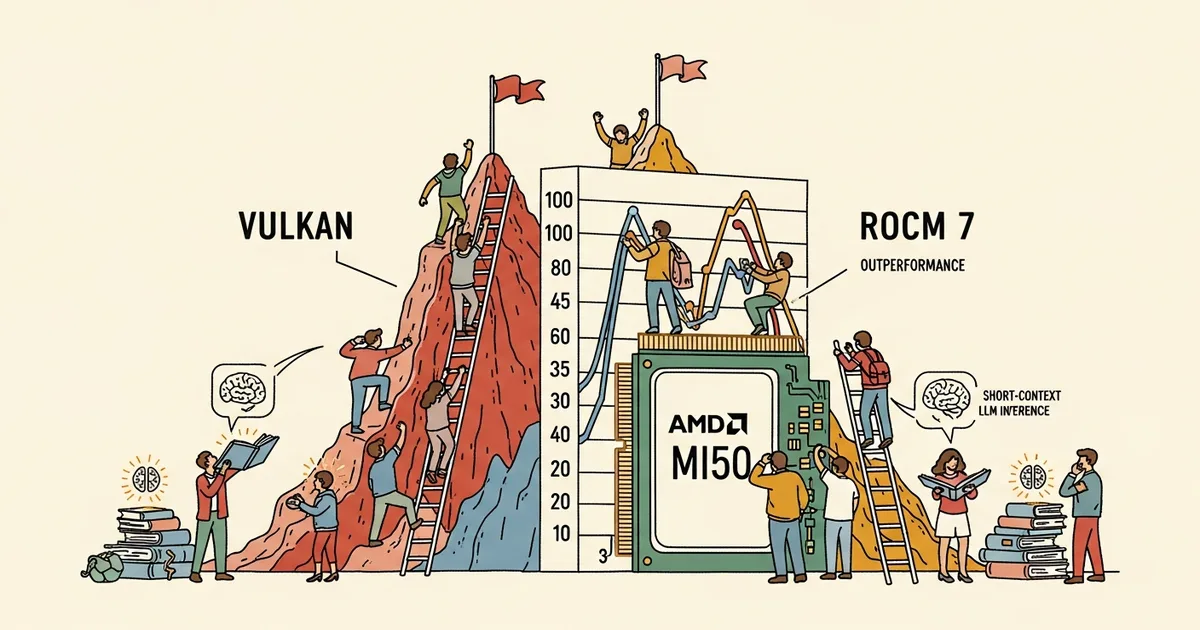
New benchmarks comparing AMD’s ROCm 7 and Vulkan backends for llama.cpp on a Radeon Instinct MI50 32GB GPU reveal that Vulkan delivers faster inference for short-context dense models, while ROCm maintains advantages for long-context and mixture-of-experts workloads. The tests, posted to the LocalLLaMA community on March 22, used a nightly ROCm 7.13.0a build against Vulkan 1.4.341.1 across multiple quantized models including Qwen 3.5 variants and Nemotron Cascade 2.
For sub-16k context windows on dense models like Qwen 3.5 9B and 27B, Vulkan consistently produced faster prompt processing and token generation speeds than ROCm. The margin was significant enough to make Vulkan the preferred backend for interactive use cases — chatbots, code completion, and real-time assistants — where response latency matters more than throughput on long documents. The advantage disappeared for contexts above 16k tokens, where ROCm’s more optimized memory management and kernel implementations took the lead.
On mixture-of-experts models like Qwen 3.5 122B (which uses 122 billion total parameters but activates only a subset per inference pass), ROCm outperformed Vulkan regardless of context length. MoE architectures require efficient expert routing and sparse computation patterns that ROCm’s HIP kernels handle more effectively than Vulkan’s general-purpose compute pipeline. This distinction matters for users running large MoE models locally — the backend choice directly affects whether the model is practically usable on a given GPU.
The MI50 is a previous-generation AMD data center GPU that has become popular in the local AI community due to its 32GB VRAM capacity and availability on the used market at prices well below current-generation cards. The benchmarks demonstrate that even older AMD hardware can run substantial language models when paired with optimized inference software, expanding the accessibility of local LLM deployment beyond NVIDIA’s ecosystem.
The results highlight an ongoing fragmentation in AMD’s AI software stack. ROCm and Vulkan serve different design philosophies — ROCm targets data center workloads with deep hardware integration, while Vulkan provides cross-platform compatibility with lower setup complexity. For llama.cpp users on AMD hardware, the practical recommendation from these benchmarks is to use Vulkan for quick interactive queries on dense models and switch to ROCm for long-document processing or MoE model inference.