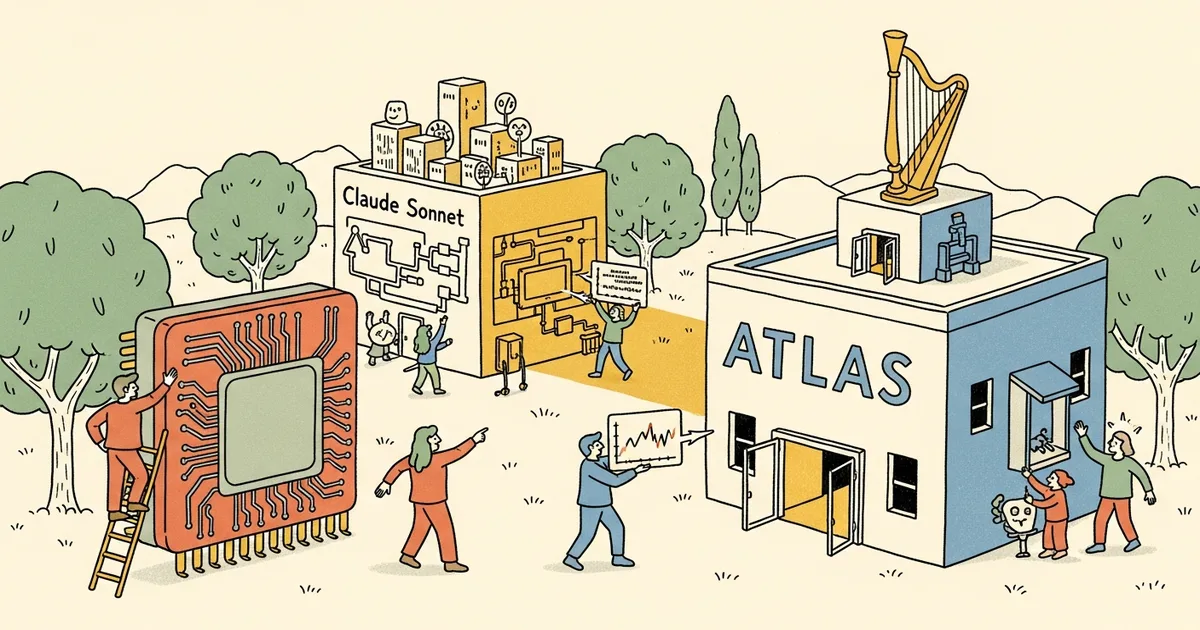
A 22-year-old Virginia Tech student has built an open-source AI coding system called ATLAS that outperforms Anthropic’s Claude Sonnet 4.5 on LiveCodeBench, running entirely on a single $500 consumer GPU. ATLAS scored 74.6 percent on 599 LiveCodeBench problems, surpassing Claude Sonnet 4.5’s score of 71.4 percent. The system’s electricity cost per task is approximately $0.004.
ATLAS uses a 14-billion parameter model — small by frontier standards — combined with a pipeline architecture that generates multiple solution approaches for each coding problem, tests them, and selects the best result. This generate-and-verify approach boosted the base model’s score from 55 percent to 74.6 percent, a nearly 20-percentage-point improvement achieved entirely through system design rather than model scaling. No cloud services, API costs, or fine-tuning are required.
The result adds to a growing body of evidence that smaller models paired with better infrastructure can match or exceed much larger proprietary systems on specific tasks. MiniMax’s M2.5, an open-weight model released in February 2026, scored 80.2 percent on SWE-bench Verified while costing one-twentieth as much per token as Claude Opus 4.6. DeepSeek V3.2, Qwen 3 Coder, and Kimi K2.5 have all demonstrated competitive performance on coding benchmarks at a fraction of frontier model costs.
The practical implications are significant for developers and organizations evaluating AI coding tools. If a system running on consumer hardware can beat a $20-per-month subscription model on standardized benchmarks, the value proposition of cloud AI services shifts from raw capability to convenience, integration quality, and breadth of features. A developer willing to run local infrastructure can achieve comparable coding assistance for pennies instead of dollars.
Context matters when interpreting these results. LiveCodeBench tests algorithmic problem-solving — a narrow slice of what professional software engineering requires. Claude Sonnet 4.6, released in February 2026, scores 79.6 percent on SWE-bench Verified, which tests more realistic software engineering tasks including understanding codebases, writing tests, and fixing bugs. ATLAS has not been benchmarked on SWE-bench. The gap between solving coding puzzles and shipping production software remains wide.
Still, ATLAS represents a meaningful milestone in the democratization of AI capability. A college student with a consumer GPU matching a billion-dollar company’s product on any benchmark — even a narrow one — illustrates how rapidly the floor is rising for what open-source AI can achieve. The question is no longer whether open models can compete but which specific tasks still require frontier scale.