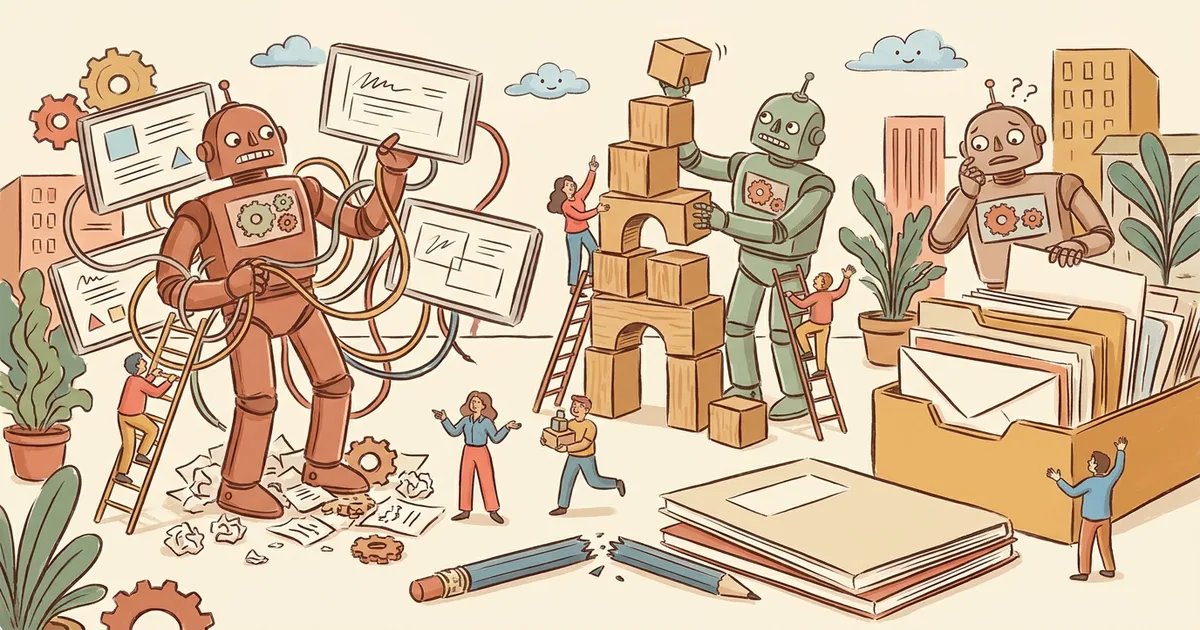
- A new experiment placed AI coding agents inside a simulated software company with colleagues, project boards, and chat histories.
- Even Claude Opus 5.5 and GPT-6 Astra fully completed fewer than one in ten tasks in the simulated workplace.
- The result contrasts with near-saturated scores on standard isolated benchmarks like SWE-bench.
- Anthropic has said Claude writes more than 80 percent of the company’s own production code.
What Happened
A new experiment tested leading AI coding agents for the first time as “digital employees” inside a simulated software company, complete with colleagues, project boards, and chat histories, according to a report published by THE DECODER on November 22, 2026. Even Claude Opus 5.5 and GPT-6 Astra fully completed fewer than one in ten assigned tasks.
Why It Matters
The gap echoes other recent workplace-realism benchmarks, including Alibaba’s Co-Design Bench, which found the top AI coding agent fully completed only 26 percent of real engineering tasks. Both results suggest standard coding benchmarks like SWE-bench, which are described as nearly saturated, may overstate how ready agents are for unstructured office environments.
Technical Details
The simulation placed agents in a software company setting with project boards and ongoing chat histories rather than isolated, single-shot coding problems. Success on this measure required fully completing a task end-to-end, not just producing plausible-looking code, which is where agent performance dropped sharply compared to isolated test scores.
Who’s Affected
The finding is relevant to engineering teams evaluating tools like Claude Code, Cursor, GitHub Copilot, and Codex for autonomous multi-step work rather than single-function code generation. It also complicates vendor claims, such as Anthropic’s statement that Claude writes more than 80 percent of its own production code, by highlighting the difference between assisted and fully autonomous task completion.
What’s Next
The researchers behind the simulation have not published a full methodology paper alongside the report. Further workplace-realism benchmarks are likely as vendors push agents toward longer-horizon, multi-step tasks.