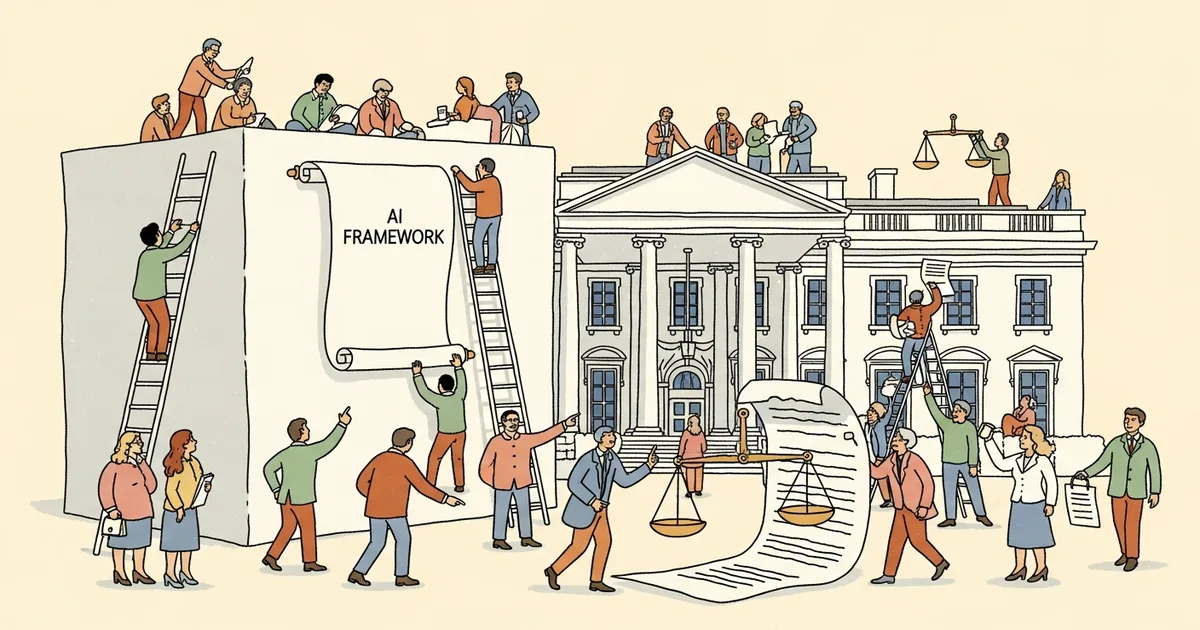
- The White House released its National Policy Framework for Artificial Intelligence on March 20, 2026, outlining nonbinding legislative recommendations for Congress to establish unified federal AI regulation.
- The framework calls for broad federal preemption of state AI laws that impose undue burdens while preserving states’ police powers to protect children, prevent fraud, and safeguard consumers.
- Seven legislative objectives are identified: child protection, community safeguards, intellectual property, free speech, innovation, workforce development, and federal-state governance.
- The framework takes a narrower stance than Sen. Marsha Blackburn’s 291-page TRUMP AMERICA AI Act, which proposes developer duties, liability regimes, and labor reporting requirements.
What Happened
The White House released its National Policy Framework for Artificial Intelligence on March 20, 2026, a set of nonbinding legislative recommendations for Congress to create a unified federal approach to AI regulation. The framework, analyzed by Ropes & Gray LLP and Holland & Knight LLP, calls for broad federal preemption of state AI laws that impose undue burdens on AI developers and deployers, while preserving states’ traditional police powers to enforce laws of general applicability.
The document reflects the administration’s position that a patchwork of state-level AI regulations threatens to obstruct innovation and create compliance costs that disproportionately affect smaller AI companies. As Roll Call reported, the framework represents the most detailed articulation of the administration’s preferred legislative architecture for AI governance to date.
Why It Matters
At least 15 states introduced AI-related legislation in 2025 and early 2026, creating a growing compliance burden for AI companies operating nationally. Colorado became the first state to enact a broad AI governance law in 2024, and states including Connecticut, California, and Texas have active AI bills in their current legislative sessions. The White House framework directly addresses this proliferation by arguing that AI model development is inherently interstate in nature and should not be subject to state-by-state regulation.
The framework also takes the position that AI developers should not be penalized for unlawful conduct by third parties using their models, a liability shield that the technology industry has actively lobbied for and that consumer advocates have opposed. This position creates a clear fault line in the upcoming congressional debate over comprehensive AI legislation and will likely be one of the most contested provisions if the framework’s recommendations are translated into legislative text.
Technical Details
The framework identifies seven legislative objectives. Child protection provisions would empower parents with privacy tools and age assurance mechanisms while safeguarding against exploitation. Community safeguard provisions would codify protections barring ratepayers from funding AI data center electricity costs and streamline federal permitting for power generation infrastructure. Intellectual property provisions support voluntary licensing rather than mandatory requirements for training data and protect voice and likeness replicas with First Amendment exceptions.
The free speech provisions would bar federal agencies from pressuring AI or technology providers to suppress lawful content, a provision that reflects ongoing debates about content moderation and government influence. Innovation provisions propose regulatory sandboxes and improved access to federal datasets for AI training. Workforce development provisions call for integrating AI training into existing educational programs and supporting land-grant institutions. The federal-state governance section details the preemption framework, preserving state zoning authority and police powers while preempting state regulation of AI model development and deployment.
Who’s Affected
State legislators working on AI bills face the prospect of federal preemption that could override their enacted or pending legislation, potentially nullifying years of policy development at the state level. AI companies operating across multiple states would benefit from regulatory consolidation under a single federal framework, reducing compliance costs and legal uncertainty. Consumer protection advocates and civil rights organizations have raised concerns about the framework’s liability protections for AI developers, arguing that they could leave consumers without adequate recourse when AI systems cause harm. Sen. Marsha Blackburn’s TRUMP AMERICA AI Act, a 291-page legislative proposal that includes developer duties, liability regimes, and labor reporting requirements, represents a more prescriptive alternative that Congress may consider alongside the White House framework.
What’s Next
The framework is not binding and does not impose new legal obligations or direct agencies to take regulatory action. Congressional action is required to implement any of the framework’s recommendations. Democratic lawmakers have expressed opposition to broad preemption provisions, suggesting that comprehensive federal AI legislation faces a contested path through Congress. Political observers note that progress is more likely through discrete legislation addressing specific issues, such as child safety, fraud prevention, and government AI procurement, than through a single comprehensive reform bill. The framework’s influence will ultimately depend on whether Congress adopts its preemption approach or pursues a more prescriptive regulatory model.