Nikkei Asia reported on April 9, 2026 that 78,557 technology workers were laid off between January and April 2026 — and 47.9% of those cuts, or 37,638 positions, were directly attributed by employers to AI automation and workflow replacement. The tech layoffs AI 2026 story is real, but OpenAI CEO Sam Altman complicated the narrative at the India AI Impact Summit, arguing that a meaningful portion of those figures represents “AI washing”: companies blaming machine intelligence for cuts they were going to make regardless.
The number that matters isn’t 78,557. It’s the methodology behind the 47.9%.
Tech Layoffs AI 2026: The Numbers, Unpacked
Nikkei Asia’s dataset spans January through early April 2026, drawing on employer filings, earnings call disclosures, and public statements. Of the 78,557 affected workers, 76% were employed at US-based companies — approximately 59,703 jobs concentrated in a single market that has spent the past 18 months aggressively deploying AI infrastructure.
The 47.9% AI attribution figure means that in those specific cases, employers explicitly cited AI-driven automation, workflow consolidation, or direct software replacement as the primary driver. Nikkei was counting what companies said publicly — a meaningful distinction that captures narrative as much as causation.
For context, Layoffs.fyi tracked approximately 34,000 tech layoffs across all of Q1 2025. The jump to 78,557 in the same window a year later represents a 131% increase year-over-year. Even accounting for AI washing, the acceleration is structural.
Sam Altman’s AI Washing Admission
At the India AI Impact Summit in April 2026, OpenAI CEO Sam Altman — whose company’s products appear directly in many of the workflow replacement decisions driving these layoffs — said that some portion of AI-attributed cuts are “not entirely honest.” Companies, he argued, are using AI as a convenient narrative to justify cost reductions that were already planned before meaningful automation was deployed.
“AI washing” in a layoff context works like this: a company announces headcount reductions, attributes them to AI productivity gains, captures the associated stock price lift from appearing operationally modern, and moves on — without having actually automated the displaced roles. It’s a communication strategy for markets, not a report of technical reality.
Altman’s candor is notable given OpenAI‘s position in this story. The company simultaneously sells the tools enabling genuine automation and acknowledges those same tools are being invoked misleadingly by CFOs looking for clean narratives. That tension sits at the center of the growing Humans First movement, which has framed AI displacement as structural rather than episodic — and which Altman’s admission doesn’t fully refute.
What “AI-Attributed” Actually Measures
The 37,638 AI-attributed layoffs in Nikkei’s count aren’t uniformly caused by automation replacing individual workers. The category covers three distinct dynamics that aggregate data cannot separate:
- Direct automation replacement: Software or AI agents performing tasks previously requiring human labor — customer service triage, QA testing, data annotation
- Productivity compression: Fewer workers needed because each remaining employee now handles more with AI assistance — a team of 10 engineers producing what previously required 14
- Narrative attribution: Layoffs labeled AI-driven in press releases but driven primarily by market conditions, elevated capital costs, or post-pandemic headcount normalization
All three appear in the same 47.9% bucket. Separating genuine automation displacement from narrative attribution requires individual company-level analysis that Nikkei’s aggregate methodology cannot provide. That’s not a criticism of the data — it’s the inherent limit of self-reported employer filings.
IBM’s Contrarian Hiring Strategy
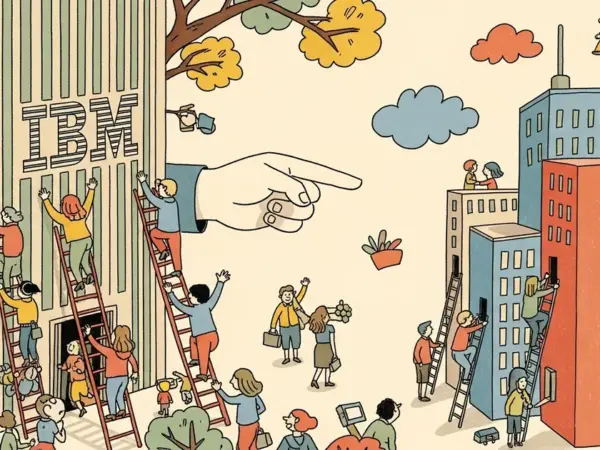
International Business Machines Corporation (IBM) is running a different playbook in Q1 2026. IBM tripled its entry-level hiring against the industry trend, specifically targeting roles in AI operations, model governance, and enterprise deployment support — functions that barely existed as discrete job categories 24 months ago.
IBM’s argument, consistent with CEO Arvind Krishna’s public statements throughout 2025, is that AI creates demand for new specialist roles faster than it eliminates generalist ones — at least in the near term. MegaOne AI tracks 139+ AI tools across 17 categories, and the pattern across enterprise deployments supports IBM’s logic: organizations deploying AI at scale consistently report needing more human oversight, not less, during the first 12–18 months of rollout.
Whether IBM’s bet pays off depends on the rate of agentic AI maturation. If autonomous AI systems become reliable enough to manage their own deployment and governance by 2027, the specialist roles IBM is hiring for today face the same displacement pressure currently hitting QA engineers and support teams. IBM is essentially betting on a longer transition window than the market is pricing in.
The Geography of Displacement: Why 76% Is in the US
The US concentration — 76% of all 78,557 layoffs — reflects both where AI adoption is most advanced and where labor costs make automation investments most financially attractive. A San Francisco-based software engineer costs roughly 4–5x what an equivalent role costs in Eastern Europe or Southeast Asia. The return on investment from replacing or compressing that role with AI tooling is correspondingly higher, and the decision calculus moves faster.
European tech layoffs remain constrained by labor protections that make workforce reductions more expensive and procedurally complex. Asia-Pacific tech employment is growing in absolute terms, driven by AI infrastructure buildout — the same investment thesis behind the €10 billion Nebius AI data center expansion now under construction near the Russian border.
The current picture: the US absorbs disproportionate near-term displacement while simultaneously building the infrastructure that will eventually export that displacement globally. Other markets are roughly 18–24 months behind on the same curve.
The Roles Most Exposed in Q1 2026
Breaking down Nikkei’s data by function, the highest AI-attribution rates appear in four categories:
- Software QA and testing — automated testing tools now handle test case generation, execution, and bug triage that previously required dedicated headcount
- Content and documentation roles — technical writers, content moderators, and UX copywriters absorbed significant compression as AI video and voice tools handle production work that previously required full teams
- Customer-facing tier-1 support — LLM-powered agents are handling resolution rates above 70% in enterprise deployments, up from roughly 35% in 2024
- Data annotation and labeling — the workforce that trained earlier AI models is being replaced by synthetic data generation and active learning pipelines
Software engineering itself showed lower AI attribution than most 2025 predictions anticipated. The data suggests AI is currently more effective at eliminating support and process roles than at replacing core development — though that picture is expected to shift as agentic coding systems demonstrate consistent reliability on production codebases.
The Signal Beneath the Noise
The honest read on 78,557 is this: the number is real, the AI attribution is partly real and partly a capital markets communication strategy, and the gap between the two is exactly where Sam Altman was pointing. Companies have a clear financial incentive to frame restructuring as AI-driven — it signals operational modernity to investors and deflects scrutiny from strategic missteps or demand shortfalls.
That doesn’t make the genuine displacement less significant. Even if the real AI-driven figure is 25,000–30,000 after adjusting for AI washing, that represents a structural shift in the technology labor market — not a cyclical correction. The scale of enterprise AI investment from companies like OpenAI guarantees the trend continues through 2026 and accelerates in 2027.
Workers in the most exposed roles — QA, tier-1 support, annotation, documentation — should treat the Q1 2026 data as a leading indicator. IBM’s contrarian bet on AI governance specialists and Altman’s AI washing acknowledgment both point to the same conclusion: AI’s employment impact is real, uneven across functions, and consistently overstated in quarterly press releases. The workers absorbing the real version don’t benefit from the distinction.