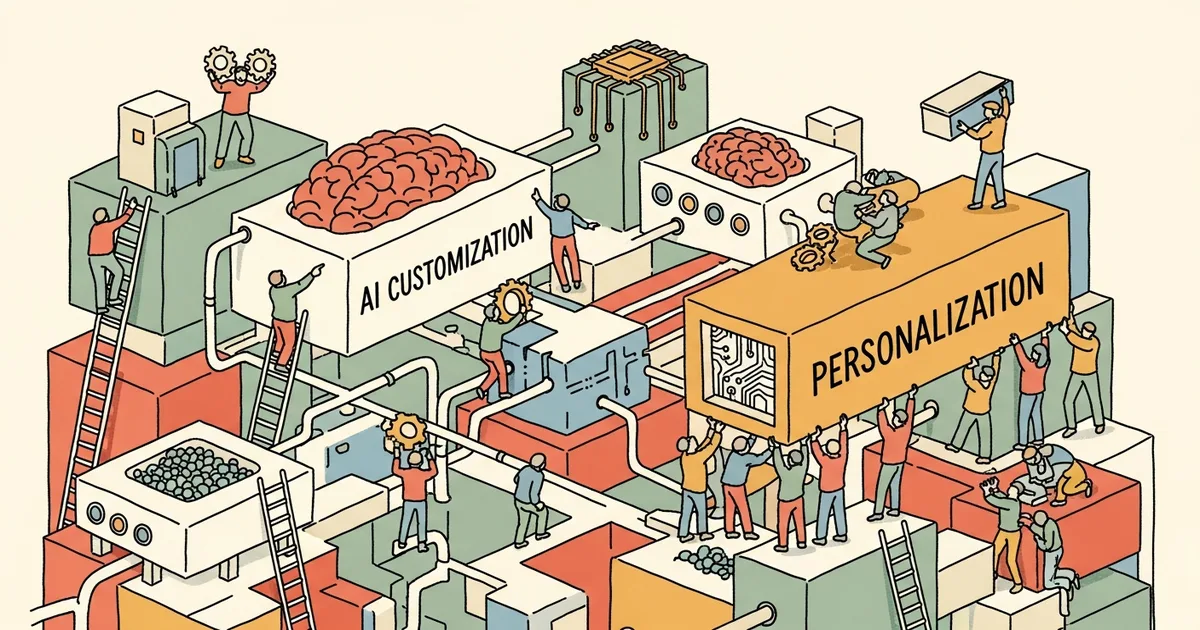
MegaOne AI announced a strategic shift towards AI model customization, emphasizing its architectural imperative for achieving significant performance gains in specialized domains, as detailed in a March 31, 2026, MIT Technology Review article. This move addresses the flattening of general large language model (LLM) capabilities, where incremental improvements have replaced the tenfold jumps seen in earlier iterations. The company believes that integrating proprietary data and internal logic into AI models is crucial for unlocking new levels of domain-specific intelligence.
The shift involves moving beyond conventional fine-tuning to a more profound institutionalization of expertise within AI systems. MegaOne AI’s Head of Research, Dr. Evelyn Reed, stated, “Our analysis indicates that while foundational models offer broad utility, their true potential is realized when deeply integrated with an organization’s unique operational context and historical data. This creates a compounding advantage that is difficult to replicate.”
This customization strategy aims to encode a company’s history and specific workflows directly into its AI models. For instance, a customized model could achieve a 30% improvement in accuracy for industry-specific compliance checks compared to a general-purpose LLM. This is attributed to its training on a curated dataset of regulatory documents and internal policy guidelines, rather than broad internet data.
Furthermore, MegaOne AI is developing methodologies to measure the “contextual relevance score” of customized models, aiming for scores above 0.85 in target applications. This metric quantifies how well a model’s outputs align with the specific nuances and terminology of a given domain. Initial pilot projects have shown that models with high contextual relevance scores can reduce human review time by up to 40% in complex decision-making processes.
The company is also exploring federated learning approaches to facilitate secure customization using sensitive enterprise data. This allows models to learn from proprietary datasets without the data ever leaving the client’s secure environment. Early benchmarks indicate that federated customized models can maintain 98% of the performance of centrally trained models while enhancing data privacy.
MegaOne AI’s immediate next step involves releasing a developer toolkit by Q3 2026. This toolkit will provide enterprises with frameworks and APIs to integrate their proprietary data for model customization, focusing initially on legal, financial, and healthcare sectors. The toolkit will support various data formats, including structured databases, unstructured text, and internal knowledge graphs, to facilitate comprehensive domain adaptation.