- OpenAI now has 900 million weekly active users and more than 50 million paying subscribers, announced February 27, 2026.
- Revenue hit $2 billion per month — growing four times faster than Alphabet and Meta did at comparable stages.
- Enterprise accounts for over 40% of revenue and is on track to reach parity with consumer by end of 2026.
- Codex, OpenAI’s coding agent, now serves 2 million weekly users — up 5x in three months — while APIs process 15 billion tokens per minute.
What Happened
On February 27, 2026, OpenAI disclosed that ChatGPT had crossed 900 million weekly active users — a jump of 100 million from the 800 million figure the company reported in October 2025. The announcement came alongside the disclosure of a new funding round, with OpenAI ultimately raising $122 billion at an $852 billion valuation.
Alongside the user figure, OpenAI reported more than 50 million paying consumer subscribers and over 9 million paying business users. January and February 2026 are on track to become the largest months for new subscribers in the company’s history, according to OpenAI.
Revenue has crossed $2 billion per month — double what the company was generating per quarter at the end of 2024. Annualized, that puts OpenAI above $24 billion in run-rate revenue, with TechCrunch reporting the company crossed $25 billion in annualized revenue in late February 2026.
Why It Matters
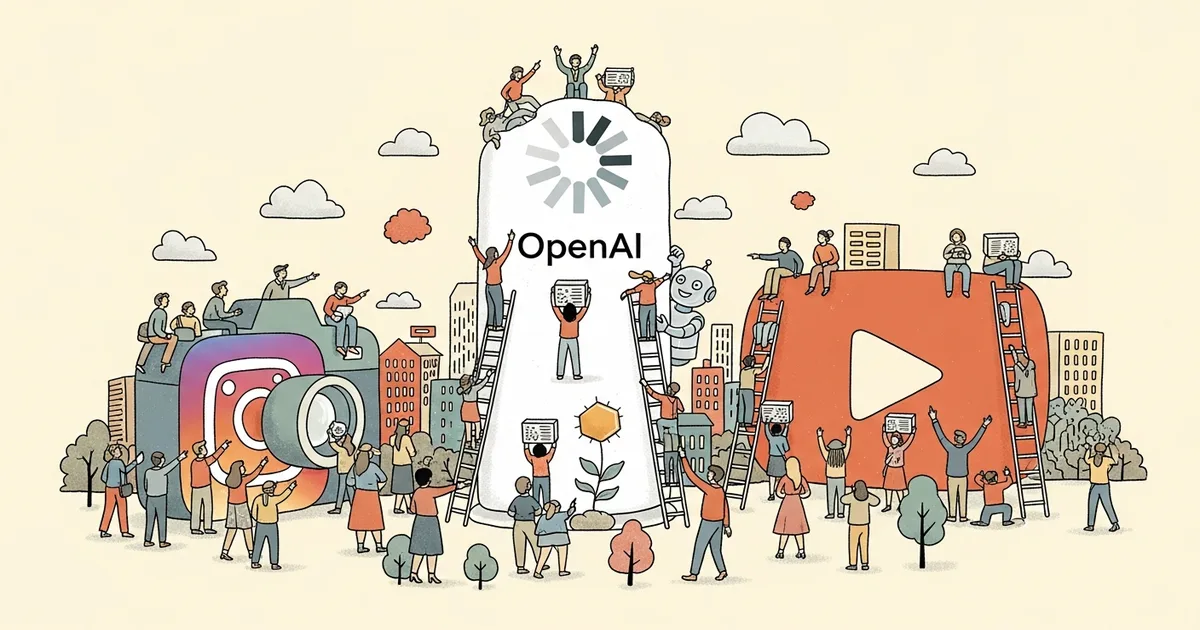
The 900 million weekly active user figure places OpenAI in rarefied company — and in an instructive gap. Instagram has approximately 2.2 billion monthly active users; YouTube sits at roughly 2.85 billion monthly. ChatGPT, measured on a weekly basis, already surpasses Instagram’s weekly equivalent. YouTube, with its longer history and deeper media integration, remains the ceiling ahead.
What makes the comparison striking is the growth rate, not just the number. In an investor communication tied to the $122 billion fundraise, OpenAI stated: “We are growing revenue four times faster than the companies who defined the Internet and mobile eras” — a direct reference to Alphabet and Meta. What took Google and Facebook roughly eight years to build in revenue scale, OpenAI has approached in approximately three.
The company is also only monetizing a small fraction of its user base. With 900 million weekly active users and roughly 50 million paying consumer subscribers, the conversion rate sits around 5.5%. That gap between reach and paying users represents either a risk or a significant upside opportunity, depending on how aggressively OpenAI pursues subscription conversion and enterprise contracts.
Technical Details
OpenAI’s APIs now process more than 15 billion tokens per minute — a figure that reflects both consumer product usage and the growing developer and enterprise layer built on top of OpenAI’s models.
Codex, the company’s AI coding agent, has emerged as a standout product within this infrastructure layer. According to OpenAI, Codex now serves over 2 million weekly users, a 5x increase in three months, with usage growing more than 70% month over month. The rapid growth of Codex is relevant to the enterprise revenue story: developer tools tend to carry higher commercial value per seat and serve as an entry point into larger organizational contracts.
The 900 million weekly active user figure itself reflects a 350% increase over 18 months, according to 9to5Mac. OpenAI has been the fastest technology platform to reach 10 million users, the fastest to 100 million, and is now approaching 1 billion weekly active — a milestone no prior consumer internet platform has reached on this timeline.
Who’s Affected
Enterprise customers are the most commercially significant segment right now. Enterprise revenue already represents more than 40% of OpenAI’s total revenue, and the company expects enterprise to reach parity with consumer revenue by the end of 2026. Sam Altman told editors in late 2025 that enterprise would be a top priority in 2026, framing it as an application problem rather than a training problem — meaning the focus is on building products that embed into business workflows, not on model capability alone.
For competing AI platforms — Anthropic, Google DeepMind, and Meta AI — the user and revenue gap is becoming harder to close on distribution alone. OpenAI’s 900 million weekly active users represent a built-in audience for any new product the company launches, a compounding advantage that pure model quality cannot easily offset.
Developers building on the API layer face an increasingly consolidated ecosystem. With 15 billion tokens per minute in API throughput, OpenAI’s infrastructure is handling volumes that make switching costs real. Businesses that have integrated OpenAI’s models into core workflows are now structurally tied to the platform’s pricing and roadmap decisions.
For the broader AI industry, the revenue and user figures confirm that the consumer AI market is not a niche. The February 27 announcement represents the clearest evidence to date that AI assistants are moving from early adopter curiosity to mainstream utility at scale.
What’s Next
The 1 billion weekly active user milestone is the immediate target. At the current growth trajectory — approximately 100 million new weekly active users per quarter — OpenAI could reach that figure by mid-2026. The company has not given a public forecast for when it expects to cross the threshold, but the February announcement framed it as imminent.
On the revenue side, OpenAI is targeting enterprise parity with consumer by year-end. That would require enterprise revenue to grow from roughly 40% of $2 billion monthly to 50% — implying continued acceleration in enterprise contract volume, not just API usage. Codex’s growth rate and the company’s broader agent product strategy are the primary levers for that shift.
OpenAI is also reportedly eyeing an IPO by late 2026, according to AIToolly. The $852 billion valuation set in the April 2026 funding round would establish a reference point for public market pricing. Whether public markets assign a premium or discount to that figure will depend heavily on whether the enterprise monetization story continues to materialize through the rest of the year.
For businesses evaluating AI integration and developers choosing a platform, the practical next steps are narrow: monitor OpenAI’s enterprise pricing changes as competition for that 40%-to-50% revenue shift intensifies, track Codex adoption as a signal of developer platform lock-in, and watch whether the 5.5% consumer conversion rate improves — either through product changes or new pricing tiers — as OpenAI approaches the 1 billion user mark.