- OpenAI released a policy framework proposing taxes on AI-driven corporate profits and capital gains, a potential robot tax, and a Public Wealth Fund to distribute AI economic gains directly to citizens.
- The company warned that AI-driven growth could shrink the payroll tax base underpinning Social Security, Medicaid, SNAP, and housing assistance programs.
- Additional proposals include subsidizing a four-day workweek at full pay, portable worker benefit accounts, and treating AI infrastructure as a public utility.
- The document arrived six months after rival Anthropic released its own AI policy blueprint, and amid the Trump administration’s development of a national AI framework.
What Happened
OpenAI on April 6, 2026 released a public policy framework outlining how it believes governments should restructure taxation, labor protections, and public investment to manage AI’s economic disruption. The $852 billion company structured its proposals around three stated goals: distributing AI-driven prosperity more broadly, building safeguards to reduce systemic risks, and ensuring widespread access to AI capabilities so that economic power does not become overly concentrated. The document functions as a public position statement rather than a formal legislative proposal, directed at elected officials, investors, and the general public.
Why It Matters
OpenAI’s publication arrives as the Trump administration moves toward a national AI framework and ahead of midterm elections, placing the company in a position of bipartisan policy signaling. Six months prior, rival Anthropic released its own policy blueprint covering a range of possible responses to AI-driven economic disruption. The timing is complicated by OpenAI president Greg Brockman’s reported multi-million dollar donations to President Donald Trump and the broader flow of hundreds of millions of dollars from technology executives into super PACs supporting light-touch AI regulation — a posture that sits in tension with the redistributive proposals in the new document.
Technical Details
OpenAI’s central economic argument is that AI-driven productivity growth will erode the payroll tax base that currently funds major safety-net programs. “As AI reshapes work and production, the composition of economic activity may shift — expanding corporate profits and capital gains while potentially reducing reliance on labor income and payroll taxes,” OpenAI wrote in the document. To compensate, the company proposed higher taxes on corporate income, AI-driven returns, or capital gains at the top tier. It also floated a robot tax — a mechanism Microsoft founder Bill Gates proposed publicly in 2017, under which an automated system would contribute taxes equivalent to the human worker it replaced. OpenAI did not specify a target corporate rate; the Trump administration reduced it to 21 percent from 35 percent during his first term.
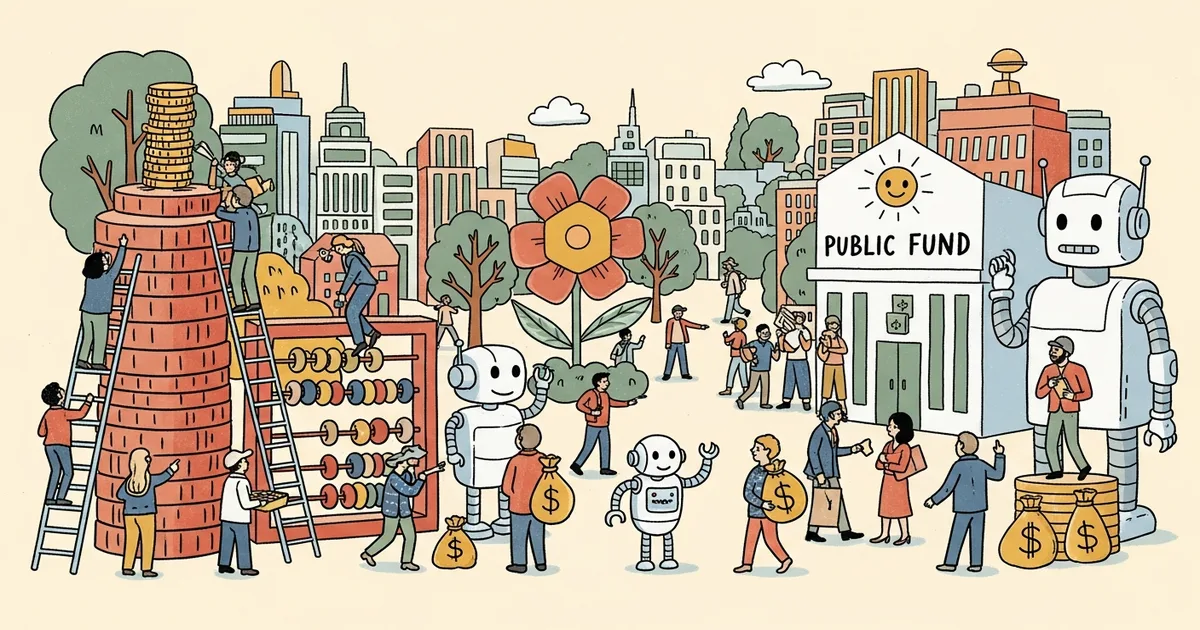
The document also proposed a Public Wealth Fund that would give Americans an automatic public stake in AI companies and infrastructure, with returns distributed directly to citizens. Separately, OpenAI proposed portable benefit accounts that follow workers across jobs — though the company acknowledged these accounts would still depend primarily on employer or platform contributions rather than government-backed universal coverage.
Who’s Affected
The Public Wealth Fund proposal most directly targets Americans outside the investment market who have not participated in AI-driven equity gains. Labor-focused proposals — subsidizing a four-day workweek at no reduction in pay, expanded retirement matches, expanded employer coverage of healthcare costs, and employer subsidies for childcare and eldercare — are framed in the document as corporate responsibilities rather than government mandates. That framing leaves a gap: workers displaced entirely by automation would lose access to employer-tied benefits along with their jobs, and the portable benefit accounts proposed as a partial remedy still depend on employment relationships to function.
On the infrastructure side, proposals to expand electricity capacity and treat AI as a public utility would affect energy providers, grid operators, and local governments managing permitting and land use for data center development.
What’s Next
OpenAI also proposed new oversight bodies, containment plans for dangerous AI systems, and targeted safeguards against high-risk applications including cyberattacks and biological threats. The company cited New Deal-era reforms as a historical analogy, writing: “The transition to superintelligence will require an even more ambitious form of industrial policy, one that reflects the ability of democratic societies to act collectively, at scale, to shape their economic future so that superintelligence benefits everyone.” OpenAI completed its conversion from nonprofit to for-profit status last year, a shift critics have argued creates tension with its stated mission of benefiting humanity broadly. The company has not announced a timeline for advancing any of these proposals through lobbying or legislative channels.