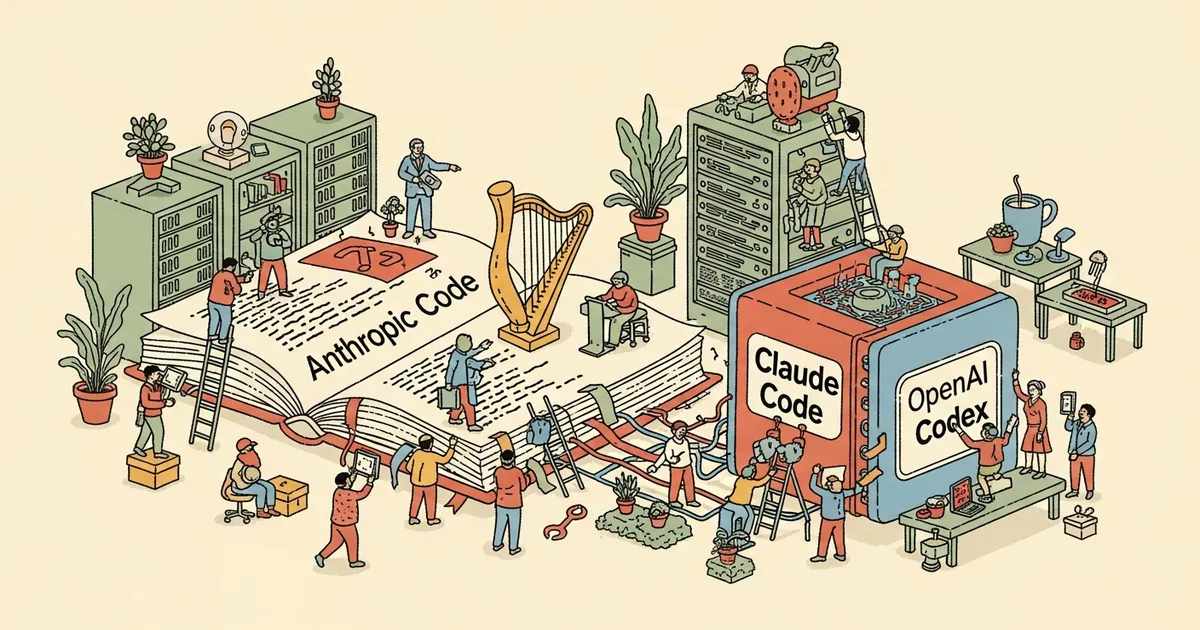
- OpenAI released a plugin that integrates its Codex coding assistant directly into Anthropic’s Claude Code, allowing developers to run code reviews without leaving their existing workflow.
- The plugin offers standard review, adversarial review that challenges design weaknesses, and an optional “Review Gate” that blocks Claude Code from finalizing changes until Codex approves them.
- The move follows OpenAI CEO of Applications Fidji Simo calling Claude Code’s market dominance a “wake-up call” that prompted a strategic refocus on coding tools.
What Happened
OpenAI published a plugin on March 31, 2026, that embeds its Codex coding assistant inside Anthropic’s Claude Code terminal. The plugin, available on GitHub at openai/codex-plugin-cc, allows developers to access OpenAI’s code review capabilities directly from the Claude Code environment without switching between tools or platforms.
The repository collected over 3,700 GitHub stars shortly after launch, indicating significant early developer interest. OpenAI framed the release as a pragmatic decision to meet developers where they already work rather than waiting for them to migrate to OpenAI’s own standalone coding tools.
The plugin marks an unusual competitive dynamic in the AI industry: a company deliberately embedding its product inside a direct rival’s platform to capture developer usage that it was otherwise losing.
Why It Matters
The plugin represents one of the more striking competitive moves in the current AI landscape. OpenAI CEO of Applications Fidji Simo reportedly called Claude Code’s success a “wake-up call” that prompted the company to refocus its strategy on coding tools and enterprise developer customers. Rather than competing head-to-head with Claude Code as a standalone coding environment, OpenAI chose to make Codex available as a complementary layer within Anthropic’s ecosystem.
The strategy acknowledges Claude Code’s established position among developers while attempting to capture a share of that usage through integration rather than displacement. For the broader AI industry, the move could signal a shift toward interoperability between competing AI platforms, where developers assemble multi-model workflows rather than committing exclusively to one provider.
If the plugin gains meaningful adoption, it may pressure other AI coding tool providers to offer similar cross-platform integrations rather than relying solely on standalone products to attract users.
Technical Details
The plugin requires a ChatGPT subscription (including the free tier) or an OpenAI API key, along with Node.js version 18.18 or higher. It uses any existing Codex installation on the developer’s machine, inheriting the same settings and credentials without requiring separate configuration.
Three core features are available. Standard code review analyzes code for bugs, style issues, and optimization opportunities. Adversarial review specifically challenges design weaknesses, architectural decisions, and potential failure modes, providing a more critical perspective than standard analysis. Background task handoff delegates longer-running work to Codex while the developer continues working in Claude Code on other tasks.
An optional “Review Gate” feature prevents Claude Code from finalizing any code changes until Codex has reviewed and approved them, functioning as an automated quality checkpoint. Every review runs on OpenAI’s servers, meaning the feature requires an active internet connection and depends on OpenAI API uptime.
Installation follows the standard plugin architecture, and the tool integrates with Claude Code’s existing command structure without modifying the underlying Claude Code installation.
Who’s Affected
Developers currently using Claude Code as their primary coding environment are the immediate target audience. The plugin gives them access to a second AI model’s perspective on code quality, architecture, and potential issues without disrupting their existing workflow. Teams that already use both OpenAI and Anthropic products may find the Review Gate feature particularly useful as an automated quality checkpoint in their development and review process.
Anthropic has not publicly commented on the plugin. The integration runs entirely through OpenAI’s infrastructure, so Claude Code itself does not need to authorize or facilitate the connection on its end.
What’s Next
The plugin’s early GitHub traction suggests developer appetite for multi-model code review workflows that combine perspectives from different AI providers. Whether OpenAI expands this approach to other rival platforms remains to be seen. The key limitation is that every review requires a round trip to OpenAI’s servers, which adds latency to the development workflow and means the feature depends entirely on OpenAI’s API availability and the developer’s subscription or API credit status.