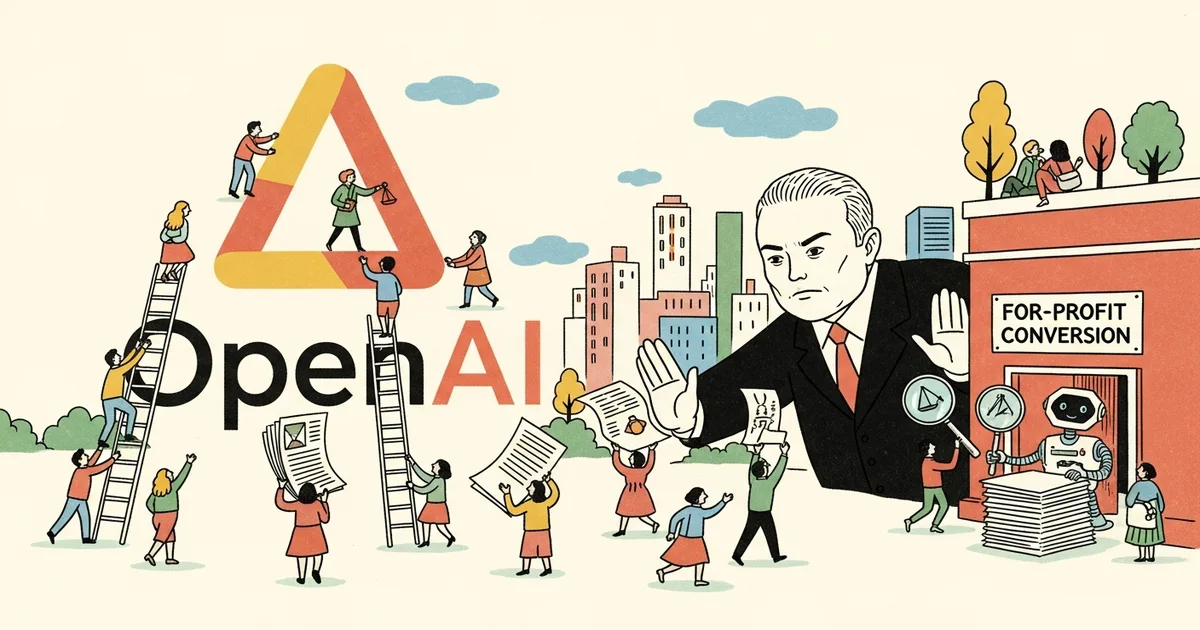
- OpenAI sent letters to the attorneys general of California and Delaware on April 6, 2026, requesting a formal investigation into Elon Musk.
- OpenAI alleges Musk engaged in “improper and anti-competitive behavior” to obstruct its planned conversion from a nonprofit to a for-profit public benefit corporation.
- California and Delaware hold jurisdiction over OpenAI as its state of operations and state of incorporation, respectively, giving both offices standing to act.
- Musk co-founded OpenAI in 2015, departed its board in 2018, and has since operated competing AI lab xAI.
What Happened
OpenAI sent letters on April 6, 2026 to the attorneys general of California and Delaware, asking each office to open an investigation into what the company characterized as “improper and anti-competitive behavior” by Elon Musk, according to a Bloomberg report. The request concerns Musk’s ongoing effort to block OpenAI’s proposed restructuring from a nonprofit entity into a for-profit public benefit corporation. By appealing directly to state regulators, OpenAI is extending a legal dispute that has played out in federal courts since at least early 2024.
Why It Matters
OpenAI’s ability to complete its for-profit conversion is tied directly to its capacity to raise the capital required for frontier model development and infrastructure build-out. Elon Musk co-founded OpenAI in 2015 alongside Sam Altman and others, resigned from its board in 2018, and launched competing AI lab xAI in 2023. He subsequently filed legal challenges in federal court seeking to halt the conversion, arguing the restructuring would violate OpenAI’s founding charitable mission. OpenAI has maintained in prior legal filings that Musk’s opposition is motivated by competitive interest rather than philanthropic concern for the nonprofit’s original purpose.
Technical Details
California and Delaware each hold distinct legal authority over OpenAI: Delaware is the state of incorporation, and California is the state of primary operations, with both attorneys general carrying oversight power over nonprofit organizations and their conversion processes. OpenAI’s framing of Musk’s conduct as both “improper” and “anti-competitive” places the allegations within a range that could implicate each state’s nonprofit governance statutes as well as unfair competition law. The California Attorney General previously signaled scrutiny of OpenAI’s conversion plan in 2024, with the office examining whether the nonprofit’s charitable assets would be fairly valued during the transition to a capped-profit structure. OpenAI’s state-level request runs parallel to, and is legally distinct from, the federal civil litigation already pending in court.
Who’s Affected
OpenAI’s institutional investors have the most immediate stake in the conversion’s outcome: Microsoft has committed more than $13 billion to the company across multiple funding rounds, with portions of that investment structured to convert under the new for-profit entity. Employees and early backers holding equity under OpenAI’s existing capped-profit structure would also face uncertainty from any regulatory delay or legal injunction that stalls the restructuring. Competing AI organizations, including Anthropic and Google DeepMind, may face indirect consequences if the proceedings establish legal precedents governing how a nonprofit’s former co-founders can contest a structural transformation.
What’s Next
As of April 7, 2026, neither the California nor Delaware attorney general had issued a public response to OpenAI’s letters. OpenAI’s parallel federal lawsuit against Musk, active since 2024, continues independently and is not resolved by any state-level inquiry. If either attorney general opens a formal investigation, it would introduce a new regulatory dimension to the dispute and could affect the timeline for closing OpenAI’s for-profit conversion, which has already faced repeated legal delays.