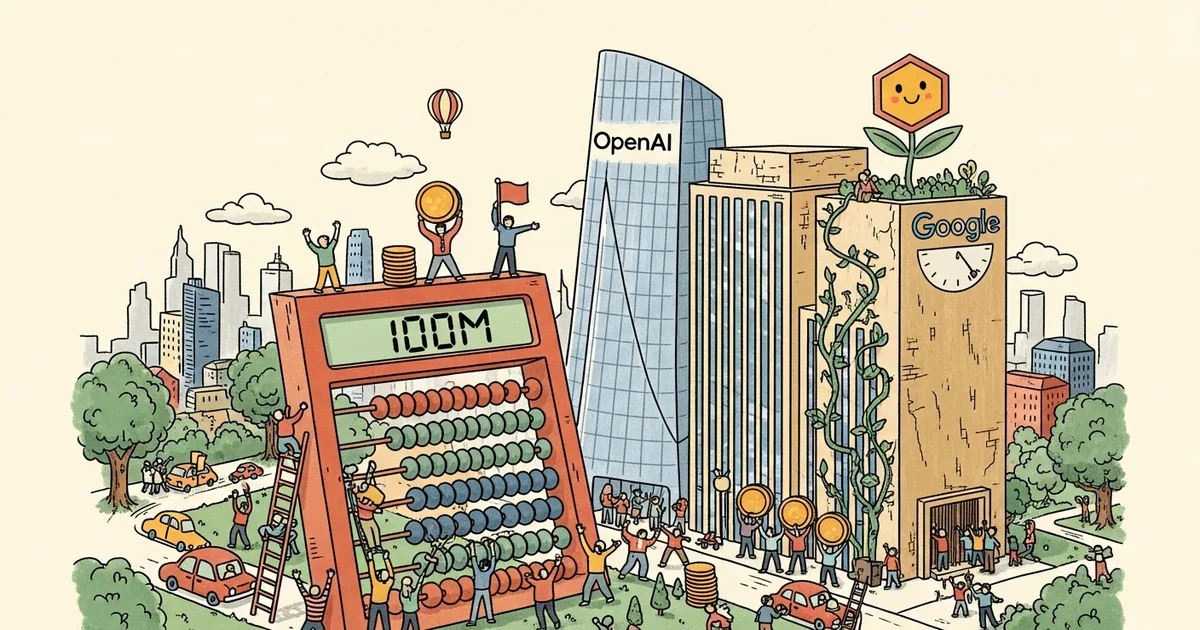
- OpenAI’s ChatGPT advertising pilot surpassed $100 million in annualized revenue (ARR) in under six weeks after launching on February 9, 2026.
- Ads appear at the bottom of ChatGPT responses for free and Go-tier users in the US, clearly labeled as “Sponsored” and walled off from influencing the AI’s answers.
- Amazon has committed $50 billion to OpenAI in a deal that includes a $35 billion tranche contingent on an OpenAI IPO or an AGI milestone.
- OpenAI is extending the pilot internationally and plans to launch self-serve advertising tools in April 2026, dropping the current $200,000 minimum commitment.
What Happened
OpenAI’s advertising pilot reached an annualized revenue run rate above $100 million in roughly six weeks, according to The Information. The company launched its first paid ad placements inside ChatGPT on February 9, 2026, initially restricting them to logged-in adult users on its free and $8-per-month Go tiers in the United States. The $100 million ARR figure was reported publicly on March 26, 2026.
The pilot launched with participation from major holding companies. Omnicom confirmed that more than 30 of its clients entered the program at launch, alongside WPP and other agency partners. OpenAI is now working with more than 600 advertisers in total, per CNBC.
Why It Matters
The speed of the revenue ramp has no direct parallel in the history of digital advertising. Google launched AdWords in October 2000 and generated approximately $70 million in its first full year; it took several more years before the platform crossed $100 million in annualized revenue from a standing start. OpenAI covered that distance in six weeks with a product still in controlled testing.
The milestone arrives at a moment when AI-driven search is beginning to redirect high-intent queries away from Google. eMarketer projects that AI-driven search advertising spending in the United States will rise from roughly $1.1 billion in 2025 to $26 billion by 2029, a trajectory that would position ChatGPT as a structurally significant rival to Google’s core search ad business.
Technical Details
Ads inside ChatGPT appear in a dedicated, tinted box at the bottom of the AI’s response, visually separated from the organic answer and labeled “Sponsored,” per OpenAI’s Help Center. They are triggered by the topic of the active conversation rather than third-party tracking cookies or browsing history. OpenAI states that ads do not influence ChatGPT’s answers and that user conversation data is not shared with advertisers.
Roughly 85 percent of OpenAI’s free and Go users in the US are eligible to see ads, but fewer than 20 percent are shown them on any given day. Users under 18 are excluded entirely, as are conversations touching politics, health, and mental health. The current entry price for advertisers is $200,000, which has kept smaller buyers out; a self-serve tier with no minimum is scheduled to open in April 2026, according to The Keyword.
Early performance data shows ChatGPT cost-per-click running 30 to 60 percent above comparable Google Search keywords, reflecting the deeper engagement context — users querying ChatGPT are typically in active problem-solving mode rather than passive browsing, according to ALM Corp’s analysis.
Who’s Affected
Advertisers currently on Google Search and Meta are the most directly affected. Early agency reporting describes budget reallocation from existing “guaranteed performance” channels toward ChatGPT as a test-and-learn line item, with some agencies expanding experimental budgets toward 25 percent of total spend to accommodate AI placements, per Digiday. The $200,000 pilot floor has so far limited participation to enterprise brands and agency-managed accounts.
Free and Go-tier ChatGPT users in the US are now seeing sponsored placements in a portion of their sessions. Paid subscribers — Plus ($20/month), Pro ($200/month), Enterprise, Business, and Education accounts — remain ad-free. OpenAI said in January that it had seen no negative movement in privacy-related trust metrics among users exposed to ads.
Alphabet faces competitive pressure on two fronts simultaneously: ChatGPT is drawing users away from Google Search while also now competing for the advertising dollars that Google Search generates. Sam Altman wrote on X in January: “We will not accept money to influence the answer ChatGPT gives you, and we keep your conversations private from advertisers,” framing the ad model as structurally distinct from search advertising.
What’s Next
OpenAI is extending the pilot beyond its original April end date and has begun testing in Canada, Australia, and New Zealand, per CNBC. The self-serve advertising manager, expected in April 2026, will open the platform to small and medium-sized businesses; approximately 80 percent of SMBs surveyed have expressed interest in ChatGPT ad placements, held back only by the current minimum spend threshold.
The ad business is developing alongside a major capital restructuring. Amazon committed $50 billion to OpenAI in a deal announced in February 2026 as part of a $110 billion funding round that also included $30 billion each from Nvidia and SoftBank, against a $730 billion valuation. The Information reported that $35 billion of Amazon’s $50 billion is contingent on OpenAI completing an IPO or reaching a defined AGI milestone — a clause unusual enough that its existence drew public comment. OpenAI is targeting a public listing in the fourth quarter of 2026, per Techi, at a projected valuation near $1 trillion.
Whether the $100 million ARR figure reflects durable demand or early advertiser novelty spending will become clearer once the self-serve tier opens and volume-level pricing data is available. eMarketer analysts have noted that doubts remain about whether ChatGPT’s conversational ad format can scale to the click volumes that underpin Google’s and Meta’s ad economics.