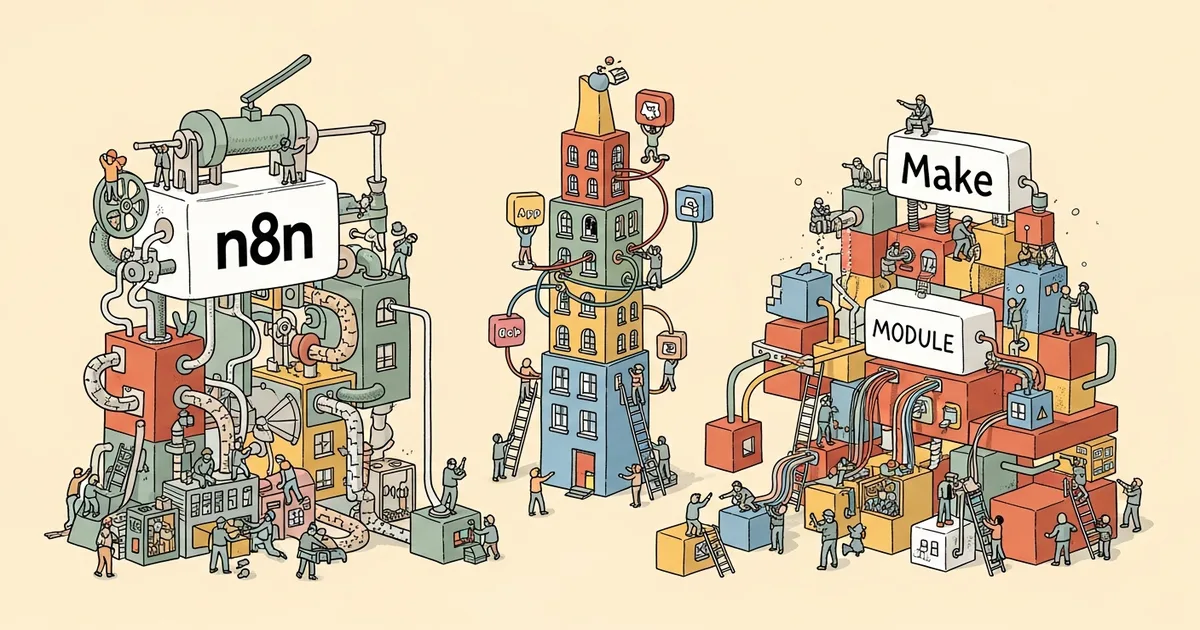
In April 2026, three platforms dominate AI workflow automation: n8n (open-source, self-hostable, 700+ integrations), Zapier AI (the SaaS market leader with 7,000+ integrations and an estimated 60% category share according to G2’s 2026 Automation Category Report), and Make (formerly Integromat, acquired by enterprise software firm Celonis in 2022, now at 2,000+ integrations). MegaOne AI tracks 139+ AI tools across 17 categories — workflow automation is among the fastest-moving. After stress-testing all three on identical multi-step sequences involving LLM calls, data routing, and webhook handling, the verdict is nuanced: each platform wins on a different dimension.
The short version: n8n wins on cost and AI agent depth for developers who self-host. Zapier wins on ecosystem breadth and zero-friction setup for non-technical teams. Make sits in a productive middle ground for agencies. What follows is the data behind those conclusions.
The Three Platforms at a Glance
n8n launched in 2019 under a fair-code license — technically open-source but with commercial restrictions on building managed SaaS products on top of it. Self-hosting is genuinely free with no execution limits. As of Q1 2026, n8n reports over 400,000 active community users and 70,000+ GitHub stars, with 847 commits shipped to the main repository in 2025 alone. The cloud offering adds managed hosting, but the real value proposition for cost-conscious teams is running their own instance.
Zapier AI has been the category default since 2012. The additions of AI Actions, Copilot (natural language workflow creation), and Agents (autonomous task execution) in 2025 meaningfully expanded what non-developers can build. Zapier reports over 2 million AI-assisted automations created via Copilot as of Q1 2026. The integration breadth remains the platform’s decisive advantage — if your tool exists, Zapier almost certainly connects to it.
Make differentiates on its visual scenario builder: a flowchart-based interface that’s more granular than Zapier’s linear step structure and more accessible than n8n’s node graph. The Make.com pricing model charges per operation (each module execution) rather than per task or execution — an architectural choice that makes complex multi-step workflows significantly cheaper than Zapier at medium volumes.
Head-to-Head: The Full Comparison Table (2026)
| Feature | n8n | Zapier AI | Make |
|---|---|---|---|
| Licensing model | Open-source (fair-code) | Proprietary SaaS only | Proprietary SaaS (Enterprise on-prem beta) |
| Self-host availability | Yes — Docker, npm, Kubernetes Helm charts | No | Enterprise beta only (requires sales) |
| Total integrations | 700+ native + 3,200+ community nodes | 7,000+ | 2,000+ |
| AI / LLM actions | LangChain nodes, OpenAI, Anthropic, custom AI agent chains, RAG pipelines | AI by Zapier (100+ AI steps), Copilot NL builder, Agents product, MCP integration | OpenAI, Anthropic, Gemini modules; basic AI text steps |
| Free tier | Unlimited executions (self-hosted) | 100 tasks/month | 1,000 operations/month |
| Paid entry price | $20/mo (2,500 executions, cloud) | $29.99/mo (750 tasks) | $10.59/mo (10,000 operations) |
| Cost per 100K tasks/month | $0–$30 (self-host infra only); ~$640 (cloud Enterprise) | $390–$780 (Professional/Team plans) | $50–$100 (Work plan) |
| Flow paradigm | Node graph — complex but maximally flexible | Linear step-by-step Zap builder | Visual scenario flowchart |
| Custom code support | Full JS and Python nodes (npm packages, pip installs) | Code by Zapier (JS/Python — sandboxed, no external HTTP) | HTTP module + custom formula language; no raw code execution |
| Webhook support | Full — incoming/outgoing, polling, custom headers | Yes — webhook triggers and actions | Yes — custom webhooks, instant triggers |
| Error handling | Dedicated error workflows, retry logic, full execution logging | Basic — task history, manual retry via dashboard | Error handlers, rollback routes, configurable retry intervals |
| Version control | Full Git-backed workflows (self-host); workflow history on cloud | Zap version history — limited rollback | Scenario versioning on paid plans |
| Learning curve | Steep — developer-oriented; CLI and JSON familiarity assumed | Gentle — non-technical teams productive in hours | Moderate — visual but logic-heavy for complex flows |
| Enterprise features | SSO, audit logs, custom auth, air-gapped deployment | SSO, shared workspaces, admin controls (Teams/Company plans) | SSO, team management, scenario locking (Work/Enterprise) |
| API / raw HTTP access | Full HTTP node — any REST, GraphQL, SOAP endpoint | Webhooks by Zapier; limited raw HTTP without code step | Universal HTTP module — full header/auth/body control |
AI-Native Capabilities: Who Actually Built AI In
All three platforms added AI features in 2025, but the architectural depth varies significantly. Zapier AI went furthest in the no-code direction: its Copilot feature generates complete Zap workflows from a natural language description, and its Agents product creates autonomous AI agents capable of taking real-world actions — booking meetings, parsing inbound email, triggering downstream workflows. The February 2026 Zapier MCP integration allows AI models to directly trigger Zapier automations via the Model Context Protocol, making Zapier a callable tool within agent systems — architecturally significant as AI agents increasingly need programmatic access to automation infrastructure, a dynamic visible in Anthropic’s own agent infrastructure work.
n8n’s AI integration is composable and technically deeper. Its LangChain node cluster lets you chain LLMs, memory stores (Pinecone, Postgres pgvector, Supabase), vector databases, and tool-calling agents in a single workflow. A RAG pipeline, a multi-step autonomous agent with tool use, or a conditional LLM routing chain — all buildable without leaving n8n. The trade-off is transparency: you need to understand what you’re constructing.
Make’s AI additions are more modular than architectural. Direct connectors to OpenAI GPT-4o, Anthropic Claude 4, and Google Gemini 2.0 work cleanly within existing scenarios. What Make lacks is the agent abstraction layer — there’s no equivalent to Zapier Agents or n8n’s agentic chains. For teams using AI for discrete transformations (summarize this email, classify this ticket, extract these fields), Make’s approach is sufficient and well-integrated.
Platform feature convergence in AI automation mirrors a pattern seen across the AI tool market in 2026. In AI video tools, similar consolidation is playing out — ElevenLabs, HeyGen, and Synthesia all added overlapping capabilities, but deep technical differentiation persisted underneath the surface similarities. The same dynamic is at work here.
Pricing Reality: Cost Per 100K and 1M Tasks
Pricing architecture matters more than headline rates. n8n charges per execution (one completed workflow run). Zapier charges per task (each individual step action within a Zap). Make charges per operation (each module execution). A single 8-step workflow costs 1 execution on n8n, 8 tasks on Zapier, and 10 operations on Make. Same automation, radically different cost at volume.
Cost to run 100,000 task-equivalents per month:
- n8n self-hosted: $0–$30/mo (VPS infrastructure cost only — 2 vCPU, 4GB RAM handles this volume)
- n8n cloud: ~$640/mo (Enterprise tier required at this volume)
- Zapier Professional/Team: $390–$780/mo depending on average steps-per-Zap complexity
- Make Work plan: $100–$200/mo (operation model compresses cost significantly at moderate volume)
Cost to run 1 million task-equivalents per month:
- n8n self-hosted: $50–$150/mo in infrastructure (Redis + Postgres for queue mode)
- Zapier: $2,000–$5,000+/mo — enterprise negotiation required above 1M tasks
- Make Enterprise: Custom pricing, typically $500–$1,200/mo based on reported agency contracts
The n8n self-host cost advantage at 1M tasks is not marginal — it runs 10x–30x cheaper than Zapier. This is the core driver of enterprise migration to n8n among technical teams. The calculation shifts if you factor in DevOps overhead: server provisioning, monitoring, updates, and the occasional 2am incident. Zapier and Make eliminate that entirely. For teams without an engineer who owns infrastructure, the managed premium is often rational.
Self-Hosting Reality: n8n’s Differentiator
n8n’s self-hosting story is production-grade. The Docker image deploys in under 10 minutes. Official Helm charts support Kubernetes with autoscaling. Queue mode — enabled via Redis and PostgreSQL — handles high-concurrency workflows with horizontal scaling. The community offers 1,200+ workflow templates covering common use cases from CRM sync to Slack alerting to AI document processing.
The compliance argument for self-hosting is concrete: healthcare organizations under HIPAA and financial firms under SOC 2 constraints keep all workflow execution data, credentials, and logs on their own infrastructure. No API calls leave the network boundary. Neither Zapier nor Make can make that offer on standard plans. Make’s on-premises offering entered enterprise beta in Q1 2026 but requires a direct sales engagement — it is not a self-service option.
Infrastructure costs for a self-hosted n8n instance at 500,000 executions/month run approximately $30–$80/mo on a dedicated VPS. Cloud compute pricing has continued its deflationary trajectory — Nebius’s $10B AI data center build in Finland is one signal of continued capacity investment that puts downward pressure on compute costs through 2027.
Developer Flexibility: Code, APIs, and Custom Nodes
n8n’s custom node system has no practical ceiling for developers. Any npm package runs inside JavaScript execution nodes. Python support (added in 2024) covers the full standard library plus pip-installable packages. The 3,200+ community-published nodes extend the integration surface far beyond the official 700 — covering niche APIs, internal tooling, and emerging platforms that Zapier’s larger team has not yet prioritized. Entire workflow suites version-control cleanly in Git, and the n8n API supports programmatic workflow management for teams building internal tooling.
Zapier’s “Code by Zapier” step executes JavaScript and Python but sandboxes execution severely: no external HTTP requests from code, no file system access, 1-second runtime limit. It handles data transformation tasks well — reformatting strings, computing values, parsing JSON — but is unsuitable for building complex custom logic or calling internal APIs. The Zapier MCP integration announced in early 2026 is more architecturally interesting: it allows AI agents to invoke Zapier actions as tools, connecting the Zap ecosystem to the emerging agentic layer.
Make’s universal HTTP module handles arbitrary REST and GraphQL calls without code, which covers the majority of developer use cases without writing a line. For data transformation, Make uses a custom formula language (similar to spreadsheet functions) that is powerful for non-developers but non-standard for engineers. Custom Make app modules require working within Make’s app manifest format — more accessible than building n8n custom nodes from scratch, but less composable for complex scenarios.
Best For: Matching Platform to Use Case
Marketers and non-technical teams: Zapier AI is the clear answer. The 7,000+ integrations mean the entire martech stack — HubSpot, Salesforce, Mailchimp, Notion, Slack, Google Ads, Intercom — is covered natively. AI Copilot removes the workflow design barrier entirely; teams that previously needed a RevOps engineer to configure automations now ship them without one. At under 10,000 tasks/month, the cost premium over Make is modest ($30–$100/mo), and the time savings from avoiding a developer engagement justify the difference.
Developers and technical teams: n8n, self-hosted. The economics are decisive at scale. The LangChain-based AI agent capabilities surpass both competitors in composability and depth. Git version control of workflows is a genuine operational requirement for teams treating automation as code. The setup friction is a one-time cost — not a recurring one.
Agencies managing client workflows: Make. The scenario-based organization maps naturally to per-client separation. Pricing per operation rather than per task rewards the complex multi-step workflows agencies typically build. Make’s visual flowchart interface is presentable in client reviews. Team management and scenario versioning handle the operational complexity of maintaining 20–50 distinct client automation environments simultaneously — a use case neither Zapier’s linear Zaps nor n8n’s node graphs serve as cleanly.
The tendency to frame one platform as “best for everyone” is the same overclaiming pattern that weakens most SaaS vendor positioning. The Humans First movement’s critique of AI platforms applies here too: tools optimized for every user simultaneously tend to serve none of them optimally. The honest answer is segmentation.
Verdict
Pick n8n if you have at least one technical team member, your task volume exceeds 50,000/month, and you care about data residency or AI agent composability. The self-host cost advantage is structural, not incidental — it does not disappear as you scale.
Pick Zapier AI if you’re a small team or solo operator who needs automations running in a day. The integration breadth is unmatched: 7,000+ connectors mean your niche CRM, your legacy ticketing system, and your email platform are almost certainly covered. AI Copilot delivers real productivity gains for non-developers — 2 million AI-generated workflows is a credible signal of adoption, not marketing noise.
Pick Make if you’re an agency or power user who wants visual control at lower cost than Zapier for medium volumes (10,000–500,000 operations/month). Make’s pricing model is the most rational at that tier, and its scenario builder is the most client-friendly interface of the three.
MegaOne AI tracks 139+ AI tools across 17 categories. In workflow automation, the feature gap between these three is narrowing on the surface while the underlying architectural differences — open-source vs. SaaS, per-task vs. per-operation billing, composable AI vs. point-and-click AI — are becoming more consequential as usage scales. The platforms that win through 2027 will reduce per-execution cost while expanding agent-native depth. Right now, n8n’s self-host model has the structural cost advantage; Zapier has the distribution advantage. Make has the pricing model that makes most sense in the middle.
FAQ: n8n vs Zapier vs Make 2026
Is n8n actually free?
The self-hosted version is free with no execution limits under n8n’s fair-code license for personal and internal business use. Building a commercial SaaS product on top of n8n requires a commercial license. The cloud offering starts at $20/month.
What is the main reason to choose Zapier over n8n in 2026?
Integration breadth (7,000+ vs 700+) and zero setup friction. If your automation depends on a niche SaaS tool — a regional CRM, a specific payments platform, a legacy HR system — Zapier is statistically 10x more likely to have a native integration than n8n.
Is Make cheaper than Zapier at scale?
Yes, significantly at medium volume. Make’s operation-based pricing at 10,000–100,000 ops/month runs 50–70% cheaper than equivalent Zapier task volumes on comparable plans, primarily because Make counts each module execution once rather than each step as a separate billable task.
Can n8n handle real AI agent workflows in 2026?
Yes. n8n’s LangChain node cluster supports multi-step agentic workflows with tool calling, persistent memory, RAG pipelines, and conditional LLM routing. It is the most technically capable of the three platforms for complex AI agent construction — at the cost of a steeper learning curve.
Does Make offer self-hosting?
Make’s on-premises deployment is in enterprise beta as of April 2026. It requires a direct enterprise sales engagement and is not available on standard plans. It is not a self-service option comparable to n8n’s Docker deployment.
How does Zapier AI differ from standard Zapier?
Zapier AI adds natural language workflow creation via Copilot, 100+ AI-powered action steps for data transformation and generation, and an Agents product for autonomous multi-step task execution. Core Zap functionality is unchanged — the AI features are additive. The February 2026 MCP integration further extends Zapier into the agent-native ecosystem by allowing AI models to invoke Zaps directly as tools.