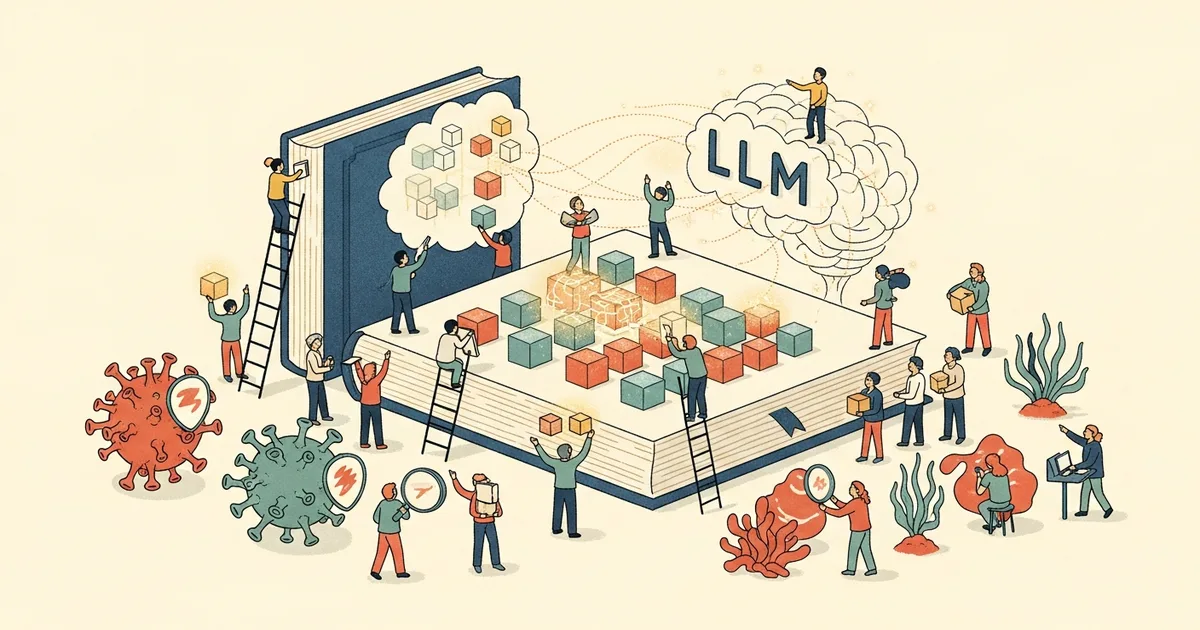
- Los Alamos National Laboratory researchers used ChatGPT and Grok to build comprehensive databases of medical countermeasures for five dangerous viruses and marine toxins.
- The system employs agentic AI workflows with two specialized agents — one for research, one for decision-making — to rank potential treatments.
- Databases cover Lassa, Marburg, Ebola, Nipah, and Venezuelan equine encephalitis viruses, filling a gap in publicly available biodefense resources.
- The LLMs automatically identified public data sources, cross-validated information across them, and generated interactive web interfaces for the resulting databases.
What Happened
A team at Los Alamos National Laboratory has demonstrated that large language models can systematically build and maintain knowledge databases for medical countermeasures against biological threats. The paper, posted to arXiv on March 31, 2026 (report number LA-UR-26-22203), describes how researchers Hung N. Do, Jessica Z. Kubicek-Sutherland, and S. Gnanakaran used ChatGPT and Grok to create comprehensive therapeutic databases for five viruses — Lassa, Marburg, Ebola, Nipah, and Venezuelan equine encephalitis — as well as several marine toxins.
The core problem the team addresses is straightforward: no single comprehensive database currently curates countermeasure data for these pathogens and toxins. Decisions about medical countermeasures during outbreaks depend on scattered, inconsistent sources — slowing response times when speed matters most.
Why It Matters
Biodefense preparedness relies on having up-to-date, accessible information about available treatments. The five viruses selected for this study are all classified as high-priority biological threats, and marine toxins present additional challenges due to their diverse mechanisms of action. Existing databases tend to be siloed by pathogen or by type of countermeasure, making cross-referencing difficult for researchers and decision-makers.
The work fits into a broader pattern of applying LLMs to scientific knowledge management. Earlier efforts, such as Google DeepMind’s use of Gemini for protein structure prediction and Microsoft’s BioGPT for biomedical literature mining, have shown that language models can accelerate literature review and data synthesis. The Los Alamos approach goes further by automating the full pipeline from data discovery through validation to interactive presentation.
Technical Details
The researchers designed a multi-step pipeline where the LLMs first identify public databases containing relevant data on the target pathogens and toxins. The models then collect information from these databases and the published literature, iteratively cross-validating the collected data to catch errors and fill gaps. As the authors describe it, the LLMs serve as “a scalable, updatable approach for building comprehensive knowledge databases and supporting evidence-based decision-making.”
A key technical contribution is the agentic AI workflow architecture. The system uses two specialized AI agents: one focused on research — scanning sources, extracting structured data, and flagging inconsistencies — and a second focused on decision-making, which ranks countermeasures based on the compiled evidence. This two-agent design separates information gathering from evaluation, reducing the risk of confirmation bias in the ranking process.
The final outputs include interactive webpages that allow users to browse and query the curated databases. This interface layer addresses a practical gap: raw database dumps are difficult for non-specialist decision-makers to navigate during time-sensitive situations.
Who’s Affected
The primary audience is biodefense researchers and public health officials who need rapid access to countermeasure options during disease outbreaks. The five viruses covered are all Category A or B biological threat agents, making this work directly relevant to agencies like BARDA (Biomedical Advanced Research and Development Authority) and the Department of Defense’s Chemical and Biological Defense Program.
The approach also has implications for pharmaceutical researchers evaluating treatment pipelines, and for the broader AI-for-science community exploring how agentic workflows can automate knowledge curation tasks that traditionally require months of manual expert review.
What’s Next
The paper demonstrates feasibility but leaves several questions open. The cross-validation step depends on the LLMs’ ability to detect factual errors — a capability that remains inconsistent across models and domains. Scaling to additional pathogens or to rapidly evolving threats like novel influenza strains would test whether the pipeline can maintain accuracy under higher data velocity.
The researchers have not yet published the interactive databases publicly. Whether the curated data will be made available as an open resource — and how frequently it will be updated — will determine the practical impact of the work beyond the proof of concept described in the paper.