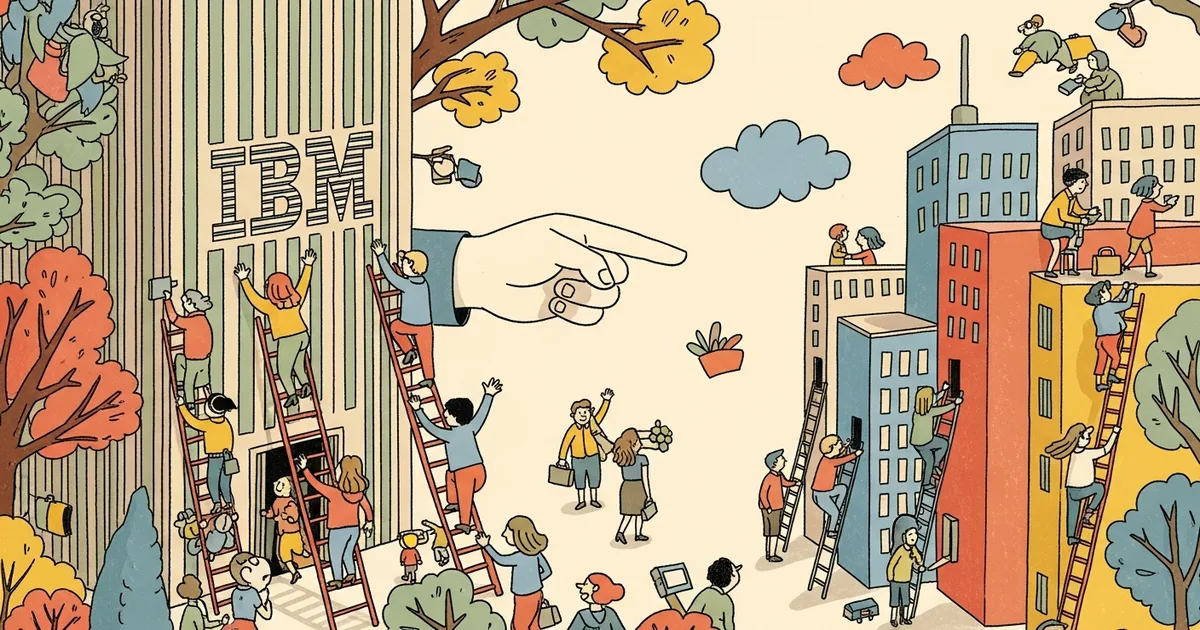
International Business Machines Corporation (IBM) tripled its entry-level hiring in Q1 2026 — a deliberate expansion while 193 tech companies cut a combined 78,557 positions in the same period, per tracking by Layoffs.fyi. IBM entry-level hiring in 2026 is the most significant counter-trend talent decision in enterprise technology. The company’s reasoning is not altruistic — it’s architectural: reliable AI deployment requires humans trained alongside the systems from day one.
This is not IBM hedging against automation criticism with a feel-good employment announcement. Every role in this expansion is designed to operate inside AI-augmented workflows — not people who learn to use AI tools after the fact, but people who start their careers embedded within them.
The Quarter in Numbers
Tech sector job cuts in Q1 2026 reached 78,557 across 193 companies, per Challenger, Gray & Christmas industry tracking. Entry-level positions bore a disproportionate share: junior roles in software engineering, product management, and data analysis were eliminated at rates above the sector average as companies cited AI-driven automation as the primary restructuring rationale. For recent graduates, the hiring market contracted to its narrowest point in over a decade.
IBM moved opposite. The company employs approximately 288,000 people globally; tripling entry-level intake represents a commitment measured in thousands of new positions. IBM has framed the expansion as an AI workforce readiness program — hiring not despite AI capability, but specifically to deploy that capability inside client environments from a new hire’s first week on the job.
What IBM Is Actually Hiring For
IBM’s entry-level expansion concentrates in four functional areas:
- AI systems integration — deploying large language models and enterprise AI pipelines inside existing client workflows
- Data engineering — pipeline integrity, data quality oversight, and regulatory compliance infrastructure
- Consulting delivery — on-site execution of IBM’s AI transformation engagements at Fortune 500 clients
- Hybrid cloud infrastructure — the technical layer beneath IBM’s watsonx and cloud AI stack
These are not the routine coding tasks that tools like GitHub Copilot have demonstrably compressed. They sit at the intersection of AI output and human judgment — roles requiring organizational context, stakeholder communication, and iterative calibration that current AI systems cannot reliably execute end-to-end.
The consulting positions are the most telling signal. IBM Consulting generated over $5 billion in revenue in Q4 2025. Every enterprise AI transformation IBM sells requires human delivery capacity at client sites. Junior consultants trained natively in IBM’s toolset — watsonx, OpenScale, and the broader data stack — are how IBM scales delivery against a growing contract backlog without proportionally scaling senior headcount costs.
The AI-Still-Needs-Humans Argument
IBM’s core thesis: AI amplifies judgment, but requires human scaffolding at every functional layer of the enterprise stack. This is not a new argument — but IBM is the first major employer to operationalize it at scale through hiring strategy rather than white papers and policy statements.
Enterprise AI research consistently finds that human-AI hybrid workflows outperform fully autonomous approaches in complex, context-dependent tasks. The Stanford Human-Centered AI Institute’s 2025 AI Index documents persistent failure rates in AI-only decision pipelines across regulated industries. In financial services, healthcare, and legal domains — IBM Consulting’s primary markets — those failure rates carry material financial and liability consequences, not just technical inconvenience.
There is also the model calibration problem. AI systems require continuous human feedback to remain accurate as markets, regulations, and organizational contexts shift. IBM’s entry-level hires are not merely executing tasks — they are generating the feedback loops that keep AI systems calibrated over time. That is a qualitatively different function than the entry-level coding roles that large language models have compressed, and it cannot itself be automated without compounding the accuracy problem it is meant to solve.
The Humans First movement has documented that AI deployments without adequate human oversight layers produce fragile, error-prone systems in production environments. IBM appears to have internalized this critique operationally rather than rhetorically.
Microsoft, Meta, and Google: The Other Side of the Ledger
The contrast with IBM’s primary competitors is direct. Microsoft, Meta, and Google each announced significant headcount reductions in Q1 2026, cuts concentrated in product management, junior engineering, and roles identified as candidates for AI-driven automation. All three simultaneously committed to AI infrastructure spending at record levels — Microsoft at $80 billion through 2025–2026, Meta guiding $60–65 billion in 2026 capital expenditure, Google’s parent Alphabet at comparable scale.
The strategic logic is consistent across all three: replace human labor costs with capital investment in AI systems, betting that frontier AI capabilities will compress junior human labor needs faster than enterprise demand can absorb. Infrastructure investment of this magnitude reflects conviction that compute, not people, is the binding constraint on AI capability.
IBM’s bet runs the opposite direction — that expanding AI capability creates proportionally more demand for human AI operators in enterprise deployment contexts, not less. The table below quantifies the divergence:
| Company | Q1 2026 Hiring Direction | AI Capex Commitment | Entry-Level Approach |
|---|---|---|---|
| IBM | +300% entry-level intake | $37B (2025–2026) | AI-native workforce from day one |
| Microsoft | Net contraction | $80B (2025–2026) | Junior PM and engineering reduction |
| Meta | Net contraction | $60–65B (2026) | Reality Labs and infrastructure cuts |
| Net contraction | $75B+ (2026) | Cloud and consumer apps reduction |
IBM’s Long Game: Why Entry-Level Is a Strategic Asset
IBM’s hiring bet operates on a 5-to-7-year horizon. Entry-level hires in 2026 become mid-level AI specialists by 2030 — professionals who understand AI not as an external tool bolted onto their workflow, but as a native component of how work gets done. That cohort carries different, more durable value than experienced staff re-trained after the transition curve has already steepened.
IBM has navigated structural transitions before. The company’s shift from hardware to services in the 1990s required a decade-long rebuild of its talent base at the junior level — a painful process that ultimately produced the consulting and software business defining IBM today. Current leadership appears to be betting on hiring ahead of demand rather than scrambling to re-skill existing staff once AI deployment becomes table stakes across enterprise clients.
There is also a talent market dynamic IBM is exploiting with clear-eyed precision. With Google, Microsoft, and Meta all contracting junior hiring simultaneously, entry-level candidates from strong engineering programs face fewer options than at any point in the past decade. IBM is absorbing that talent at below-peak cost, during a window that closes once competitors stabilize their AI investments and rebuild junior pipelines. The scarcest resource in enterprise AI deployment is not compute or foundation models — it is humans who can bridge the gap between AI output and organizational usability. The most aggressive AI acquirers have understood this for years. IBM is building that capacity organically.
Who Gets This Right?
Neither IBM nor its competitors will have a definitive verdict for several years. But the structural logic favors IBM’s approach in enterprise contexts — complex, regulated, client-facing deployments where AI failure carries real financial and reputational consequences, not just metric degradation on a benchmark leaderboard.
MegaOne AI tracks 139+ AI tools across 17 categories, and the adoption pattern is consistent: tools designed for human-in-the-loop workflows show materially higher enterprise uptake scores than fully autonomous alternatives. IBM’s hiring thesis maps directly onto that adoption reality. The enterprise market is not buying autonomous AI — it is buying AI with human accountability attached.
The one credible risk to IBM’s bet is model capability acceleration. If frontier AI reaches a reliability threshold in the next 18–24 months where enterprise deployment genuinely requires minimal human oversight, IBM’s expanded junior workforce becomes overhead rather than strategic asset. That threshold has not been reached — successive releases of the Stanford AI Index document persistent non-trivial failure rates in AI systems operating on complex enterprise reasoning tasks, and regulated industries remain structurally resistant to full automation regardless of model performance.
Companies eliminating junior roles are optimizing for a future that has not arrived. IBM is hiring for the present one. The talent window IBM is exploiting may close by mid-2027 — which means competitors that cut junior hiring now will face a more expensive rebuild when AI deployment demand forces the issue. IBM’s counter-trend hiring is not generosity. It’s timing.
Related Reading
- Harvard Just Confirmed AI Is Frying Your Brain — Workers Who Use AI Most Are the Most Exhausted [HBR Study]
- He Spent 8 Years Wanting to Build a Project — AI Got It Done in 3 Months
- MCP Just Hit 97 Million Installs — The Protocol Nobody Heard of 18 Months Ago Is Now the Backbone of AI Agents
- MIT’s AI Jobs Study 2026 Debunks the Apocalypse Narrative [Data]