- Researchers posted a paper to arXiv in April 2026 describing Holos, a web-scale LLM-based multi-agent system designed to address scaling and coordination failures in large agent networks.
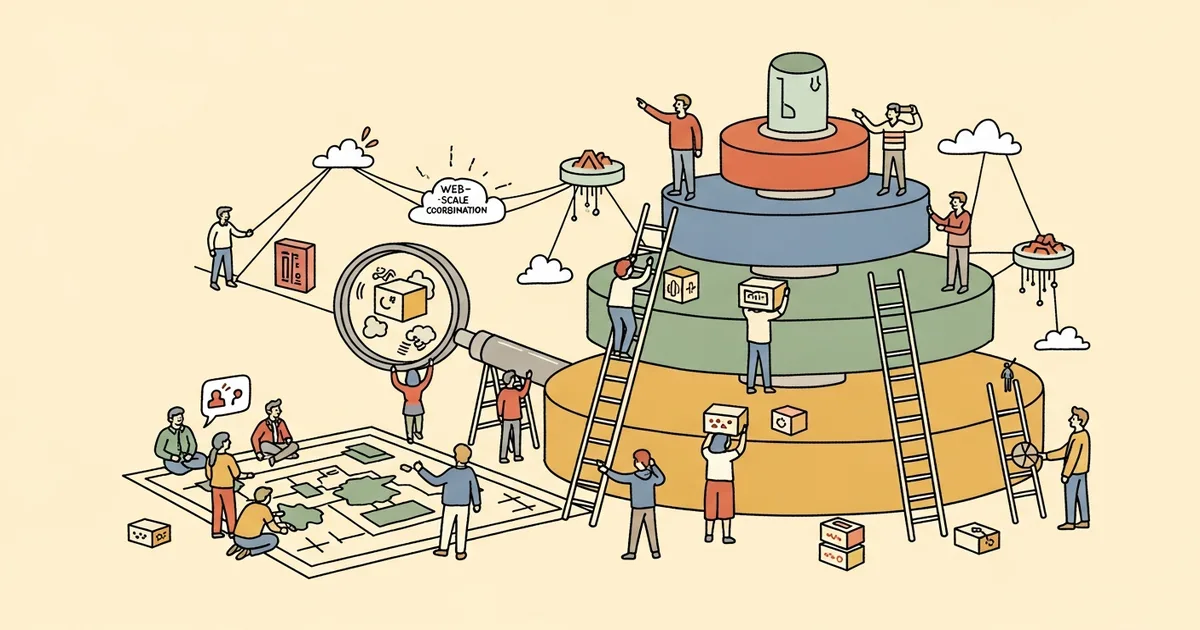
- Holos uses a five-layer architecture with a Nuwa engine for agent generation, a market-driven Orchestrator for coordination, and an endogenous value cycle for incentive alignment.
- The system targets three identified failure modes in existing multi-agent frameworks: scaling friction, coordination breakdown, and value dissipation.
- Holos has been publicly released as an open research testbed for large-scale agentic ecosystem research.
What Happened
Researchers posted a paper to arXiv in April 2026 describing Holos, a web-scale LLM-based multi-agent system (LaMAS) designed to serve as persistent infrastructure for what the authors call the “Agentic Web.” The paper, titled “Holos: A Web-Scale LLM-Based Multi-Agent System for the Agentic Web” (arXiv:2604.02334), identifies three compounding failure modes in current multi-agent LLM frameworks: scaling friction, coordination breakdown, and value dissipation. Holos has been publicly released alongside the paper.
The authors argue that existing frameworks treat agents as isolated task solvers rather than persistent, co-evolving digital entities — a structural mismatch that compounds as agent populations grow. Holos is designed to address that mismatch at the architectural level rather than through incremental improvements to existing coordination protocols.
Why It Matters
The multi-agent LLM space has expanded rapidly since 2024, with frameworks including Microsoft’s AutoGen, LangChain‘s LangGraph, and various commercial orchestration platforms each approaching coordination with different tradeoffs. Most production deployments remain limited to small numbers of agents within tightly constrained pipelines, in part because coordination overhead grows nonlinearly with agent count and because value misalignment between individual agents and system-level objectives is difficult to manage at scale.
Holos positions itself not as a task-completion tool but as ecological infrastructure — designed for continuous, open-ended agent interaction at web scale. The paper introduces the “Agentic Web” as a distinct paradigm: an ecosystem in which heterogeneous agents autonomously interact and co-evolve without requiring human direction for each interaction, analogous in structure to how the current web operates without centralized content arbitration.
Technical Details
Holos adopts a five-layer architecture. Its two primary operational components are the Nuwa engine, which handles high-efficiency agent generation and hosting, and a market-driven Orchestrator responsible for coordination across the agent population. A third core element, the endogenous value cycle, is designed to maintain incentive compatibility — ensuring that agents pursuing individual objectives do not degrade system-level coherence over time.
The market-driven Orchestrator represents a structural departure from hierarchical control approaches used in systems like AutoGen’s GroupChatManager or LangGraph’s state machines. Rather than routing tasks through a fixed control layer, the Orchestrator allows agents to negotiate resource allocation and task assignment dynamically — an approach the authors argue is more robust to open-world variability where agent populations and task spaces are not predetermined.
The paper describes its design goal as bridging “the gap between micro-level collaboration and macro-scale emergence,” targeting system-wide coherent behavior without centralized per-task orchestration. Detailed performance benchmarks against existing frameworks are not included in the abstract and appear only in the full paper text.
Who’s Affected
AI researchers studying multi-agent systems and organizations running large-scale LLM automation pipelines are the primary audience for Holos. Companies building enterprise automation on frameworks such as AutoGen or CrewAI — particularly those encountering reliability degradation as agent counts increase — would find the architectural approach directly relevant. The public release makes the system immediately available for independent evaluation and integration testing.
The endogenous value cycle mechanism also has direct relevance for teams working on agent alignment and incentive design, given its stated purpose of maintaining consistent agent behavior relative to system goals without per-interaction human oversight.
What’s Next
The authors describe Holos as “a resource for the community and a testbed for future research in large-scale agentic ecosystems.” The public release opens the system to independent stress-testing, including evaluation of the market-driven Orchestrator under adversarial conditions and high agent heterogeneity. Whether the endogenous value cycle maintains incentive compatibility at scale beyond the authors’ own internal evaluation will depend on results from subsequent independent research.