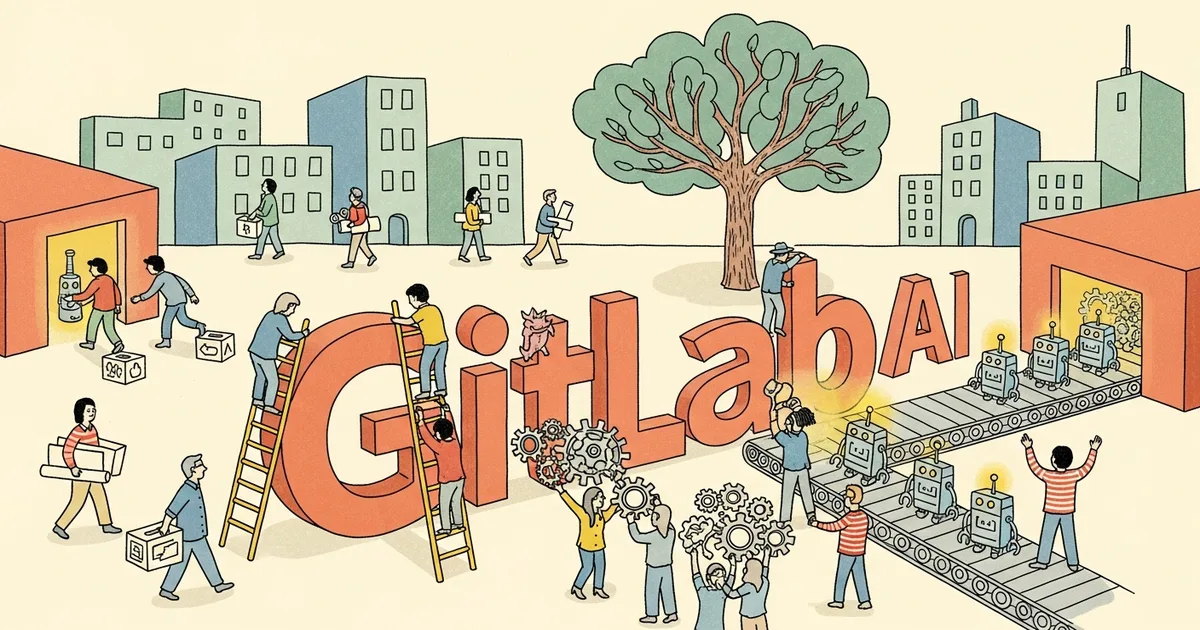
- GitLab announced workforce reductions on May 11 to free capital for investment in agentic-AI products.
- The company framed the moves as a reallocation toward the “agentic era” of software development.
- The cuts add to a 2026 wave of DevOps and developer-tools restructurings prompted by AI-coding workflows.
- GitLab joins Microsoft, Salesforce, Workday, and others that have cited AI productivity gains as a rationale for headcount changes this year.
What Happened
GitLab Inc., the DevOps platform that helps developers manage coding projects, said on Monday that it is cutting jobs to free up capital for investment in artificial-intelligence agents, Bloomberg reported. The company described the moves as a reallocation toward the market opportunity created by autonomous coding agents. GitLab did not disclose the exact headcount reduction in its initial filing.
Why It Matters
GitLab’s restructuring is the latest in a clear 2026 pattern: established enterprise-software vendors are cutting non-AI headcount to redirect spending toward agentic products and infrastructure. Microsoft has restructured its sales organisation twice in 2025–2026 around its Copilot stack; Salesforce executed similar moves tied to Agentforce; Workday paused hiring in mid-2025 citing AI-driven productivity. The GitLab cuts extend the pattern into the pure-play developer-tools category, where competitive pressure from agentic coding products — OpenAI’s Codex CLI, Anthropic’s Claude Code, Cursor, and Cognition’s Devin — has intensified through 2025 and 2026.
Technical Details
GitLab has been building out GitLab Duo, the company’s AI suite, and a newer line of GitLab AI Agents that automate code review, security scanning, and pipeline orchestration. The company has positioned itself as the open-core integrated DevSecOps platform, competing primarily with Microsoft-owned GitHub and Atlassian’s Bitbucket. Revenue mix has been shifting toward larger enterprise customers; the company’s last reported quarter showed continued growth in customers spending more than $100,000 annually. GitLab did not disclose specific revenue or operating-margin guidance with the restructuring announcement.
Who’s Affected
Affected GitLab employees are the immediate group. Competing platforms — GitHub, Atlassian, JetBrains — will read the move as confirming that traditional DevOps headcount no longer scales linearly with revenue when agentic tools handle routine workflows. GitLab’s enterprise customers — including Goldman Sachs, T-Mobile, NVIDIA, and Cisco per the company’s case studies — may see accelerated agent rollouts. GitLab’s investors will look for whether the freed capital produces measurable agent-product revenue in the next two quarterly reports. The cuts also signal to coding-tool startups — Cursor, Replit, Codeium — that incumbents will fight back in the agentic category rather than cede it.
What’s Next
GitLab is expected to provide more detail on the headcount change, revenue impact, and product roadmap in its next quarterly earnings call. The company has not announced a specific timeline for the agent product expansion. Analysts at Bernstein and Morgan Stanley have noted that DevOps platforms are likely to bifurcate in 2026–2027 between agentic-native architectures and traditional Git-hosting plus CI/CD bundles; GitLab is now positioning itself in the former camp. A public response from competitors is expected at this year’s KubeCon and GitHub Universe conferences.