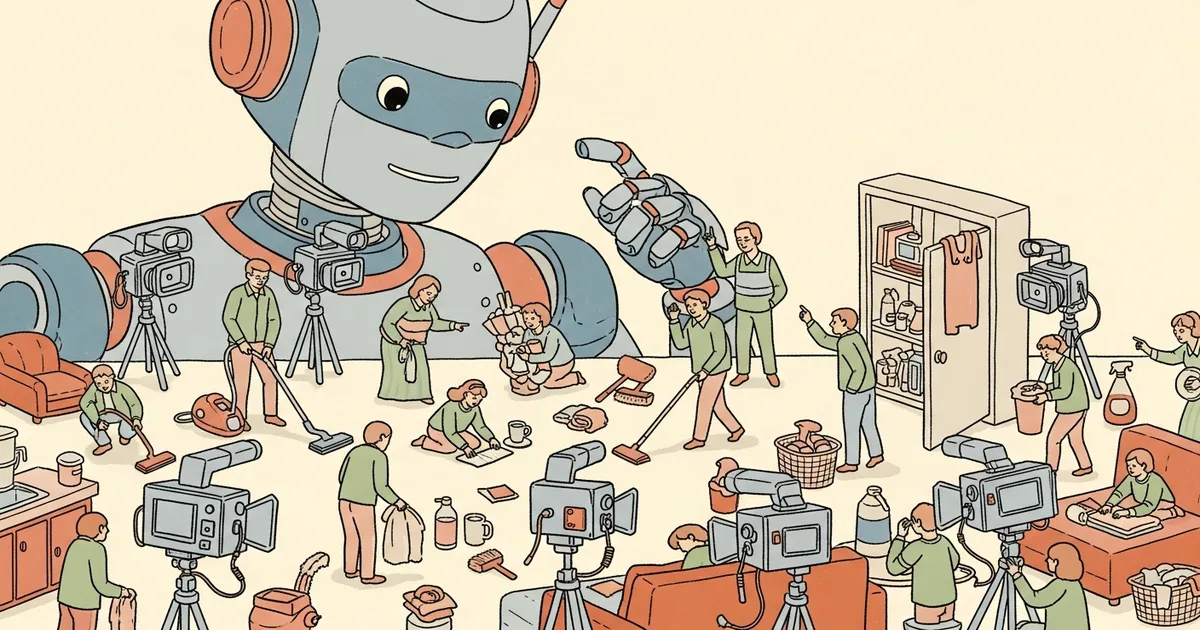
NBC News reports a new app allows couriers and gig workers to earn extra money by filming themselves performing household tasks — cooking, cleaning, folding laundry, organizing — to create training data for AI and robotics models. The pay: approximately $15 per hour. The purpose: teaching robots to do these tasks autonomously.
How It Works
Workers download the app, accept available tasks from a catalog, and film themselves completing them using their phone camera. Each task has specific requirements:
- Camera angles: First-person (mounted) and third-person views required
- Narration: Workers describe what they’re doing and why (providing language labels for actions)
- Repetitions: Each task is performed 3-5 times with variations to capture different approaches
- Environment diversity: The same task in different kitchens, living rooms, and bathrooms provides environmental generalization data
The data quality requirements are precise — shaky footage, poor lighting, or incomplete narration gets rejected. Workers report acceptance rates of 60-70%.
Who Buys the Data
The training data feeds into robotics programs at:
- Tesla (Optimus): Training humanoid robots for household tasks
- Google DeepMind: Training manipulation models for robotic arms
- Figure AI: Developing general-purpose humanoid robots
- Hyundai/Boston Dynamics: Training robots for commercial and residential environments
The robotics industry needs millions of hours of task demonstration data, and traditional approaches — recording data in controlled lab environments with research staff — are too slow and lack environmental diversity. Gig workers in real homes solve both problems.
The Economics of Training Your Replacement
At $15/hour, the economics work for both sides. Workers earn supplemental income from tasks they’d do anyway (cooking, cleaning). Companies get diverse, real-world training data at a fraction of lab recording costs — estimated at $200-500/hour for traditional data collection.
But the philosophical tension is obvious: these workers are being paid to create the exact training data that will teach robots to do their jobs. The courier who films themselves cooking dinner is contributing to a dataset that will eventually enable a robot to cook dinner — potentially replacing human domestic workers.
Scale of the Operation
The app reportedly has over 50,000 active workers across 12 US cities, generating approximately 2 million hours of task footage per month. At this scale, the combined dataset represents the largest collection of real-world household task demonstrations ever assembled.
For context, academic robotics datasets typically contain thousands of hours. This gig-economy approach generates that volume every day.
What This Says About the AI Labor Market
The gig economy has always involved workers performing tasks that technology hadn’t yet automated. This is the first large-scale example of workers explicitly performing tasks in order to automate them. The difference matters: it changes the relationship between labor and technology from “humans do what machines can’t” to “humans teach machines to do what humans currently do.”
The $15/hour rate will look different when the robots these workers are training start displacing domestic service jobs, which currently employ millions of workers in the US alone.