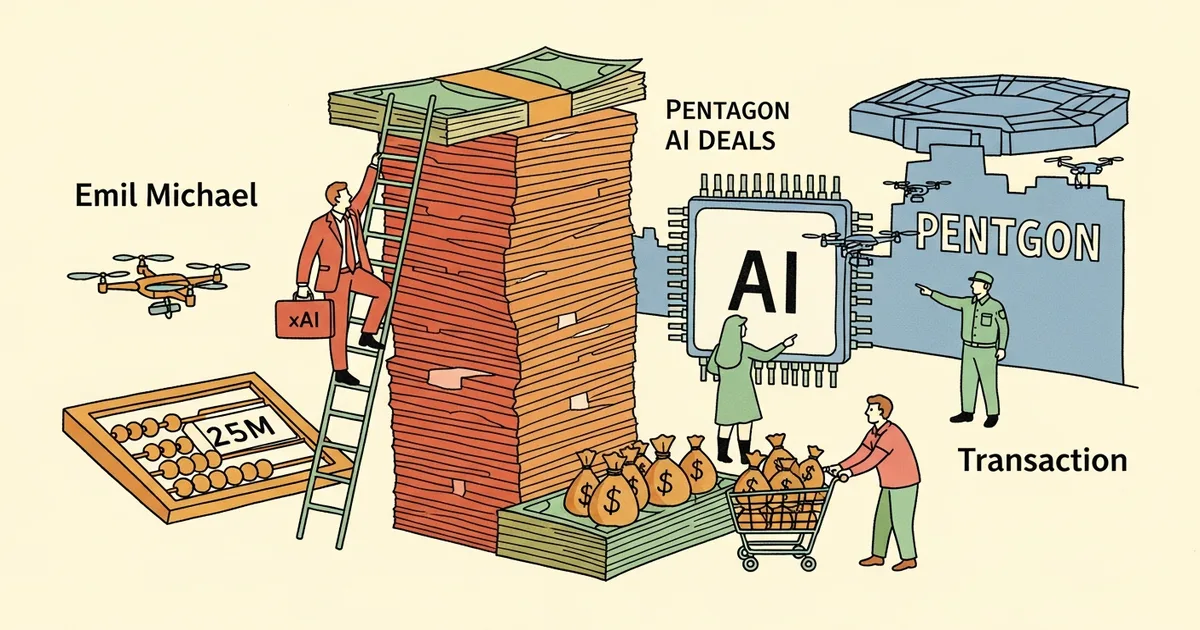
- Emil Michael, the Pentagon’s under secretary for research and engineering, sold an xAI stake on January 9, 2026, for between $5 million and $25 million, per government ethics filings.
- Michael held the position while the Defense Department announced two separate agreements with xAI — in July 2025 and December 22, 2025.
- He received an Office of Government Ethics divestiture certificate on December 18, 2025, but did not complete the sale until after the December 22 xAI contract announcement.
- Former White House ethics lawyer Richard Painter said an official holding AI stock while overseeing AI contracts carries “a very high chance of violating the criminal statute.”
What Happened
Emil Michael, the Pentagon’s under secretary for research and engineering, sold a private stake in Elon Musk’s xAI on January 9, 2026, for between $5 million and $25 million, according to government ethics disclosures reviewed by The Guardian and reported on April 9, 2026. Michael had declared the holding in March 2025, valuing it at between $500,000 and $1 million, owned through an entity called KQ Partners.
The disclosed sale price represents a gain of between 400% and 4,800% over his initial declared value. Because xAI is not publicly traded, the filings do not reveal how Michael originally acquired the position, how it was priced, or the identity of the buyer.
Why It Matters
Michael was the Pentagon’s lead official on AI acquisition and vendor negotiations throughout the period he held xAI stock. The Office of Government Ethics issued him a divestiture certificate on December 18, 2025, requiring him to sell. Four days later, on December 22, the Defense Department — which now refers to itself as the Department of War — announced a new agreement with xAI to deploy capabilities on GenAI.mil. Michael did not complete the sale until January 9, 2026.
A separate agreement, announced in July 2025, had already selected xAI’s Grok chatbot as one of four commercial AI providers for Pentagon-wide use — also while Michael held the stake.
Technical Details
Federal financial disclosure forms filed with the OGE report holdings in value bands rather than exact amounts. Michael’s March 2025 declaration placed the xAI position in the $500,000–$1 million band. The January 9, 2026 sale was reported in the $5 million–$25 million band, producing the 400%–4,800% gain range. The December 18 divestiture certificate cited compliance with conflict-of-interest obligations under federal statute.
Richard Painter, who served as chief White House ethics counsel under President George W. Bush, told The Guardian: “There is no way that a decent ethics lawyer would let a [defense department] official hold on to AI stock while he’s involved in AI matters. You would have a very high chance of violating the criminal statute.” Federal law — specifically 18 U.S.C. § 208 — prohibits officials from participating in matters that directly benefit their financial interests.
Who’s Affected
The disclosures implicate both the Pentagon’s AI procurement process and xAI directly, given that Grok secured two Defense Department agreements while a senior official with a declared financial interest in the company managed AI policy. Anthropic, which publicly disputed the terms of its own Pentagon contract with Michael — he called the firm’s CEO a “liar” with a “God-complex” in posts on X — is also a participant in the same procurement environment Michael controlled.
The Pentagon’s statement, attributed to spokesperson Sean Parnell, said Michael was “in full compliance with all ethics laws and regulations. Any claims otherwise are false.” The department did not respond to detailed questions submitted by The Guardian.
What’s Next
As of April 10, 2026, no congressional committee or federal law enforcement body has publicly announced a review of the transactions. The OGE disclosures are public record and available to oversight bodies. Painter’s assessment points to potential exposure under the criminal conflict-of-interest statute, though whether the Justice Department or inspector general offices pursue the matter has not been reported.