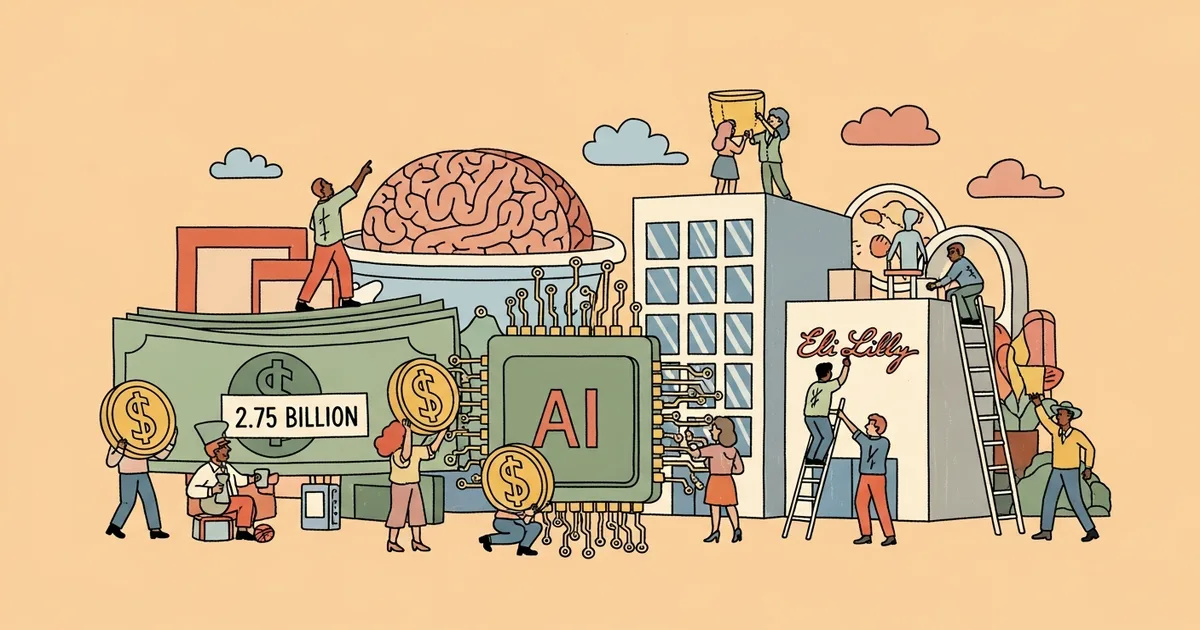
- Eli Lilly signed a research and licensing agreement with Insilico Medicine worth up to $2.75 billion, including a $115 million upfront payment, with the remainder tied to regulatory and commercial milestones plus royalties on future product sales.
- Insilico has used generative AI to develop at least 28 pharmaceutical compounds, with nearly half of those already progressing through clinical-stage trials.
- The deal grants Lilly an exclusive worldwide license for certain preclinical oral therapeutics developed using Insilico’s proprietary AI drug discovery platform.
- The agreement expands an existing collaboration that began in 2023 and follows a $100 million partnership between the two companies signed in November 2025.
What Happened
Eli Lilly announced a $2.75 billion research and licensing agreement with Hong Kong-based Insilico Medicine on March 29, 2026. The deal gives Lilly exclusive worldwide rights to develop, manufacture, and commercialize certain preclinical oral therapeutics identified and optimized through Insilico’s AI-driven drug discovery platform.
Insilico will receive $115 million upfront under the terms of the agreement, as reported by The Decoder and confirmed by CNBC. The remaining potential value, up to $2.635 billion, is contingent on the licensed compounds successfully clearing regulatory approvals, hitting commercial sales milestones, and generating royalties on future product revenue.
Andrew Adams, a representative for Eli Lilly, described the collaboration as “a powerful complement” to Lilly’s internal clinical development capabilities. Insilico founder and CEO Alex Zhavoronkov characterized the relationship as mutually strengthening, stating that “Lilly actually outperforms Insilico in some areas of AI.”
Why It Matters
The deal represents one of the largest financial commitments a major pharmaceutical company has made to AI-driven drug discovery to date. At $2.75 billion in total potential value, it signals that Big Pharma is moving decisively past small pilot programs and early-stage research grants into full-scale commercial partnerships with AI drug development firms.
Traditional drug development takes an average of 10 to 15 years from initial discovery to regulatory approval and costs well over $2 billion per successfully approved drug. Insilico’s platform aims to compress the early discovery and preclinical optimization phases by using generative AI to identify molecular candidates, predict their biological activity, and optimize their properties computationally before committing to expensive laboratory synthesis and animal testing.
The upfront payment is also notable. At $115 million, it is substantially larger than the upfront components of earlier pharma-AI deals, which typically involved smaller initial commitments with heavily back-loaded milestone structures. The larger figure reflects growing confidence that AI-generated drug candidates can produce clinical results.
Technical Details
Insilico’s AI platform uses generative models to design novel molecular structures, predict how they will interact with biological targets, and optimize them for drug-like properties including oral bioavailability and metabolic stability. The company has produced at least 28 pharmaceutical compounds through this process, with nearly half advancing into clinical trials.
The company develops its AI capabilities in Canada and the Middle East, while early-stage drug development takes place in China. Insilico completed a Hong Kong initial public offering at the end of 2025, raising $293 million, and has since signed several additional partnerships. The most notable is a potential $888 million agreement with French pharmaceutical company Servier.
The specific therapeutic indications covered by the Lilly deal have not been publicly disclosed. The focus on oral therapeutics indicates that the AI-identified candidates are small molecules rather than biologics, which aligns with Insilico’s core strength in small-molecule generative chemistry.
Who’s Affected
The deal directly strengthens both companies’ positions: Eli Lilly gains access to a pipeline of AI-optimized preclinical candidates without building the full discovery infrastructure internally, while Insilico secures the funding, manufacturing capability, and global regulatory expertise needed to move its compounds through late-stage trials and commercialization.
Competing AI drug discovery companies, including Recursion Pharmaceuticals, Exscientia, and AbSci, may benefit indirectly from the validation effect. A $2.75 billion commitment from a top-five global pharmaceutical company makes it easier for smaller AI biotech firms to justify their own valuations and negotiate stronger partnership terms with other pharma buyers.
Patients are the most distant but potentially most important stakeholder group. If Insilico’s AI-identified compounds succeed in clinical trials, the compressed discovery timeline could bring new treatments to market years faster than traditional methods would allow.
What’s Next
The partnership will move into preclinical development of the licensed oral therapeutics, with regulatory milestone payments determining how much of the $2.75 billion total Insilico ultimately receives. Eli Lilly is also pursuing a separate AI-driven medicine collaboration with a DeepMind subsidiary, indicating the company views AI drug discovery as a portfolio strategy rather than a single bet on one platform. The key limitation remains the clinical trial phase: no amount of AI optimization during discovery guarantees that a drug candidate will prove safe and effective when tested in human patients, and most preclinical compounds historically fail to reach market regardless of how they were identified.
Related Reading
- CoreWeave Raises $8.5 Billion GPU Loan Backed by Meta Deal
- CoreWeave Expands Meta Deal to $21 Billion for GPU Capacity Through 2032
- OpenAI Killed Sora and a $1 Billion Disney Deal in a Single Day
- Anthropic Signs Multi-Gigawatt Google TPU Deal — Enough to Power a Country
- Developer Reviews 40 Months of AI Coding Tools, From ChatGPT to Claude Code