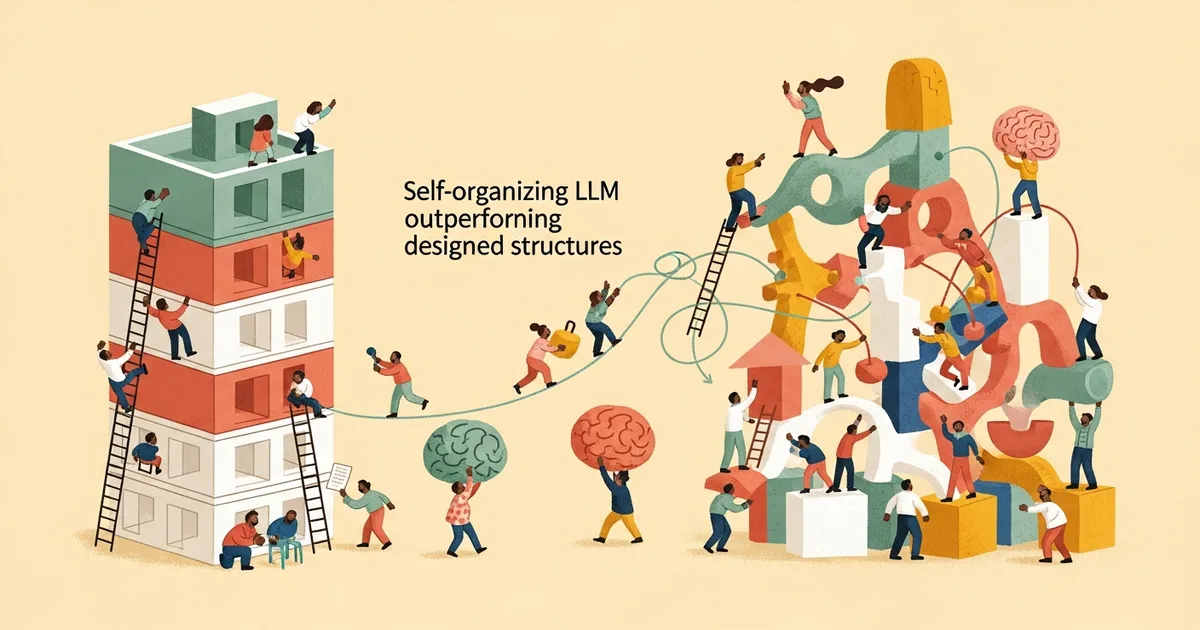
A computational study published to arXiv on March 30, 2026, by Victoria Dochkina found that multi-agent LLM systems given minimal structural scaffolding consistently outperform externally designed hierarchies. The paper, titled “Drop the Hierarchy and Roles: How Self-Organizing LLM Agents Outperform Designed Structures”, draws its conclusions from 25,000 tasks run across eight models, four to 256 agents, and eight coordination protocols ranging from fully imposed hierarchy to emergent self-organization.
- A hybrid “Sequential” protocol enabling emergent self-organization outperformed centralized coordination by 14% (p<0.001) across 25,000 tasks.
- Quality spread between the best and worst coordination protocols reached 44% (Cohen’s d=1.86, p<0.0001).
- The system scaled to 256 agents without quality degradation (p=0.61), generating 5,006 unique roles from as few as 8 agents.
- Open-source models achieved 95% of closed-source quality at 24 times lower cost across the same benchmark.
What Happened
Victoria Dochkina submitted this paper to arXiv on March 30, 2026, presenting a large-scale computational experiment designed to measure how much autonomy multi-agent LLM systems can sustain — and what structural conditions enable it. The experiment covered 25,000 tasks, eight models, and eight distinct coordination protocols, with agent counts scaling from 4 to 256. The central question was whether emergent self-organization produces better task outcomes than pre-assigned roles and explicit orchestration layers.
Why It Matters
Most multi-agent LLM frameworks currently deployed rely on designer-specified roles: orchestrators, critics, specialists, and planners are defined in advance and handed to agents as fixed identities. This study directly tests that design assumption against a lighter-touch alternative — fixed task ordering only — and finds that capable models outperform the rigid structure without it.
The distinction the paper draws is between what was demonstrated versus what is claimed as general: the results replicate across both closed-source and open-source models in this experimental setting, but the paper is a computational study, not a live deployment evaluation. Prior work on emergent coordination in LLMs has largely been observational; this study is among the first to quantify the effect through a controlled protocol comparison at this scale.
Technical Details
The core result is that the “Sequential” protocol — a hybrid that fixes only task ordering while leaving role assignment entirely to the agents — outperformed centralized coordination by 14% (p<0.001). The total quality spread across all eight coordination protocols reached 44%, with a Cohen’s d of 1.86 (p<0.0001), indicating a large effect size across the full 25,000-task benchmark.
Dochkina reports that under the Sequential protocol, agents “spontaneously invent specialized roles, voluntarily abstain from tasks outside their competence, and form shallow hierarchies — without any pre-assigned roles or external design.” Starting from just 8 agents, the system generated 5,006 unique roles across the experiment — a measure of how much specialization emerges without explicit design.
The capability threshold finding adds an important qualification: stronger models self-organize effectively, while models below a certain capability level still benefit from rigid structure. The abstract does not name the specific models tested or define the exact capability cutoff. Scaling to 256 agents produced no measurable quality degradation (p=0.61), a sub-linear scaling result that held across both closed-source and open-source models. Open-source models achieved 95% of closed-source quality at 24 times lower cost — a directly measured cost-performance ratio on the same standardized benchmark.
Who’s Affected
Developers and researchers building multi-agent LLM pipelines — particularly those using frameworks that hardcode agent roles such as AutoGen, CrewAI, or similar orchestration tools — are the most direct audience for these findings. The practical recommendation the paper states explicitly is: “give agents a mission, a protocol, and a capable model — not a pre-assigned role.”
Organizations weighing open-source against closed-source models for agentic deployments have a concrete benchmark data point to work with: 95% quality parity at 24x lower cost, measured across a controlled 25,000-task experiment rather than a vendor-reported estimate.
What’s Next
The study is a computational experiment, and the paper does not claim these results generalize directly to production deployments without further validation. The capability threshold — below which rigid structure still outperforms self-organization — is identified as a meaningful variable but is not precisely defined in the available abstract, leaving the boundary condition underspecified for practitioners trying to apply the finding.
Dochkina frames the broader trajectory as an inference from the scaling results: as foundation models improve, the scope for autonomous coordination is expected to expand. Full replication data across all eight models and eight protocols is available in the paper at arxiv.org/abs/2603.28990.