Researchers have published DesignWeaver (arXiv:2502.09867), a system that provides “dimensional scaffolding” to help novice product designers explore design spaces more effectively when using generative AI tools. The work addresses a gap between tool capability and user expertise identified through a formative study with 12 experienced product designers.
The study found that expert designers naturally organize exploration along dimensional axes — systematically varying one aspect of a product (material, form factor, color palette) while holding others constant. Novice designers, by contrast, tend to change everything at once through free-form prompts, producing visually varied but strategically unfocused results.
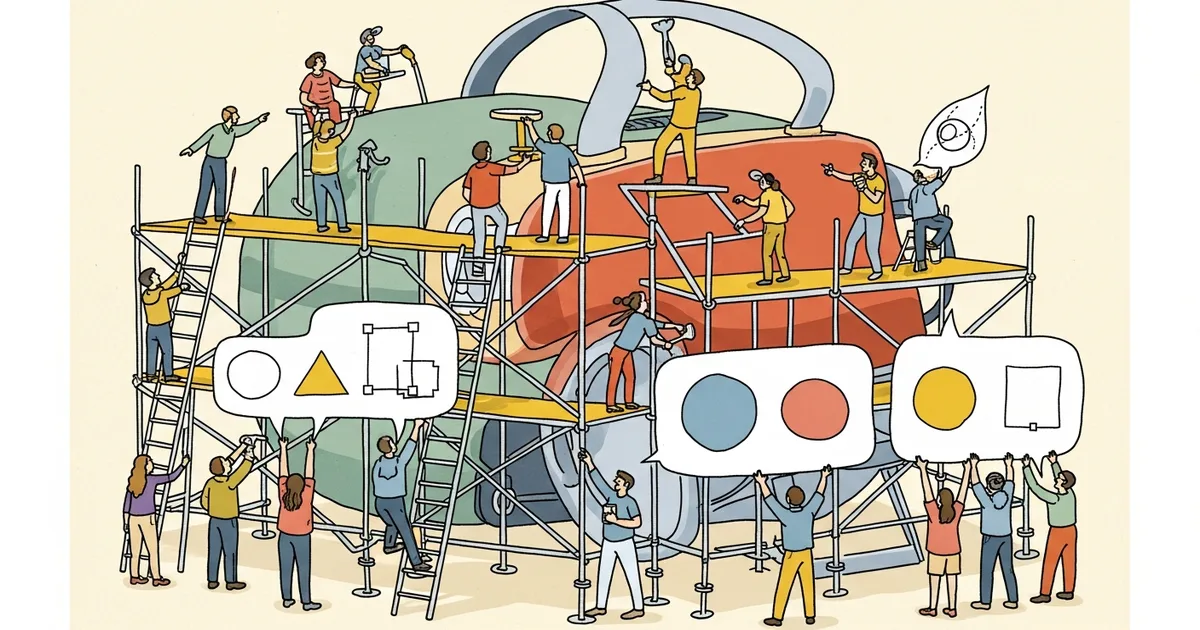
DesignWeaver decomposes product design tasks into constituent dimensions and guides users through systematic exploration of each. Rather than writing unconstrained prompts, users manipulate specific design parameters within a framework that ensures comprehensive coverage of the design space without constraining creative expression.
The system addresses an increasingly relevant problem as generative AI tools like Midjourney and DALL-E make the execution of visual design concepts nearly free. The competitive advantage in AI-assisted design is shifting from technical execution to design strategy — knowing what to create rather than how to create it. Tools that transfer expert-level strategic thinking to novice users may prove more valuable than further improvements to image generation quality.