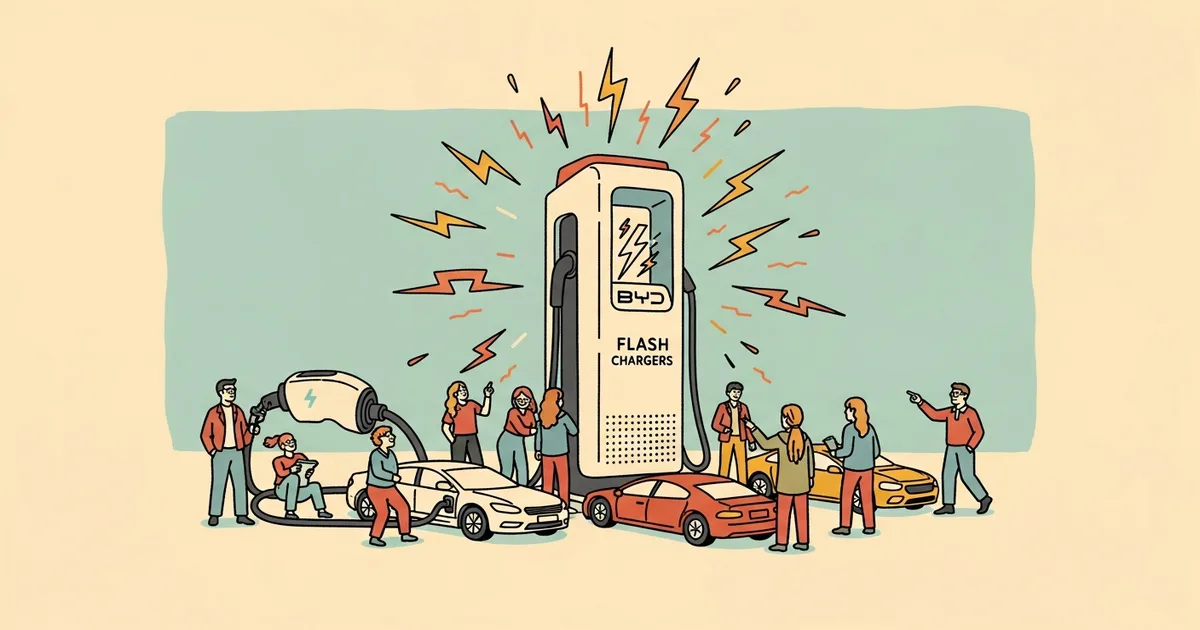
Chinese automaker BYD announced in mid-March 2026 that its Flash Chargers can now charge certain EV batteries from 10 to 70 percent in five minutes, and from 10 to 100 percent in approximately nine minutes — enough to add more than 600 miles of range in under ten minutes. The announcement was reported by Wired’s Aarian Marshall on March 21, 2026, who noted that BYD did not respond to Wired’s questions directly.
- BYD’s updated Flash Chargers deliver up to 1,500 kW — more than four times the output of the 350 kW “hyper-fast” chargers commonly deployed in the US.
- The newest Blade battery uses lithium manganese iron phosphate (LMFP) chemistry, increasing energy density by 5% over the previous LFP generation.
- BYD has deployed over 4,000 Flash Chargers in China and plans 16,000 more plus 2,000 in Europe by end of 2026.
- Only the Denza Z9GT currently supports maximum Flash Charger speeds, due to battery chemistry and vehicle wiring requirements.
What Happened
BYD’s updated Flash Chargers deliver up to 1,500 kilowatts of power — the second generation of a charging system the company first rolled out approximately one year ago. The updated specifications represent a substantial step beyond the company’s prior system, and bring EV charging speeds closer to what drivers expect from a gas station. The 1,500 kW output is enough to add more than 600 miles of range in roughly the time it takes to order a coffee, according to Marshall’s reporting.
For context, the 350 kW “hyper-fast” chargers more typical in the US require 15 to 25 minutes to reach 80 percent charge, and approximately 40 minutes for a full charge. BYD did not respond to Wired’s requests for comment; details about the new battery chemistry came from Chinese-language media cited in Marshall’s piece.
Why It Matters
Survey data consistently shows that range anxiety and charging speed are among the top concerns cited by potential EV buyers. Faster charging times directly address one of those two barriers, and BYD’s update narrows the gap between EV refueling and the gas station experience that most drivers are accustomed to.
BYD’s ability to achieve these speeds is rooted in vertical integration: the company manufactures its own vehicles, batteries, and chargers, allowing all three to be co-engineered. Tesla has pursued a similar approach with its Supercharger network, and both companies have demonstrated advantages over competitors that rely on third-party charging infrastructure. Most other global automakers cannot match this level of system-level coordination.
Technical Details
The performance gains are tied to BYD’s newest Blade battery generation. According to Chinese-language media cited by Marshall, the updated battery uses lithium manganese iron phosphate (LMFP) chemistry, a shift from the previous lithium iron phosphate (LFP) formulation. LFP trades some energy density for durability and fast-charging capability; LMFP recovers a portion of that energy density.
BYD states it has redesigned all major battery components: the electrodes that store and release energy, the electrolytes that allow ion transfer between electrodes during charge and discharge cycles, and the separators that disconnect and then conduct ion flow. The net result is a 5 percent increase in energy density compared to the previous generation. The Denza Z9GT, the first vehicle to carry the new battery, is rated at more than 620 miles of range per charge — though Marshall notes that real-world figures typically fall below manufacturer claims.
Delivering more than one megawatt from the electrical grid is a significant infrastructure challenge. BYD plans to use on-site storage batteries at charging locations to supplement grid supply and reduce peak demand loads. The charger unit itself is a teal, T-shaped design physically intended to evoke a gas pump.
Who’s Affected
Chinese EV drivers are the primary near-term beneficiaries. BYD has already deployed more than 4,000 Flash Chargers in China, with plans to build 16,000 more and an additional 2,000 in Europe by the end of 2026. In Europe, however, maximum charging speeds will initially be restricted to drivers of the Denza Z9GT — the only vehicle currently built with the software, wiring, and battery chemistry required to accept 1,500 kW of current.
US consumers are excluded entirely for the foreseeable future. BYD does not sell vehicles in the United States due to high tariffs and national security restrictions, and there is no indication those conditions will change in the near term.
What’s Next
Gil Tal, director of the EV Research Center at UC Davis’ Institute of Transportation Studies, characterized the development as “a good, marginal improvement in technology” but said “it’s not something that changes most people’s daily life.” His assessment points to the gap between engineering capability and practical infrastructure: ultra-fast charging only matters where compatible chargers and vehicles are both available.
The Denza Z9GT is scheduled to make its public debut at the Paris motor show in April 2026, which will serve as the first major European demonstration of the system’s capabilities. BYD has stated it plans to integrate the new chargers into existing charging banks. Whether other automakers can close the gap depends largely on whether they pursue similar vertical integration of battery and charging systems — a strategic commitment most have not yet made at the same scale.
Related Reading
- Physics-Derived Momentum Schedule Cuts Neural Net Convergence Time by 1.9x
- YC-Bench Puts 12 LLMs in Charge of Running a Startup: GLM-5 Nearly Matches Claude Opus 4.6 at 11x Lower Cost
- Research Shows AI Chatbots Misrepresent News Content 45 Percent of the Time
- InVideo Review 2026: Turn Text Prompts Into Edited Videos in Minutes
- Lovable AI Review 2026: Build Full-Stack Web Apps From Text Prompts in Minutes