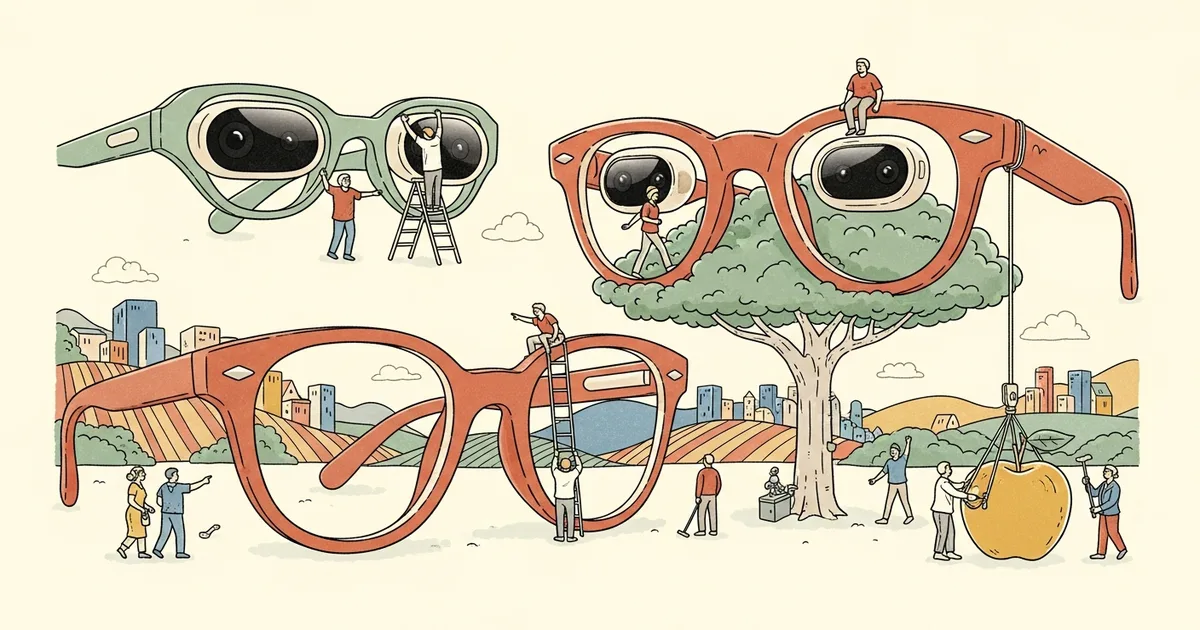
- Apple is developing AI-enabled smart glasses in multiple frame styles and colors with oval cameras, Bloomberg reported April 12, 2026.
- The glasses are designed to compete with Meta’s Ray-Ban Smart Glasses, the current market leader in consumer AI eyewear.
- John Giannandrea, Apple’s senior vice president of machine learning and AI strategy since 2018, is departing the company, per the same report.
- Apple has not confirmed a release date or disclosed which AI systems will power the device.
What Happened
Apple is developing AI-enabled smart glasses that will compete with Meta’s Ray-Ban Smart Glasses, offering multiple frame styles, colors, and oval camera housings, according to Bloomberg’s Mark Gurman, who reported the details in his Power On newsletter on April 12, 2026. Gurman cited people familiar with the product’s development; no official company statement was included in the report. The same newsletter reported that John Giannandrea, who joined Apple from Google in April 2018 to lead machine learning and AI strategy, is leaving the company.
Apple has not publicly confirmed the glasses project in its current form or Giannandrea’s departure. Both disclosures are sourced to people described as familiar with the plans.
Why It Matters
Meta’s Ray-Ban Smart Glasses, manufactured in partnership with EssilorLuxottica and updated with AI assistant features in October 2023, have established themselves as the dominant mass-market AI wearable. Meta reported in early 2025 that it sold over 1 million AI-enabled Ray-Ban pairs within months of their updated launch, making the product one of the more commercially successful AI hardware releases to date. Apple’s Vision Pro, released in February 2024 starting at $3,499, addressed immersive spatial computing at fixed locations rather than lightweight ambient AI worn throughout the day — the segment AI glasses would cover.
Giannandrea’s reported departure runs concurrently with the glasses development timeline. He has overseen Apple’s machine learning infrastructure since 2018, including the rollout of Apple Intelligence with iOS 18 in 2024, and his successor has not been publicly identified.
Technical Details
The oval camera design Bloomberg described distinguishes Apple’s planned glasses from Meta’s Ray-Ban Smart Glasses, which embed small circular cameras in the upper corners of the frame. Oval housings can accommodate larger image sensors or a wider capture angle than circular alternatives, though Bloomberg’s report did not specify camera resolution, sensor dimensions, or optical field-of-view figures.
Apple’s glasses are said to be planned in multiple frame styles and color options — a product strategy Meta applied to expand Ray-Ban Smart Glasses beyond the original wayfarer silhouette to include round, hexagonal, and sport configurations across more than a dozen colorways. The device is expected to integrate with Apple Intelligence, the on-device and Private Cloud Compute AI system Apple introduced with iOS 18. Bloomberg did not report the processor architecture, battery capacity, or connectivity specifications planned for the glasses.
Who’s Affected
Meta faces the most direct competitive exposure. The company has iterated on Ray-Ban Smart Glasses hardware since 2021 and built a developer platform around the product, but would face a challenger with Apple’s established retail network, hardware integration track record, and an iPhone-paired ecosystem. EssilorLuxottica, which holds exclusive manufacturing and co-branding rights for Meta’s Ray-Ban glasses, could see competitive pressure if Apple secures partnerships with rival optical manufacturers.
Apple’s existing iPhone user base — which exceeds 1 billion active devices globally — represents the natural primary addressable market for the glasses, given the expected iOS integration. Enterprise customers already standardized on Apple hardware for workforce deployments represent an additional segment, particularly for ambient AI use cases such as real-time translation and hands-free search.
What’s Next
Bloomberg did not report a launch window, and the glasses are described as still in active development. Apple typically introduces new hardware categories at its Worldwide Developers Conference in June or at its fall iPhone event; neither venue has been confirmed as the reveal venue for this product. The leadership transition at Apple’s AI division — Giannandrea’s replacement has not been named in public reporting — introduces an open variable in near-term AI product direction.
Gurman’s April 12 newsletter also included reporting on Apple’s foldable iPhone, indicating the company is managing multiple concurrent hardware development tracks. Additional technical specifications and a release timeline are likely to surface through subsequent Bloomberg reporting as the glasses approach a production-candidate stage.