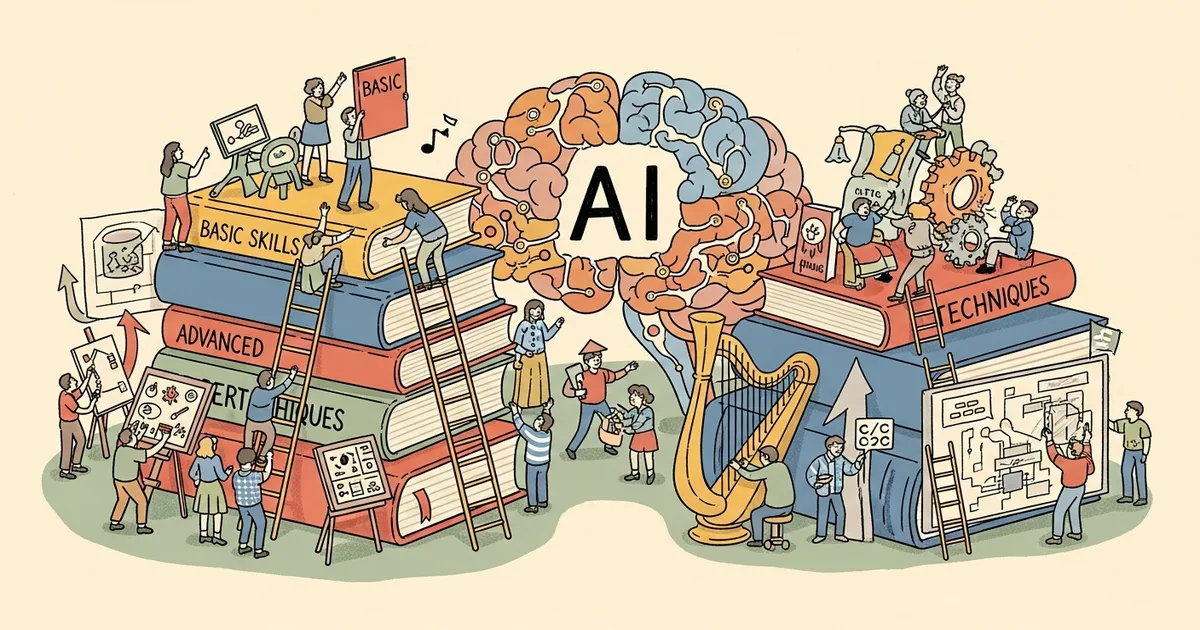
- Anthropic’s fifth Economic Index report found that experienced Claude users achieve roughly 4 percentage points higher success rates than newcomers, suggesting AI proficiency compounds over time.
- Coding now accounts for 35% of Claude.ai usage, while personal requests have grown to 42% of all conversations.
- The gap between early and late adopters may take 5 to 9 years to close in the United States, revised upward from an earlier estimate of 2 to 5 years.
- An NBC News poll found 57% of registered voters believe AI risks outweigh its benefits, raising questions about equitable access.
What Happened
Anthropic published its fifth Economic Index report on March 28, 2026, analyzing 1 million conversations from Claude.ai and its first-party API during February 2026. The report introduced a new finding: users who spend more time with AI tools develop measurably higher proficiency, and that advantage accumulates rather than plateaus.
Experienced users were 8.7 percentage points less likely to rely on simple commands and showed roughly 4 percentage points higher success rates on complex tasks. Professional use among veteran users ran 7 percentage points above that of newer adopters. The report was authored by Jonathan Kemper at THE DECODER, drawing on Anthropic’s internal telemetry data. This is the fifth installment in a series that Anthropic began publishing to track how AI is reshaping economic activity.
Why It Matters
The data points toward what economists call “skill-biased technological change,” a dynamic where early adopters gain compounding advantages that widen inequality rather than narrow it. The concept is well-established in economics literature, but Anthropic’s report provides one of the first large-scale empirical measurements of it in the context of generative AI. Individuals and organizations that invested early in learning AI tools are pulling further ahead of those who have not.
Anthropic’s revised timeline for U.S. usage convergence now stands at 5 to 9 years, up from a prior estimate of 2 to 5 years. That revision is significant: the gap is widening faster than Anthropic’s own analysts initially projected. The top 20 countries by population-adjusted traffic share now account for 48% of all usage, up from 45%, indicating that geographic concentration is increasing rather than diffusing.
Technical Details
The report drew from Claude.ai and API data separately, revealing divergent patterns. On Claude.ai, the top 10 tasks accounted for 19% of traffic, down from 24% in November 2025, suggesting broadening use cases. API concentration moved in the opposite direction, rising to 33%.
Coding dominated Claude.ai at 35% of usage, with Opus selected for 55% of coding tasks and 45% of education tasks. The average economic value per task was $47.90 per hour, a slight decline from $49.30 in the prior period. Sales automation and financial trading doubled their API share since November 2025.
Personal requests grew to 42% of all Claude.ai conversations, up from 35%, while coursework dropped from 19% to 12%. Roughly 49% of professional occupations now have at least 25% of their tasks performed via AI.
Who’s Affected
Workers and organizations without early AI adoption face the most risk. The compounding skill gap means that the cost of delayed adoption grows over time rather than remaining static. Educators may also need to reconsider how AI literacy is taught, given the decline in coursework-related usage and the rise in professional and personal applications.
Employers in sales, finance, and software development are already seeing the effects. The doubling of API usage in sales automation and financial trading signals that entire industries are restructuring workflows around AI tools. Developing nations also face a widening gap, as the top 20 countries continue to consolidate their share of global AI usage.
What’s Next
Anthropic plans to continue publishing the Economic Index on a regular basis, tracking whether the convergence timeline shortens or extends further. Future reports will likely examine whether new product features or pricing changes affect the adoption curve.
The key limitation of the report is its reliance on Claude-specific data, which may not reflect patterns across competing platforms such as OpenAI’s ChatGPT or Google’s Gemini. The sample also cannot account for users who try AI tools and abandon them entirely, potentially understating the actual skill gap. Whether governments or institutions will intervene to accelerate equitable access remains an open question with no concrete policy proposals on the table.