The Weather Company, operator of the Weather Channel, released a revamped version of its Storm Radar app on March 31, 2026, centered on an AI-powered Weather Assistant designed to personalize how users navigate forecast data. The launch, reported by Boone Ashworth at WIRED, comes as weather apps across the consumer market add AI interpretation layers on top of existing government data feeds.
- The Weather Company launched a revamped Storm Radar app on March 31, 2026, with an AI Weather Assistant priced at $4/month, currently iOS-only with no confirmed Android release date
- The assistant draws on NOAA and National Weather Service data, adding a customization and notification layer rather than generating independent forecasts
- Accuweather has integrated directly into OpenAI’s ChatGPT; Apple and Google have added AI summaries to their native weather apps
- Former DarkSky founder Adam Grossman’s Acme Weather is pursuing a distinct approach focused on surfacing forecast uncertainty rather than AI-driven personalization
What Happened
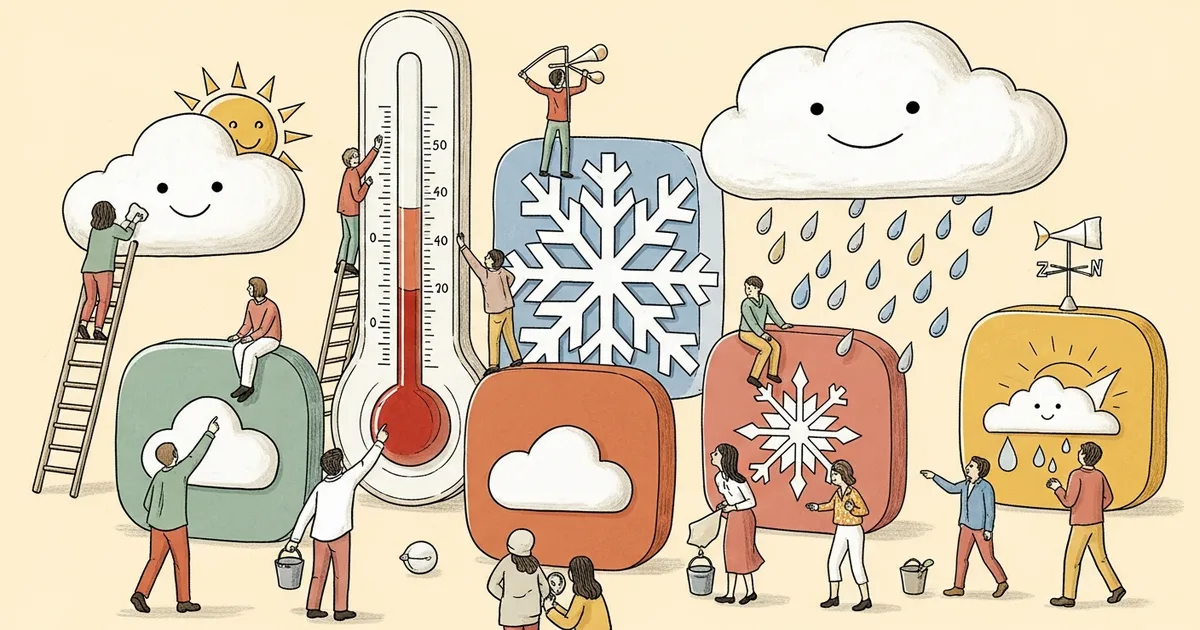
The Weather Company released its updated Storm Radar app on March 31, 2026, featuring an AI Weather Assistant that allows users to customize forecast and weather map views. Users can toggle between data layers — radar, temperature, wind, and lightning conditions — and connect the app to external calendars for weather-linked text notifications and daily summaries. The app also includes a voice interface styled after a traditional radio weather broadcaster.
“We wanted to build an experience that would be a weather level-up for anybody, really, from a casual observer to a seasoned storm chaser,” said Joe Koval, a senior meteorologist at The Weather Company. “If you’re looking for advice on when the weather will be good to walk your dog tomorrow, you no longer have to look at a bunch of different disparate weather data elements and try to figure out the answer to that question yourself.”
Why It Matters
Weather forecasting data has long been publicly available from government sources, making the app layer largely a question of interface design. The addition of AI features is changing how that question is answered. Apple acquired DarkSky in 2020 and folded it into Apple Weather, which now incorporates AI-powered summaries. Google has taken a similar approach with its native weather app on Android.
The competitive landscape now spans app-native AI features, AI-first newcomers like Rainbow Weather, and direct integrations into AI chatbots. Accuweather recently launched a dedicated app within OpenAI’s ChatGPT, allowing weather queries to be handled inside a conversational AI interface rather than a standalone application. Adam Grossman, who co-founded DarkSky before its Apple acquisition, framed the core challenge facing all weather app developers: “Everyone has their idea of what they want in a weather app, what data they’re interested in, how they’re interested in it being presented. How do you build a single weather app that works for everybody?”
Technical Details
Storm Radar’s forecast data comes from the National Oceanic and Atmospheric Administration (NOAA) and the National Weather Service (NWS) — the same government repositories that supply most consumer weather applications. The AI assistant does not generate independent forecasts; it operates as an interface layer, interpreting and presenting existing government data according to user preferences. Underlying weather data from these agencies is collected through weather satellites, radar networks, and weather balloons.
The app is priced at $4 per month. At launch it is available exclusively on iOS; the company has indicated an Android version is planned but has not provided a release date. The calendar sync feature enables the app to deliver notifications that tie specific forecast conditions to events in a user’s schedule.
Who’s Affected
The update targets a broad spectrum of users — from casual observers checking daily conditions to storm chasers monitoring severe weather events. Third-party weather app developers now compete not only with each other but with platform-native apps from Apple and Google, both of which bundle AI-enhanced weather features directly into mobile operating systems at no additional cost to users.
Developers of standalone weather apps — including Carrot Weather, Rain Viewer, and Acme Weather — must differentiate on features that platform providers do not offer by default, such as detailed radar overlays or specialized use-case customization. The Accuweather-ChatGPT integration further narrows the gap between general-purpose AI assistants and dedicated weather applications.
What’s Next
Acme Weather, founded by Adam Grossman after he left Apple, is pursuing an approach distinct from AI-driven personalization. Grossman told WIRED that weather apps have historically underserved users by failing to communicate the inherent uncertainty in forecasts. “No matter how good your forecast is, you’re going to be wrong,” he said. “That’s something that weather apps traditionally haven’t done a great job of doing. Our approach is trying to figure out how to add those pieces of context back in.”
Storm Radar’s Android release has no confirmed timeline. The broader integration of weather data into AI platforms — including Accuweather’s dedicated presence inside ChatGPT — indicates that weather information is increasingly being delivered within general-purpose AI interfaces rather than standalone applications.