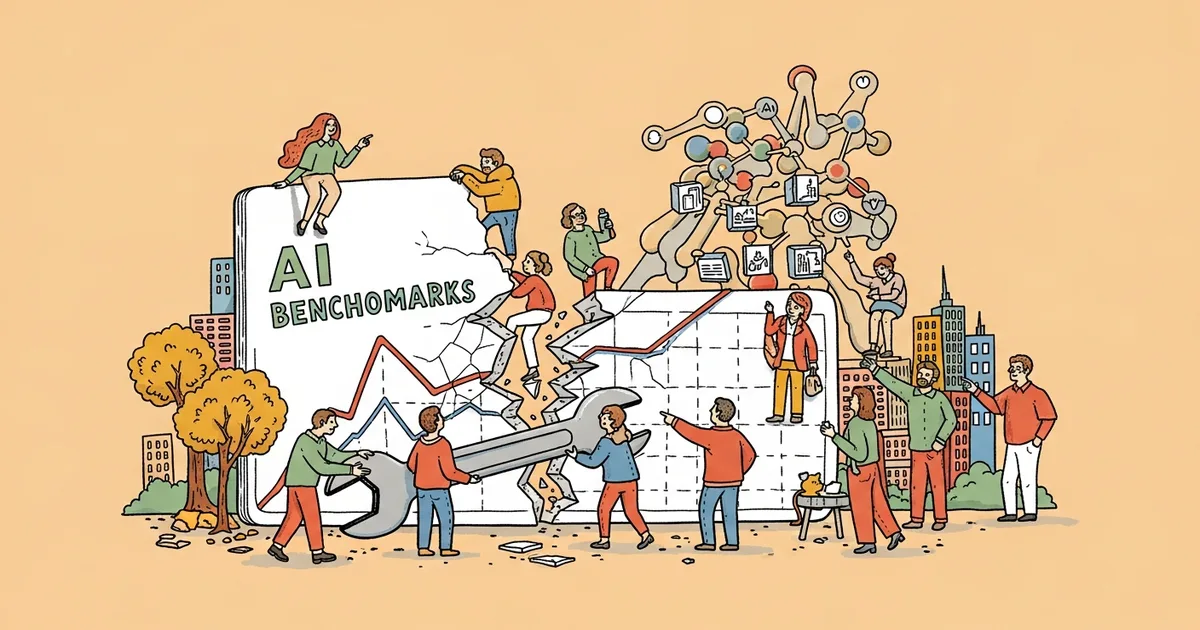
The conventional approach to evaluating artificial intelligence, which primarily compares machine performance against human capabilities on isolated tasks, is increasingly being recognized as insufficient for assessing real-world AI utility. This critique, articulated in a recent MIT Technology Review article, highlights a fundamental disconnect between how AI is benchmarked and how it is actually deployed within human teams and organizational workflows. The current paradigm, while effective for generating clear performance metrics and rankings, fails to capture the collaborative and contextual nature of modern AI applications.
For decades, benchmarks have focused on AI surpassing human performance in specific domains, ranging from chess to complex mathematical problems and even essay writing. This method provides easily standardizable comparisons and clear right/wrong answers, making it attractive for research and public communication. However, this isolated testing environment does not reflect the operational reality where AI functions as a tool augmenting human capabilities rather than replacing them entirely.
Researchers and industry practitioners have begun to address some limitations by moving beyond static tests to more dynamic evaluation methods. For instance, the introduction of benchmarks that assess an AI’s ability to adapt to new data distributions or perform multi-step reasoning tasks represents an improvement. Yet, these advancements often still evaluate AI in a vacuum, separate from the complex human-AI interaction loops and organizational processes where AI systems are integrated.
A key technical detail illustrating this gap is the performance of large language models (LLMs) on benchmarks like GLUE or SuperGLUE, which measure natural language understanding. While an LLM might achieve a 90% accuracy rate on a specific question-answering dataset, its effectiveness in a customer service workflow, where it must interact with human agents, interpret nuanced queries, and escalate complex cases, involves a different set of performance indicators not captured by these isolated metrics. The human-AI teaming aspect, including factors like trust, explainability, and error recovery, remains largely unquantified by traditional benchmarks.
Another example involves AI in software development. While models can achieve high scores on code generation benchmarks like HumanEval, producing functionally correct code for 70% of prompts, their real-world value is often tied to how well they integrate into a developer’s workflow, suggest improvements, or debug existing code collaboratively. The efficiency gains from AI assistance, measured in terms of reduced development cycles or fewer post-deployment bugs, are complex metrics that go beyond simple code correctness scores.
The article suggests a shift towards evaluating AI within the context of human-AI collaboration and organizational impact. This would involve designing benchmarks that assess an AI system’s ability to improve team performance, enhance decision-making processes, or increase overall operational efficiency. For example, instead of merely testing an AI’s ability to identify anomalies, a benchmark could evaluate how quickly and accurately a human-AI team can resolve incidents compared to a human-only team, factoring in communication overhead and trust calibration.
Moving forward, the AI community, including organizations like MegaOne AI, needs to develop and adopt new benchmarking methodologies that explicitly account for the socio-technical systems in which AI operates. This requires a collaborative effort to define metrics that capture the nuanced interplay between AI and human users, focusing on collective outcomes rather than individual machine performance. The next step involves piloting new benchmarks that simulate real-world team environments and measure the combined performance of human-AI systems on complex, multi-stakeholder tasks, as advocated by researchers such as Dr. Anya Sharma.