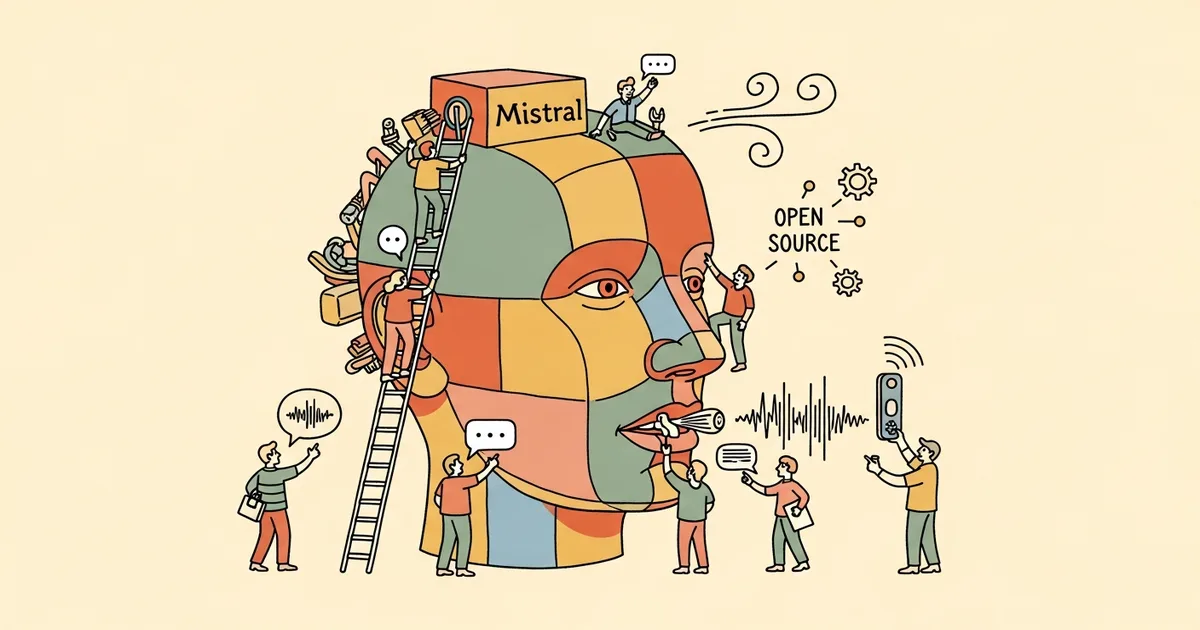
Mistral AI released Voxtral TTS on March 26, 2026, a three-billion parameter text-to-speech model designed to run on edge devices including smartwatches and smartphones. Available on Hugging Face, the model supports nine languages — English, French, Hindi, Arabic, German, Spanish, Dutch, Portuguese, and Italian — and delivers a 90-millisecond time-to-first-audio latency suitable for real-time conversational applications.
The model requires approximately three gigabytes of RAM when quantized for inference, making it deployable on consumer hardware without cloud connectivity. It can adapt to custom voices from audio samples under five seconds long, enabling voice cloning for personalized applications. The open weights are available under a Creative Commons Attribution Non-Commercial 4.0 license, with commercial use requiring a separate arrangement through Mistral’s API.
Voxtral TTS enters a voice AI market that is experiencing rapid consolidation. IBM partnered with ElevenLabs on March 25 to integrate multilingual voice AI into its watsonx Orchestrate platform across 70 languages. Hume AI released its TADA text-to-speech models earlier in March, while Fish Audio launched S2 Pro with support for over 80 languages and emotion control. The voice AI market is projected to reach $26 billion by 2028.
Mistral’s strategy differs from competitors by prioritizing edge deployment over cloud-based generation. Where ElevenLabs and OpenAI operate primarily as cloud services with per-request pricing, Voxtral TTS can run entirely offline once deployed. For applications where latency, privacy, and cost per request matter — think voice assistants in healthcare, financial services, or embedded automotive systems — the ability to run inference locally changes the economics fundamentally.
The release extends Mistral’s voice product line, which already includes Voxtral Realtime for live speech-to-text transcription and Voxtral Mini Transcribe V2 for batch processing. Together, these models give Mistral a complete speech pipeline — transcription, understanding, and generation — that can run on-device without cloud dependencies. For enterprises building voice-enabled applications, this stack offers an alternative to the patchwork of cloud APIs that currently dominates the market.
The non-commercial license for open weights limits immediate adoption in production environments, but the model’s architecture and performance benchmarks provide a reference point that will pressure competitors on pricing. When a three-billion parameter model running on a phone can match the quality of cloud services charging per minute of generated audio, the pricing floor for voice AI drops significantly.