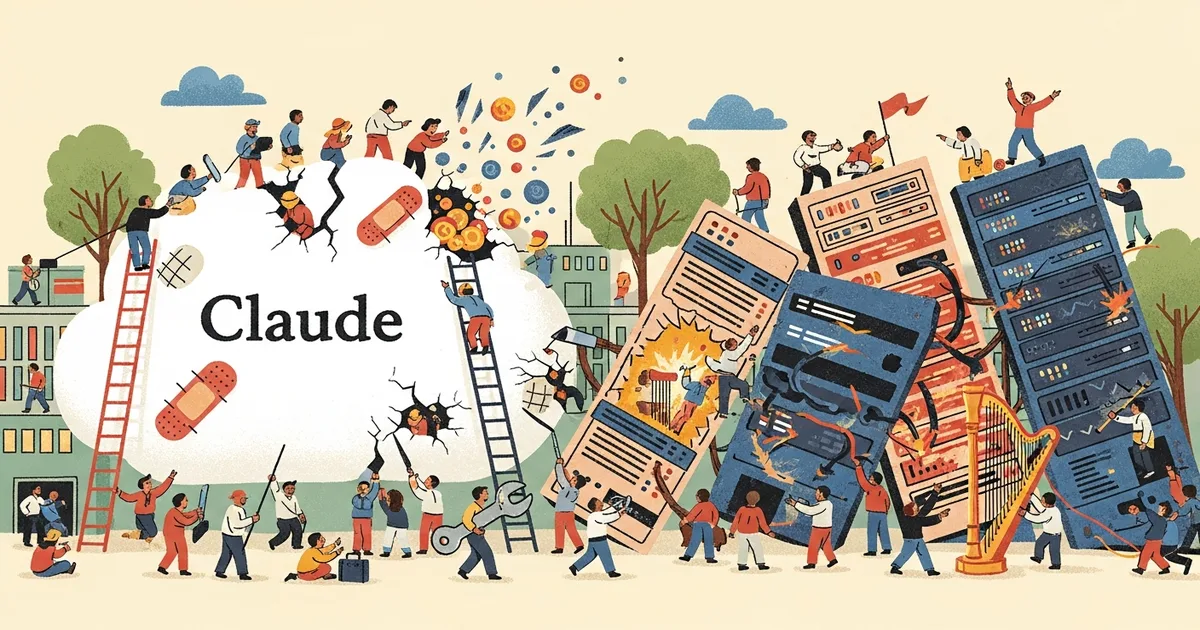
Anthropic’s Claude experienced eight major service disruptions throughout March 2026, with significant outages on March 2, 11, 17, and 25. The March 25 incident generated over 5,300 reports on Downdetector, with 57 percent of users reporting website access failures, 23 percent experiencing Claude Code disruptions, and 20 percent unable to use the mobile app. Users encountered HTTP 500 and 529 errors, blank screens, and complete inability to send prompts or receive responses.
The pattern suggests infrastructure struggling to keep pace with explosive growth. Claude surged to the number one position on the U.S. Apple App Store in early March, with downloads increasing 240 percent month-over-month in February. Usage grew 1,487 percent between mid-January and early March. The outages appear to be what engineers call a success tax, where demand overwhelms capacity faster than infrastructure can scale.
The business impact extended beyond inconvenience. Small and medium-sized businesses that built workflows around Claude reported stalled development cycles, frozen content pipelines, and silenced customer support bots during each outage. For companies using Claude Code as their primary development tool, a multi-hour outage translates directly into lost engineering productivity. The March 2 outage lasted nearly three hours and affected users globally.
The repeated disruptions expose a vulnerability in how organizations adopt AI tools. When a team builds processes around a single AI provider, using Claude for coding, writing, research, and customer interaction, an outage creates a complete operational halt rather than a partial degradation. Unlike traditional SaaS tools where competitors offer near-identical functionality, switching between AI providers mid-outage requires adapting prompts, workflows, and integration code.
Anthropic acknowledged each incident on its status page but provided limited detail on root causes or timelines for resolution. The company’s rapid capability expansion, launching Claude Dispatch, Computer Use, and Claude Code updates throughout March, may have contributed to infrastructure strain.
The March outage pattern serves as a case study in the emerging risks of AI infrastructure dependency. Organizations building critical workflows on any single AI platform face the same fundamental risk: when the service goes down, there is no fallback that preserves full functionality. Multi-provider strategies add complexity and cost but provide resilience that eight outages in one month make difficult to ignore.