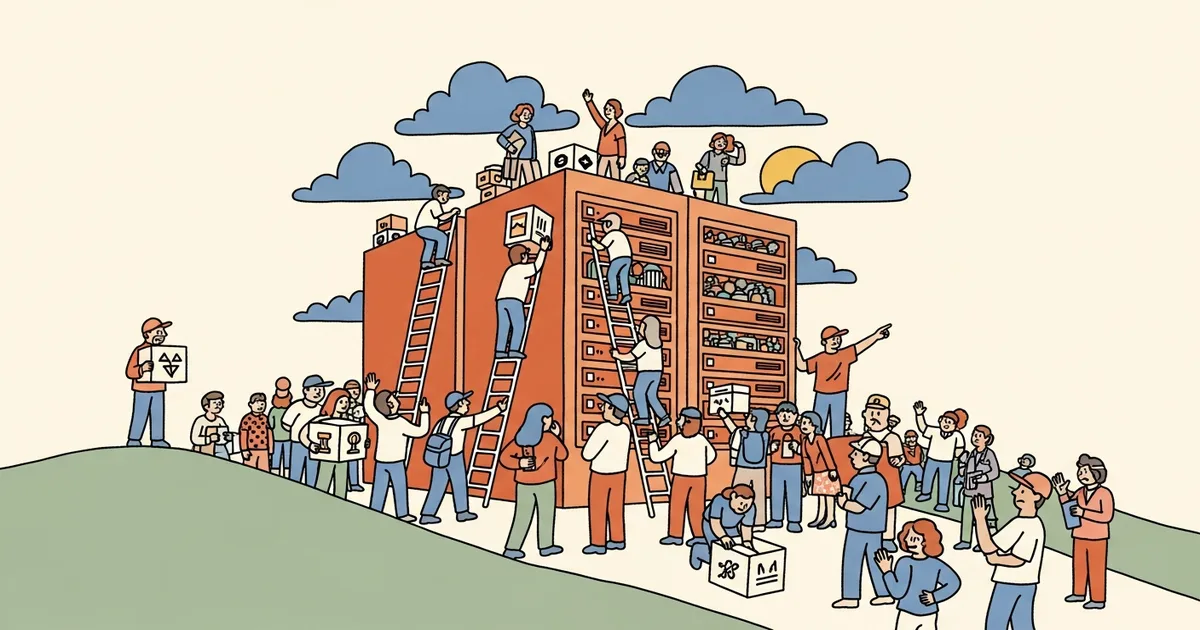
Oracle is cutting up to 30,000 jobs to fund its portion of the $500 billion Stargate AI infrastructure buildout. It is the largest AI-linked layoff on record, nearly four times the size of the next biggest.
The mechanism is explicit rather than inferred. Oracle is converting human payroll into GPU capital expenditure — the same dollars, moved from one line of the income statement to another. The oracle layoffs 30000 stargate decision is the clearest instance yet of a pattern that has been building all year.
How the cut compares to every other AI-linked layoff
Oracle’s number is not incrementally larger. It is a different order of magnitude.
| Company | Jobs cut | Multiple of next-largest |
|---|---|---|
| Oracle | Up to 30,000 | 3.75x Meta |
| Meta | 8,000 | 2x Cisco |
| Cisco | 4,000 | 4x Snap |
| Snap | 1,000 | 1.4x Coinbase |
| Coinbase | 700 | — |
Challenger, Gray & Christmas counted 49,125 AI-linked job cuts year-to-date by mid-May 2026. Oracle’s action alone would raise that total by more than 60%.
The math: what 30,000 salaries buy in GPUs
At a fully loaded cost of roughly $200,000 per employee — salary, benefits, equity, overhead — 30,000 positions represent approximately $6 billion in annual operating expense.
That is the conversion. Six billion dollars a year of recurring opex becomes available for capex against a $500 billion program. It funds roughly one large datacenter campus per year, or the accelerator complement for several.
Two structural facts make the swap attractive to a CFO rather than merely brutal. Opex recurs annually and produces no balance-sheet asset. Capex depreciates over years, sits on the balance sheet, and — in the current market — is what equity analysts reward. Oracle is not just cutting cost. It is changing what kind of cost it has.
The buildout the cuts are funding
Oracle has already committed hard dollars against Stargate:
- $16 billion closed for its Michigan datacenter.
- A Bloom Energy fuel-cell partnership to supply on-site power, bypassing grid interconnection queues that now run years in several US markets.
Power procurement is the binding constraint industry-wide, which is why the fuel-cell deal matters more than its size suggests. The same pressure is visible in Alphabet’s decision to lift 2026 capex guidance to as much as $205 billion, and in the spread of AI infrastructure bonds as a financing instrument. Capital is available; electricity and land are not.
Which roles go
The cuts concentrate where Oracle’s legacy business lives, not where its AI business is being built. Historically, restructurings of this shape hit:
- Legacy on-premises software — maintenance, support, and sales for products predating the cloud transition.
- Overlapping sales territories — the standard first target in any large enterprise-software reorganization.
- General and administrative functions — the layer whose headcount scales with company size rather than with revenue.
Datacenter operations, AI infrastructure engineering, and Stargate delivery are hiring. The net headcount story understates the gross reallocation: this is a workforce being exchanged, not simply reduced.
Will Wall Street reward it?
Recent precedent says yes, at least on announcement day. Cisco’s AI-linked restructuring was followed by a roughly 15% share-price gain; Snap’s by about 11%. Markets have consistently priced payroll-to-compute conversion as a margin story.
Oracle’s case has a complication those two did not. Cisco and Snap cut to protect margins on existing businesses. Oracle is cutting to fund a $500 billion commitment whose revenue depends heavily on a small set of AI customers — most visibly OpenAI, which burned through $34 billion last year according to FT reporting confirmed by MegaOne AI’s coverage.
The bull case is that Oracle becomes the neutral compute utility for the AI era. The bear case is that it has taken permanent cost out of a durable business to finance capacity for customers whose own economics are unproven. Both cases rest on the same $500 billion.
The pattern this establishes
The layoff-to-compute pipeline is now the defining corporate mechanism of 2026. Its logic is uncomfortable but coherent: if AI infrastructure returns more per dollar than the marginal employee, and capital markets fund the former more cheaply than the latter, the conversion happens regardless of intent.
Three signals to watch over the next two quarters:
- Whether the pattern spreads to non-tech incumbents. Oracle is a software company buying compute. The pattern becomes systemic when a bank or a retailer does it.
- Whether cut roles are backfilled offshore. A cut that reappears as lower-cost headcount elsewhere is a wage arbitrage story, not an AI story.
- Whether datacenter demand holds through 2027. Capex commitments are multi-year; the revenue assumptions behind them are not contracted that far out.
Global layoff data is published by Challenger, Gray & Christmas. For anyone tracking where AI capital is actually landing, the useful metric is no longer model benchmarks — it is the ratio of headcount reduction to announced compute spend, and Oracle just set the record.
MegaOne AI tracks 139+ AI tools across 17 categories and the infrastructure spending behind them.