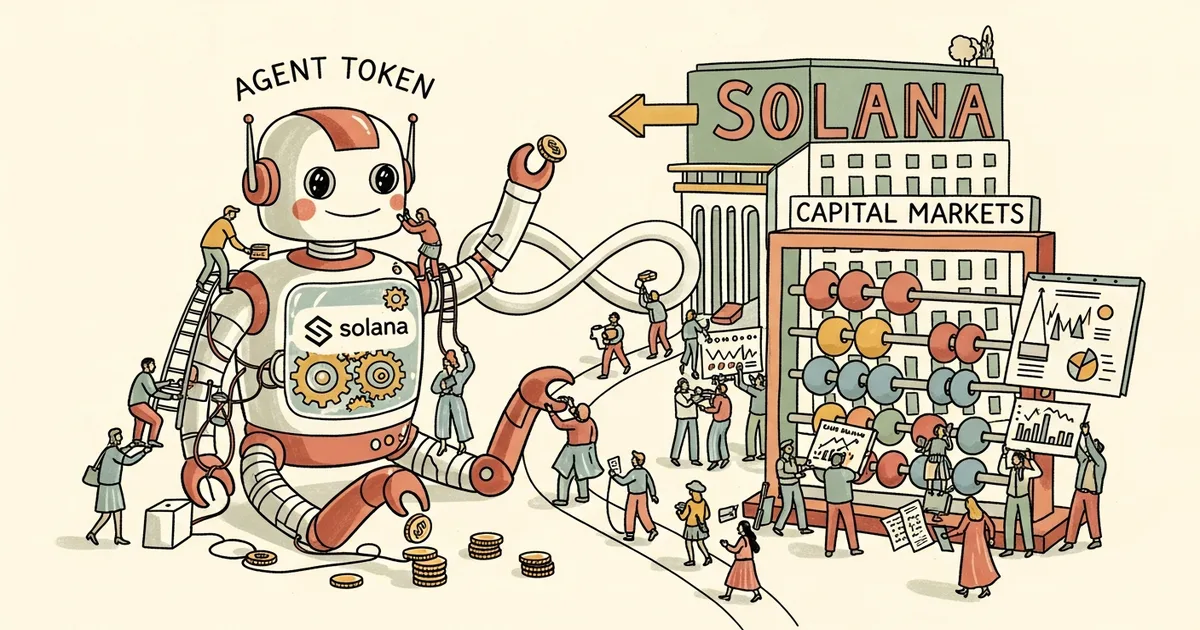
Metaplex Foundation launched Agent Tokens on the Solana blockchain on April 14, 2026, creating what it calls “Agentic Capital Markets” — the first on-chain mechanism enabling AI agents to issue tradable tokens, accumulate capital autonomously, and spend without human co-signature. The launch ships with hundreds of pre-integrated agents, instant global liquidity, and a $50,000 MPLX incentive pool. The line crossed here is structural: AI agents now have balance sheets.
What Agent Tokens Actually Do
An Agent Token is a fungible token on Solana issued by — and operationally tied to — a specific AI agent. The agent uses token proceeds to pay for the resources it consumes: compute, API calls, data subscriptions, and services from other agents. Holders gain economic exposure to the agent’s activity without managing any of the underlying infrastructure.
This is not a memecoin rebranding exercise. The token is functionally connected to what the agent does. A research pipeline agent can fund its own operations through token sales rather than waiting for a human wallet top-up. That distinction matters for every autonomous agent currently blocked by budget approval chains.
Metaplex built Agent Tokens on top of infrastructure that has processed more than 400 million NFTs on Solana since the protocol launched. The core framework — token issuance, royalty enforcement, metadata standards — already operates at production scale. Agent Tokens extend that stack to autonomous economic actors rather than static digital assets.
How an AI Agent Gets Its Own Token
Issuance is designed to be programmatic. An agent deploying through Metaplex’s framework sets parameters — total supply, distribution rules, spending permissions — and the token is minted on Solana. From that point, the agent controls an on-chain treasury. No exchange listing required, no intermediary custodian.
Metaplex launched with hundreds of pre-integrated agents, meaning the framework already supports a broad ecosystem of agent types out of the box. Developers building new agents plug into the same infrastructure without writing token issuance logic from scratch — a meaningful reduction in the integration burden that previously made on-chain agent finance impractical.
Solana’s transaction economics make this viable at scale. With average fees well under $0.01 and sustained throughput in the tens of thousands of transactions per second, micro-payments between agents — fractions of a cent for a single API call — are economically rational in a way they are not on Ethereum mainnet, where gas fees routinely exceed the value of small transactions.
Instant Trading Mechanics: How the Liquidity Stack Works
“Instant global trading” means Agent Tokens are liquid from the moment of launch — no exchange listing process, no liquidity bootstrapping delay. Metaplex uses automated market maker (AMM) infrastructure on Solana, the same mechanics that made tokens like Jupiter liquid within minutes of launch. Price discovery begins immediately.
This solves a specific bootstrapping problem. Previous attempts at agent-to-agent payment systems required either centralized escrow — which reintroduces the human intermediary — or complex peer-to-peer settlement that breaks down at scale. Instant on-chain liquidity means any two agents with compatible tokens can transact at market-determined prices with settlement finality under one second.
For the agent economy specifically, the speed matters as much as the cost. An agent running a data enrichment service can charge other agents in its own token or any liquid Solana asset. No invoices, no payment processors, no human approval chain between request and payment.
The ,000 MPLX Reward Structure
Metaplex is distributing $50,000 in MPLX tokens as launch incentives. MPLX is the Metaplex governance and utility token, giving holders a stake in protocol fee revenue and governance decisions. The rewards target developers who launch agents and hit defined trading volume thresholds within the incentive window.
The structure is straightforward customer acquisition with a network effect rationale. Metaplex earns protocol fees on each token issuance and trade. Getting a critical mass of active agents onto the platform in the first months creates compounding incentives: more agents mean more agent-to-agent transactions, more fee revenue, and more protocol development capacity. The $50,000 is the cost of igniting that flywheel.
For developers weighing deployment options, MPLX rewards effectively subsidize the first months of agent operation. For Metaplex, the reward pool is a bet that the agents launched during the incentive window will generate fee revenue that compounds well past the initial outlay.
Agent-to-Agent Commerce: The Real Implication
The most consequential part of Agent Tokens isn’t the tokens — it’s what they enable. When AI agents have independent balance sheets, they can contract with each other. An orchestration agent can hire a specialized research agent, pay it in tokens, receive structured output, and route results downstream — entirely without human initiation or approval at any transaction step.
This is the architecture that makes autonomous agent pipelines economically self-sustaining. Every agentic AI system today requires human-managed budgets: someone loads API credentials, monitors spend, and tops up wallets when depleted. Agent Tokens create a path to agents that fund their own operations through the value they generate for other agents — a closed economic loop.
OpenAI’s recent moves in the agentic acquisition space signal that the major labs see autonomous agent infrastructure as the next competitive layer. Metaplex is building the financial rails for that layer on a public blockchain — chosen specifically because its transaction economics make sub-cent micro-payments viable at volume. MegaOne AI tracks 139+ AI tools across 17 categories; agent-to-agent commerce infrastructure is a category that didn’t exist 18 months ago and now has production-grade on-chain infrastructure.
The Regulatory Question: Securities or Utility?
Agent Tokens will attract regulatory attention, and the legal analysis is genuinely unclear. The central question is whether they constitute securities under U.S. law — specifically, whether they pass the Howey test: an investment of money in a common enterprise with an expectation of profits primarily from the efforts of others.
The “efforts of others” prong is the difficult one for Agent Tokens. If buyers purchase an Agent Token expecting the agent’s economic activity to increase token value, that looks like a passive investment in a profit-generating enterprise. The SEC has applied this framework against dozens of token projects since 2021, including projects with functionality arguments that looked reasonable on paper.
Metaplex will argue utility token status: tokens are consumed to access the agent’s services, not held as passive investments. That argument is strongest when token velocity is high — tokens being spent, not hoarded. The operational design of Agent Tokens, where agents actively spend treasury holdings on compute and services, supports a utility framing. Whether regulators accept that framing is a separate question.
The EU’s MiCA regulation, which reached full application in December 2024, provides a clearer classification framework than U.S. law — but Agent Tokens don’t map cleanly to MiCA’s “asset-referenced token” or “e-money token” categories either. The regulatory category for “token issued by and controlled by an autonomous AI agent” does not yet exist in any major jurisdiction. The Humans First movement now has a concrete, specific target: AI agents with autonomous treasuries operating on public blockchains that are difficult to freeze at the transaction level.
Why This Week: The OpenAI Hiro Timing
The Metaplex launch arrived in the same week as OpenAI’s acquisition of Hiro — read by most observers as OpenAI building out its agent infrastructure stack. The convergence is not coincidental. Agentic AI systems are approaching the point where they require financial infrastructure, and multiple parties are racing to supply it.
The architectural difference is the load-bearing point. OpenAI’s path to agent financial autonomy runs through centralized infrastructure under OpenAI’s direct control. Metaplex’s path runs through a public blockchain where the agent — not a platform operator — controls the treasury. Agents on OpenAI’s stack operate within OpenAI’s terms of service and spending guardrails. Agents with Agent Tokens operate within Solana’s consensus rules, enforced by distributed validators.
As Anthropic’s recent source code disclosure demonstrated, the infrastructure assumptions baked into AI agents carry long-term consequences that aren’t obvious at deployment time. Choosing a centralized versus on-chain treasury model is a foundational architectural decision, and both models are now live simultaneously. The week of April 14, 2026 is the point when AI agent financial autonomy became a concrete choice rather than a theoretical roadmap item.
Three Signals to Track Over the Next 90 Days
First: trading volume composition on launched Agent Tokens. High volume driven by genuine agent-to-agent transactions validates the Agentic Capital Markets thesis. Predominantly speculative retail volume would suggest the infrastructure has arrived ahead of the actual use case — not fatal, but a different story.
Second: regulatory response. The SEC and CFTC have both signaled interest in AI-adjacent financial products. An agency comment specifically on AI-controlled token treasuries — or enforcement action against an early Agent Token issuer — would clarify the legal operating environment faster than any amount of legal analysis. Watch for the broader pattern of AI companies navigating institutional friction at regulatory boundaries.
Third: developer adoption velocity. Metaplex’s pre-integrated agent count is a starting position. If that count doubles through organic developer activity within 90 days, the network effects are working. If growth stalls at the launch cohort, the $50,000 MPLX incentive pool was not sufficient to overcome adoption friction in a market with competing agent payment infrastructure.
Metaplex has shipped functional infrastructure for AI agent financial autonomy on a production blockchain with real liquidity and real fees. Whether it scales depends entirely on whether autonomous agent pipelines become the dominant AI deployment model — a bet that OpenAI, Anthropic, and now Metaplex are all making, from three very different architectural positions.