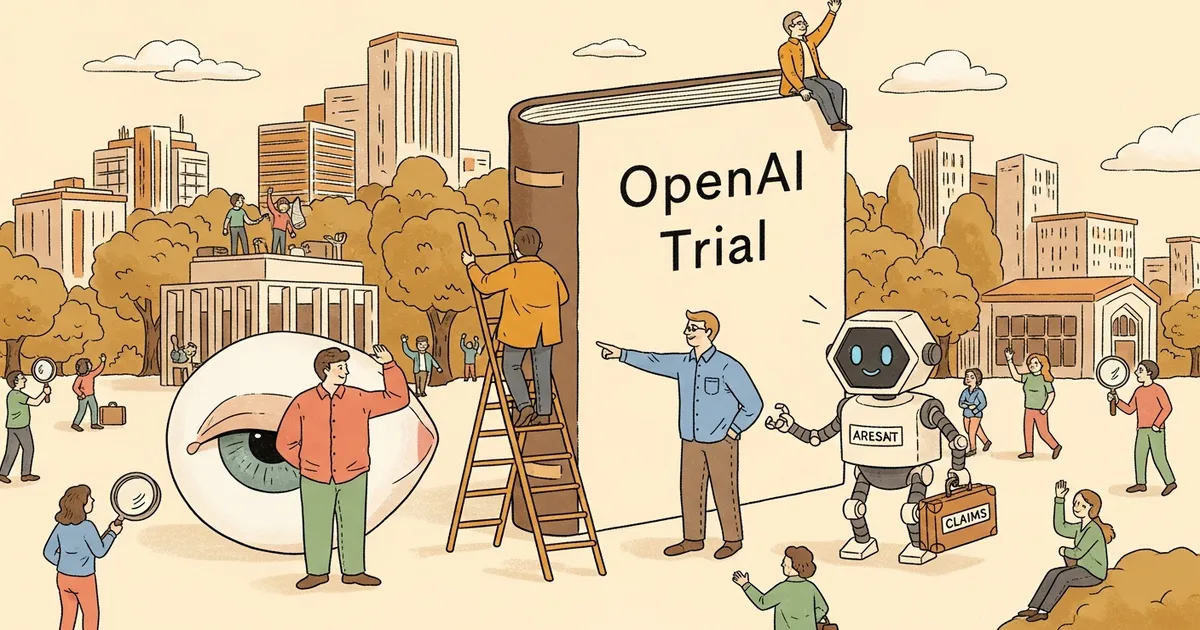
On April 25, 2026, Elon Musk — founder of xAI and Tesla — voluntarily dismissed his fraud claims against OpenAI Inc. in federal court, days before the Musk v. Altman trial begins next week. Reuters first reported the withdrawal. The fraud counts are gone. The breach-of-contract and breach-of-fiduciary-duty claims that could force OpenAI to reverse its corporate transformation remain fully intact.
This was not a concession — it was a calculation. With a $1.75 trillion SpaceX IPO filing underway and a $60 billion Cursor acquisition deal in motion, Musk’s legal team concluded that carrying active fraud allegations into a public trial created more exposure than it removed.
The Fraud Claims That Were Dropped
Musk’s fraud allegations centered on a specific accusation: that OpenAI’s co-founders — Sam Altman, Greg Brockman, and the nonprofit entity itself — induced him to contribute over $44 million by misrepresenting that the organization would remain a public-benefit research institution. When OpenAI converted to a capped-profit LLC structure and subsequently pursued full for-profit status ahead of a reported $300 billion valuation fundraise, Musk argued those representations constituted actionable fraud.
Those claims are now dead in this proceeding. The dismissal came at Musk’s own request, with no reported settlement payment and no admission of wrongdoing from either party. OpenAI will correctly note that a fraud claim withdrawn by the plaintiff is not a fraud claim that failed — it is one that was never adjudicated.
What Musk Kept: The Claims Going to Trial
The surviving allegations turn on contract law rather than intent. Musk’s legal team argues that OpenAI’s founding documents — specifically the agreements that attracted early donors and co-founders — constituted binding commitments to develop artificial general intelligence for the broad benefit of humanity, not for Microsoft’s balance sheet or private investors in a capped-profit structure.
Breach of contract requires proving an enforceable promise was broken. It does not require proving anyone intended to deceive. That is a meaningfully lower evidentiary bar — and one where the documentary record (founding charters, donor communications, early public statements about nonprofit mission) may be more favorable to Musk than the fraud standard allowed.
Reports ahead of trial also indicate remaining claims tied to the legality of OpenAI’s corporate restructuring under California nonprofit law. The operative complaint’s precise scope will be clarified when proceedings open next week.
Why Drop Fraud Now: The Strategic Math
Fraud litigation in California demands proving intent to deceive — which means surviving aggressive discovery on Musk’s own motivations. OpenAI’s pre-trial filings spent months building a counter-narrative: that this lawsuit is competitive retaliation, not principle. Musk founded xAI in 2023, launched Grok, and holds a direct financial interest in weakening the dominant AI lab in the market. OpenAI’s attorneys planned to make that argument the trial’s opening statement.
Remove the fraud counts and the proceedings narrow to whether a contract existed and was breached — a cleaner legal dispute where Musk’s motivations for filing are far less central to the outcome.
Two concurrent financial events make that cleaner framing materially valuable. SpaceX’s reported $1.75 trillion IPO filing would be the largest public offering in U.S. history — surpassing Saudi Aramco’s 2019 debut at $1.7 trillion. Musk controls an estimated 42% of SpaceX’s equity. An active fraud claim, even filed as plaintiff, invites deposition exposure and document production that generates headline risk for a listing at that scale. The $60 billion Cursor deal compounds the incentive: investment banks underwriting transactions of this magnitude price active fraud litigation into deal structure and timeline. Dropping the counts removes a specific category of unquantifiable risk from both transactions simultaneously.
As MegaOne AI has covered, OpenAI has simultaneously been expanding its commercial footprint with major institutional partners — giving it political weight and deal leverage that Musk is now litigating against at a distinct disadvantage.
The Ronan Farrow Exposé and OpenAI’s Defense
OpenAI’s legal team has been citing the Ronan Farrow New Yorker investigation as a defense exhibit — a tactically unusual move given that the piece includes a current OpenAI board member describing Sam Altman on the record as a “sociopath.”
The strategy is coherent. OpenAI appears to be arguing that even its harshest internal critics — people with board seats, operational access, and substantive grievances — chose to work within the institution rather than litigate from the outside. Musk has no current stake in OpenAI governance, resigned from the board in 2018, and filed suit five years later after founding a directly competing lab. The contrast is pointed and it is being pointed deliberately.
The Farrow reporting also documented the November 2023 board coup that briefly ousted Altman — a sequence that exposed serious governance dysfunction at OpenAI. Whether that dysfunction constitutes breach of the founding mission or simply organizational chaos is precisely the factual question the trial will surface. OpenAI’s bet is that critics who stayed, rather than left and sued, distinguishes their position from Musk’s in ways that matter to a jury.
What Next Week’s Trial Will Actually Argue
When proceedings open, three disputes will structure the testimony:
- Did a binding contract exist? OpenAI’s position is that the founding documents were aspirational statements of mission, not enforceable legal obligations to donors. Musk’s position is that his $44 million in contributions were conditional on specific governance guarantees, making those documents consideration in a contract. Courts have rarely been asked to treat charitable mission statements as binding agreements — this threshold question alone could determine the verdict.
- Was that contract breached? OpenAI’s for-profit conversion, its relationship with Microsoft (which holds a reported 49% economic stake in the capped-profit entity), and its current corporate structure are central exhibits. The founding language about open access and public benefit will be read directly against the terms of the Microsoft partnership and the subsequent fundraising structure.
- What is the remedy? Even if Musk prevails on liability, calculating damages is analytically complex. The court could award monetary compensation for the contribution amount plus interest — or structural relief requiring OpenAI to reverse aspects of its corporate conversion. The latter would effectively unwind years of capitalization and could threaten the organization’s commercial viability. Neither party has publicly stated what remedy Musk is actually seeking at trial.
Proceedings are expected to run several weeks. No active settlement discussions have been reported by either side.
The Governance Question That Outlasts the Verdict
Whatever the outcome, the Musk v. Altman litigation has already produced more involuntary transparency about OpenAI’s founding commitments than the organization would have chosen to disclose. Pre-trial depositions, document productions, and public filings have surfaced internal acquisition deliberations and governance dynamics that board minutes alone would never have revealed.
MegaOne AI tracks 139+ AI tools across 17 categories, and no single institution generates more legal, regulatory, and governance complexity than OpenAI. The broader question of who AI development ultimately serves — the public, private investors, or a specific corporate structure — is precisely what those founding documents in evidence were written to answer.
The fraud claims are dropped. The foundational question about what promises made at the birth of a major AI lab actually mean goes to trial next week. That answer matters well beyond whatever Musk personally wins or loses.