Anthropic (the AI safety company and maker of Claude, backed by Amazon and Google) announced on April 9, 2026 a suite of tools designed to remove the engineering overhead that has blocked non-technical teams from deploying AI agents at scale. The centerpiece: prebuilt agent templates and simplified workflow orchestration that collapse deployment time from weeks to hours. Combined with the company’s reported $30 billion annualized revenue run rate, this announcement marks Anthropic’s clearest move yet into enterprise infrastructure — not just model API access.
The timing is calculated. OpenAI has dominated the enterprise agent narrative for two years with its Assistants API, but persistent complaints about configuration complexity have opened a lane. Anthropic is walking through it with a platform play aimed squarely at the business buyer, not the developer.
What Anthropic Actually Released
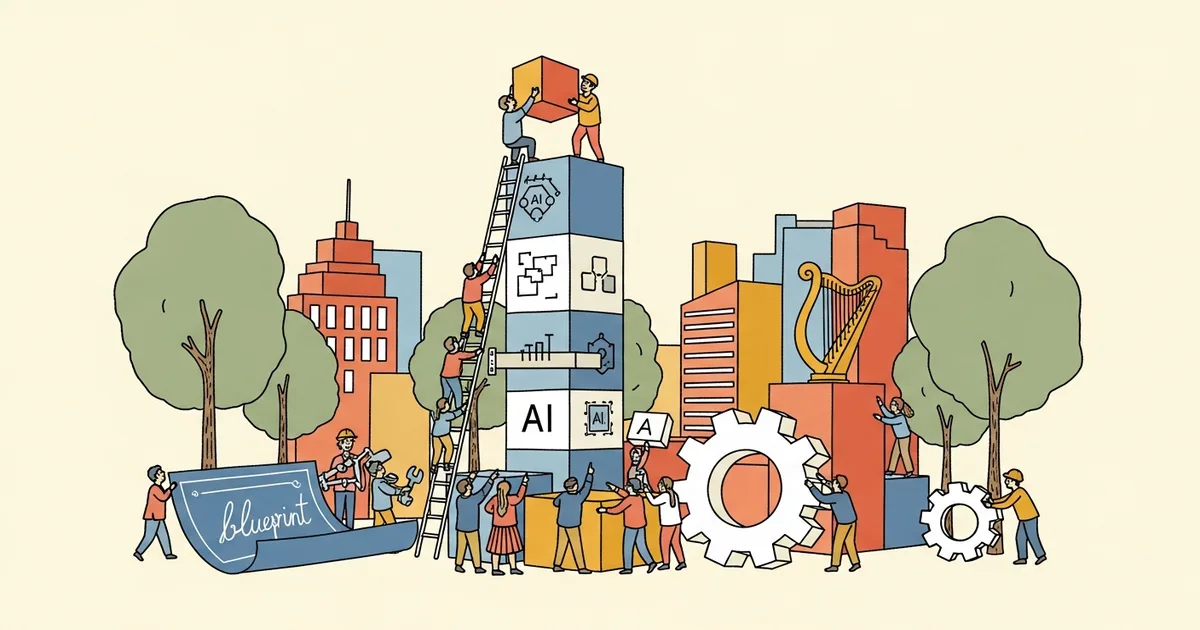
The new toolset addresses three distinct friction points that have stalled enterprise agent deployments. First, prebuilt agent templates for common business use cases — customer support routing, document summarization pipelines, data extraction workflows — that can be configured without writing custom orchestration logic. Second, simplified API scaffolding that abstracts away tool registration, memory management, and session handling. Third, a reduced configuration overhead model where multi-step agent behavior is defined through structured prompts rather than imperative code.
Anthropic’s Model Context Protocol (MCP), which standardizes how agents interact with external tools and data sources, underpins the new template layer. Rather than requiring teams to build custom integrations for every data source, MCP-compatible templates arrive pre-wired to common enterprise systems — CRMs, document stores, and ticketing platforms among them.
Critically, the templates ship with opinionated defaults. Earlier agent frameworks forced teams to make dozens of low-level decisions: how to handle tool call failures, when to escalate to human review, how to structure memory across sessions. The new templates encode Anthropic’s own production-tested answers to those questions, reducing the surface area where non-expert teams make costly configuration errors.
The Target Audience Is Explicitly Not Developers
Anthropic’s positioning here deserves careful reading. The company is not framing this as a developer productivity improvement. It is pitching a product that operations managers, marketing directors, and business analysts can deploy without filing an engineering ticket.
This matters because the ceiling on enterprise AI adoption is not compute or cost — it is the scarcity of engineering talent to build and maintain agent infrastructure. According to McKinsey’s 2025 State of AI report, 67% of enterprise AI projects stall in proof-of-concept phase because teams cannot acquire or allocate sufficient ML engineering resources. Anthropic’s templates are a direct response to that specific number.
The practical implication is concrete: a logistics company’s operations team can deploy a Claude agent that monitors shipment exceptions, drafts exception reports, and routes issues to the correct handler — without writing a line of Python. Configuration happens in structured natural language, validated against Anthropic’s template schema.
MegaOne AI tracks 139+ AI tools across 17 categories, and the pattern is consistent: tools gaining fastest enterprise adoption are those that require the least specialist knowledge to configure. Anthropic is betting the same dynamic holds for agents — and the evidence from every adjacent software category says that bet is correct.
How This Stacks Against OpenAI’s Assistants API
OpenAI’s Assistants API, launched in November 2023, was the first serious enterprise agent platform from a frontier lab and remains the default for organizations already on the OpenAI stack. The direct comparison with Anthropic’s new offering is instructive.
| Feature | Anthropic Claude Agents | OpenAI Assistants API |
|---|---|---|
| Prebuilt templates | Yes (April 2026) | Limited (partner ecosystem only) |
| Context window | 200K tokens | 128K tokens |
| Tool integration standard | MCP (open standard) | Proprietary function calling |
| No-code configuration | Yes | No |
| Memory management | Abstracted in templates | Manual thread management |
| Multi-agent orchestration | Native in templates | Requires custom implementation |
The context window gap is practically significant. Agents processing large documents — legal contracts, financial filings, technical specifications — hit OpenAI’s 128K ceiling faster than Claude’s 200K limit. For document-intensive workflows, that 56% capacity advantage translates directly to fewer truncation errors and more complete outputs without chunking workarounds.
OpenAI’s counter-advantage is ecosystem depth. The GPT Store, third-party integrations, and volume of developer tooling built on the OpenAI API represent a network effect Anthropic cannot replicate quickly. OpenAI’s $1 billion Disney deal illustrates how deeply the company has embedded itself in enterprise content workflows — precisely the territory Anthropic’s simplified agent stack is now targeting. The moat is real; the templates are Anthropic’s strategy to route around it by winning buyers who were never going to build custom API integrations anyway.
Google Vertex AI Agents: The Enterprise Incumbent to Beat
Google Vertex AI’s agent builder is the third major platform and arguably the strongest in regulated industries. Vertex agents benefit from native Google Cloud integration — direct access to BigQuery, Cloud Storage, and Google Workspace data without custom connectors, plus a compliance posture built on Google’s existing enterprise contracts.
The tradeoff is significant complexity. Vertex AI agent configuration requires familiarity with Google Cloud architecture, and production deployments typically need GCP-certified engineering resources. For healthcare, finance, and government customers, Vertex’s data residency controls and HIPAA-ready deployment paths remain a genuine moat that Anthropic’s current templates do not yet fully match.
The competitive landscape in Q2 2026 breaks down into clear use-case lanes:
- Anthropic Claude Agents: Fastest time-to-deploy for non-technical teams, largest context window, open MCP standard — best for mid-market and speed-to-value buyers
- OpenAI Assistants API: Largest ecosystem, deepest developer adoption — best for teams already on GPT-4o with engineering resources
- Google Vertex AI Agents: Strongest compliance controls, best GCP integration — best for regulated industries regardless of complexity cost
- Microsoft Copilot Studio: Strongest for Microsoft 365 environments, limited value outside that ecosystem
Anthropic is not trying to win every segment. It is targeting the largest underserved segment: the mid-market company with real automation needs, no ML team, and a decision-maker who will not wait six months for an engineering project.
The B Revenue Run Rate Makes This Sustainable
Anthropic’s reported $30 billion annualized revenue run rate — representing roughly 10x growth over 18 months — is not incidental context. It is the financial condition that makes a template library strategy viable.
Maintaining 40 production-ready agent templates across enterprise verticals requires ongoing engineering: updating integrations as downstream APIs change, testing templates against new Claude model versions, expanding coverage to new use cases. A well-funded startup cannot absorb that maintenance burden. Anthropic, at current scale, can. The revenue base is being deployed as a moat-building mechanism, not just distributed to shareholders.
The strategic logic mirrors what happened in cloud infrastructure. AWS built high-level managed services — RDS, Elastic Beanstalk, Lambda — that abstracted away the complexity of raw EC2 management. Teams that previously needed Linux expertise to deploy a database now needed none. Anthropic is executing the same abstraction one layer up: taking raw model API capability and packaging it into managed templates that reduce the specialist knowledge required to ship production agents.
This context also explains why the accidental leak of Anthropic’s Claude agent source code earlier this year attracted disproportionate attention. Developers who reverse-engineered that code were looking for exactly the orchestration patterns and memory management decisions that Anthropic is now packaging into productized templates. The market confirmed the demand before the product launched.
Why the Agent Platform Race Is Accelerating in 2026
Three converging forces explain why April 2026 is the moment all three major AI labs are pushing agent simplification simultaneously rather than staggering these launches across years.
Enterprise buyers have accumulated enough proof-of-concept data to shift from experimentation to deployment decisions. The question is no longer “can AI agents work for us?” — it is “how fast can we deploy at scale?” That shift in buyer posture changes what product features actually drive purchasing decisions.
Model quality has stabilized enough that differentiation has moved up the stack. Claude, GPT-4o, and Gemini 1.5 Pro all perform within acceptable ranges for most enterprise use cases. Competing on raw model benchmarks yields diminishing returns in sales conversations. Competing on time-to-production yields measurable ROI arguments that procurement teams can evaluate. Anthropic’s template launch is a direct acknowledgment that the model wars are settling into a platform race.
Infrastructure costs have crossed the mid-market viability threshold. According to Sequoia Capital’s 2025 AI agents market analysis, enterprise agent deployment costs fell 78% over 24 months, making the business case accessible to companies with $50M–$500M in revenue that previously could not justify the investment. Anthropic’s simplified onboarding is designed to capture that newly-viable market before OpenAI or Google can respond with equivalent ease-of-use.
The competitive consolidation across the broader AI landscape — including OpenAI’s ongoing acquisition activity — further signals that the window for independent platform differentiation is narrowing. Companies that lock in enterprise agent deployments in 2026 create switching costs that compound over time as workflows are built around specific template structures and MCP integrations.
What Businesses Should Actually Do With This
Three deployment scenarios map cleanly to current platform strengths.
If your team has no ML engineering capacity and needs a production agent deployment in under two weeks, Anthropic’s new templates represent the clearest available path. The reduced configuration overhead is real, MCP provides integration flexibility that proprietary function calling lacks, and the 200K context window eliminates the document chunking problem for most enterprise use cases.
If you are already deeply integrated with OpenAI’s API and GPT-4o is meeting your quality bar, the switching cost to Anthropic’s platform is non-trivial and the performance delta does not currently justify it for most use cases. The Assistants API ecosystem is mature, and ecosystem depth compounds over time.
If compliance and data residency are primary constraints — healthcare, financial services, government — Google Vertex AI agents remain the most defensible choice as of Q2 2026. Anthropic’s compliance roadmap is credible, but “credible roadmap” is not a substitute for current certification when patient data or regulated financial information is involved.
The agent platform race will not produce one winner. It will produce three platforms with distinct enterprise segments, and the companies that pick the right platform for their actual constraints — not the platform with the best press — will have working agents in production by Q3 2026. The rest will still be in proof-of-concept six months from now.