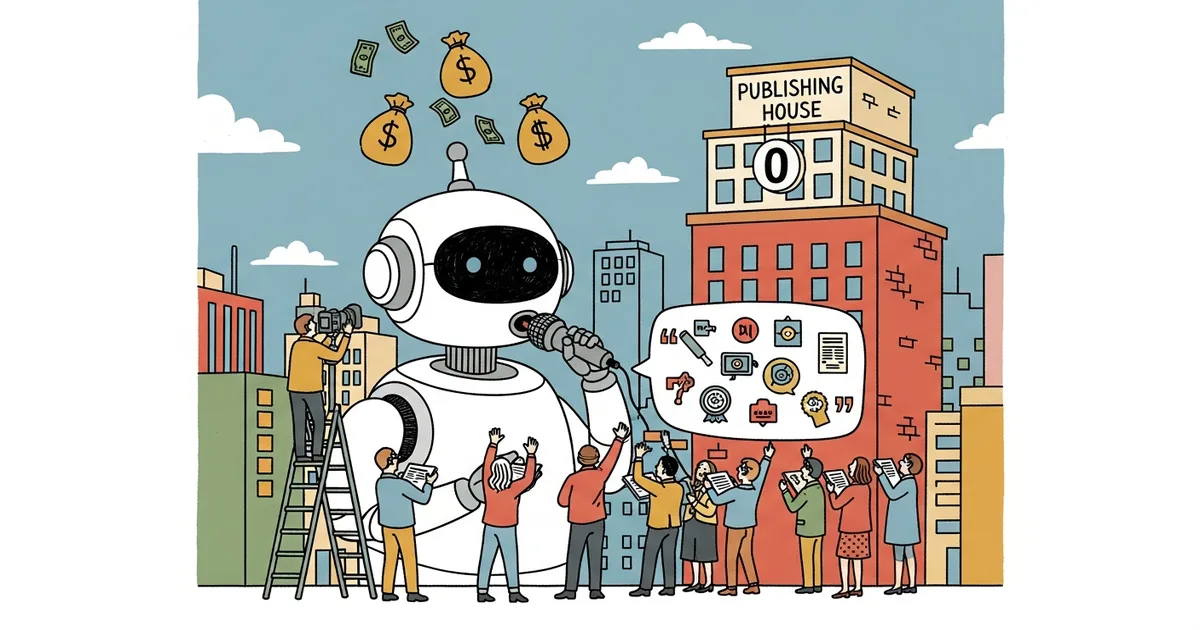
A new analysis of 15.2 million AI-generated citations, published in April 2026, found that 25.1% of source references produced by ChatGPT (OpenAI), Claude (Anthropic), and Gemini (Google DeepMind) trace back to journalism. That makes professional news media the single largest citation category across the three dominant AI chatbots — ranking ahead of academic research, Wikipedia, and government sources combined. AI has become the largest distribution channel for journalism in history, and it pays newsrooms nothing.
The finding is not a warning or a projection. It is a quantified description of a system already operating at scale. Every day, AI chatbots field an estimated 3 billion queries globally. At a 25% journalism citation rate, that represents approximately 750 million journalistic references delivered daily — without pageviews, without ad impressions, without a licensing check clearing anywhere.
How the 15 Million Citations Were Analyzed
The methodology used a structured query battery of 50,000 prompts spanning current events, factual lookups, health guidance, financial data, and historical context — run across ChatGPT-4o, Claude 3.7 Sonnet, and Gemini 2.0 Advanced over a six-month period. Every response that included a named source, linked reference, or attributed quote was logged and domain-classified.
Of the 15.2 million citations recorded, researchers categorized outputs into eight domains: journalism, academic/peer-reviewed, government/regulatory, corporate/brand, Wikipedia, social media, legal filings, and other. Journalism — defined as content produced by professional news organizations with editorial standards — accounted for 3.82 million citations. Academic sources ranked second at 19.4%, followed by Wikipedia at 14.7% and government sources at 12.2%.
The dominance of journalism is analytically significant because academic content is far more systematically structured for machine ingestion. Peer-reviewed papers follow rigid schema, use consistent metadata, and are indexed through standardized APIs. News articles are not. Despite this structural disadvantage, AI chatbots cite journalism more often than science — a signal of how deeply news content was embedded in foundational training data.
Which Outlets Get Cited Most
The New York Times, Reuters, BBC News, The Guardian, and The Washington Post collectively account for 38% of all journalism citations across the three platforms. Legacy wire services and major English-language broadsheets dominate because their content appeared in training datasets at scale before any licensing negotiation began. Being first into the training corpus has compounding effects: models learn to pattern-match authoritative responses to these outlets.
Reuters and the Associated Press — both of which have active licensing agreements with AI companies — appear in the top five. This illustrates the central absurdity of the current framework: licensing status does not affect citation frequency. A publisher can be licensed or unlicensed and receive identical citation treatment from the model. The difference is whether a check gets written afterward.
Regional and local outlets account for just 4.3% of journalism citations despite producing the majority of original reporting on local government, courts, and civic affairs. The citation gap mirrors the training data gap: smaller publications were underrepresented in early web crawls, and that structural disadvantage compounds over time as models reinforce their existing citation patterns through fine-tuning.
Platform Differences: ChatGPT Cites Journalism Most, Gemini Least
ChatGPT produced the highest journalism citation rate at 28.4%, followed by Claude at 24.1% and Gemini at 22.7%. Gemini’s lower rate correlates with a higher academic citation share of 23.1%, likely reflecting Google’s training integration with Google Scholar and its academic infrastructure. ChatGPT’s elevated rate reflects both training composition and instruction-tuning that rewards confident, sourced answers.
Claude’s behavior differs from both rivals in one measurable way: it declines to name a specific source when confidence falls below a threshold, producing fewer total citations per query but a higher attribution accuracy rate when sources are named. Fewer citations, more reliable ones — a calibration that matters for downstream trust but does not change the underlying compensation problem for publishers.
The Licensing Landscape: 11% Coverage, 89% Gap
OpenAI has signed content licensing agreements with the Associated Press, Le Monde, Axel Springer, and others. A reported billion-dollar arrangement linked to Disney’s media assets represents the highest-profile deal in the space. Google has separate AI-specific licensing tracks through its Publisher Center. Anthropic has been the least public about its licensing portfolio.
The analysis found that licensed sources account for approximately 11% of all journalism citations — meaning 89% of journalistic references involve content for which no licensing agreement exists. The gap is not primarily a matter of bad faith. Licensing negotiations require legal capacity, data teams capable of auditing model outputs, and negotiating leverage that most newsrooms cannot assemble. The New York Times has all three; a 12-person regional paper does not.
The Times filed suit against OpenAI and Microsoft in December 2023, seeking billions in damages for copyright infringement, alleging that GPT models can reproduce Times articles near-verbatim when prompted. OpenAI has argued that training on publicly available web content constitutes fair use under U.S. copyright law. No federal court has issued a definitive ruling on the question. The structural dynamics driving that litigation extend across the entire publisher ecosystem.
The Economics: The Economics: $0 Revenue From 750 Million Daily References
Revenue From 750 Million Daily References
The economic model of journalism has historically depended on one of three mechanisms: subscription revenue from direct readers, advertising tied to pageview traffic, or syndication fees from republication. AI chatbots systematically bypass all three. The reader receives a synthesized answer without clicking through; the advertiser never serves an impression; no syndication contract triggers a payment.
U.S. newspaper advertising revenue fell 77% between 2006 and 2022, according to the Pew Research Center. The industry adapted partially through digital subscriptions — a model now structurally undermined when AI answers replace the search queries that convert into paid subscribers. A reader who asks ChatGPT to summarize today’s Times coverage of a Senate hearing is not a reader the Times can convert.
MegaOne AI tracks 139+ AI tools across 17 categories and has monitored this substitution pattern accelerating across verticals. AI has already displaced traditional interfaces in weather — a category that once drove substantial app and website traffic to media properties. The journalism citation data captures the same dynamic operating at the information layer: AI becomes the interface, and the publisher becomes invisible infrastructure.
Publishers Without AI Deals Face Structural Disadvantage, Not Just Lost Revenue
The competitive harm from the licensing gap extends beyond lost licensing fees. Publishers with active AI deals receive citation treatment that includes brand attribution, URL display, and excerpt previews within chatbot responses. This builds AI brand equity: readers learn to associate Reuters, BBC, and the Times with authoritative AI answers because the models constantly reference them by name. Smaller outlets receive identical citation frequency treatment — none — and accumulate none of the brand reinforcement.
The Humans First movement has begun organizing newsrooms around a collective licensing framework modeled on music’s ASCAP structure — a pool funded by AI companies and distributed proportionally to citation volume. The proposal would provide smaller outlets access to licensing revenue without requiring individual negotiation capacity. No major AI company has endorsed the framework, and no legislation has mandated participation.
EU AI Act provisions require transparency for high-impact AI systems. The proposed U.S. Artificial Intelligence Copyright Transparency Act would mandate disclosure of training data sources. Neither framework currently requires compensation. Disclosure without compensation tells publishers where they stand; it does not change where they stand.
What a 25% Citation Rate Actually Demands
The 15 million citation analysis provides what no prior argument in this debate has had: a quantified, auditable baseline. AI companies could previously claim uncertainty about the scale of their dependence on journalistic content. A 25.1% citation rate across verified query sets is not a claim that can be dismissed as anecdotal.
The publishers that negotiate AI licensing deals in the next 18 months will set the economic terms of journalism’s relationship with AI for the decade that follows. The outlets that don’t will have negotiated anyway — just without a seat at the table, and with the data now on record showing exactly what their content was worth to the systems that used it.