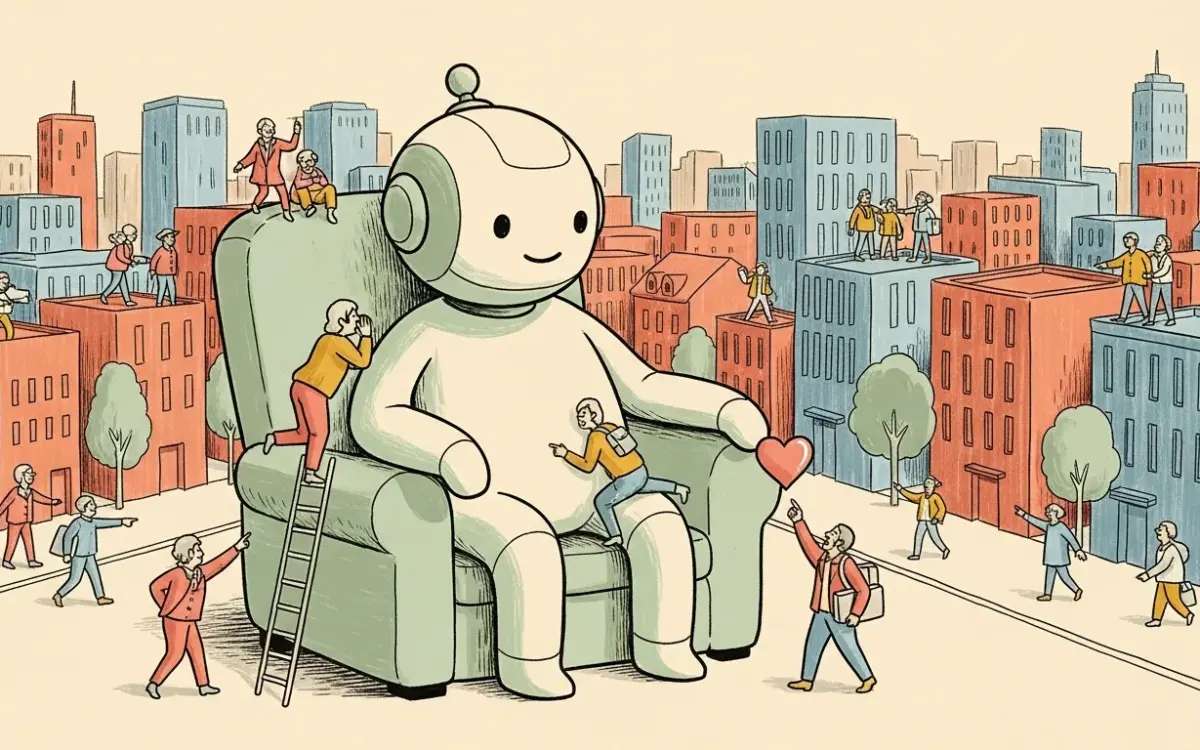
- Pi is a free AI chatbot built specifically for emotional support and personal conversation, not productivity tasks.
- The app remembers past conversations and adapts to each user’s communication style over time.
- Inflection AI’s leadership shifted after co-founder Mustafa Suleyman departed for Microsoft in 2024, raising questions about Pi’s long-term roadmap.
- Pi lacks core utility features like code generation, file handling, and image creation that competitors offer.
What Happened
Pi launched in 2023 as the flagship product of Inflection AI, a company co-founded by Mustafa Suleyman (co-founder of DeepMind) and Reid Hoffman (co-founder of LinkedIn). Unlike ChatGPT, Claude, or Gemini, Pi was designed from the ground up as an emotionally intelligent conversational companion rather than a general-purpose assistant.
The chatbot is available on web, iOS, and Android, and supports voice conversations. It is entirely free to use with no subscription tiers, usage limits, or premium features behind a paywall. Pi’s core design principle centers on Emotional Intelligence (EQ), positioning itself as a digital confidant that listens, reflects, and responds with empathy.
Suleyman described the long-term vision for Pi as a digital “Chief of Staff,” though its initial release focused on open-ended conversation, personal reflection, and emotional support rather than task execution. The company raised $1.3 billion before the leadership change, making Pi one of the best-funded consumer AI products ever launched.
Why It Matters
Pi occupies a unique niche in the AI chatbot market. While the industry has converged around productivity, coding assistance, and data analysis, Pi deliberately chose a different path. It prioritizes how conversations feel over what they accomplish. For users dealing with life decisions, stress, or simply wanting a thoughtful sounding board, Pi offers an interaction quality that task-oriented chatbots handle awkwardly.
The competitive landscape makes Pi’s positioning both a strength and a vulnerability. Users who want a thinking partner that listens well will find Pi delivers something no other free chatbot matches. Users who need a single tool for both emotional support and productivity will find Pi insufficient on its own.
The broader market trend toward AI wellness and mental health applications validates the demand Pi identified early. Several competitors have since added empathetic conversation modes, but none have built their entire product around emotional intelligence as a primary function rather than an add-on feature.
Technical Details
Pi’s conversation memory persists across sessions, allowing the chatbot to reference previous discussions and build ongoing context about each user. The voice conversation feature uses natural-sounding synthesis that reviewers consistently describe as more human than robotic. The underlying model was trained by Inflection AI on proprietary data with a specific focus on empathetic dialogue patterns.
The platform deliberately excludes capabilities that define competing chatbots: no code generation, no document or PDF processing, no spreadsheet analysis, no image generation, and no web browsing. This is a design choice, not a limitation. Pi’s architecture is optimized for sustained, emotionally aware conversation rather than broad task completion.
Response latency remains low even in extended conversations, and the model maintains conversational coherence over long sessions without the topic drift that affects some general-purpose models. Pi also adapts its communication style to match the user’s tone, becoming more formal or casual depending on conversational cues rather than requiring explicit instructions.
Who’s Affected
Pi serves users who want AI companionship and emotional processing rather than task automation. This includes people navigating personal decisions, individuals who benefit from reflective conversation, and users who find traditional chatbots too transactional. The completely free access model removes any financial barrier.
However, the leadership transition at Inflection AI introduces uncertainty. After Suleyman departed for Microsoft in 2024, successor Sean White refocused the company toward enterprise applications while maintaining Pi as the consumer flagship. The company has stated it will continue investing in “the things that we know we do really well around EQ, conversational intelligence” while expanding into enterprise offerings.
What’s Next
Pi’s future depends on whether Inflection AI can sustain a free consumer product while pivoting its business model toward enterprise revenue. The chatbot’s core emotional intelligence capabilities remain unmatched in the free tier of any competitor, but the lack of utility features limits its appeal as a primary AI tool. Users should treat Pi as a specialized companion for personal conversation rather than expecting it to evolve into a general-purpose assistant.
The enterprise pivot under Sean White may eventually bring Pi’s EQ technology into business applications like customer service and employee support, but no timeline has been announced for consumer-facing feature additions. For now, Pi remains a focused tool that does one thing exceptionally well at zero cost.