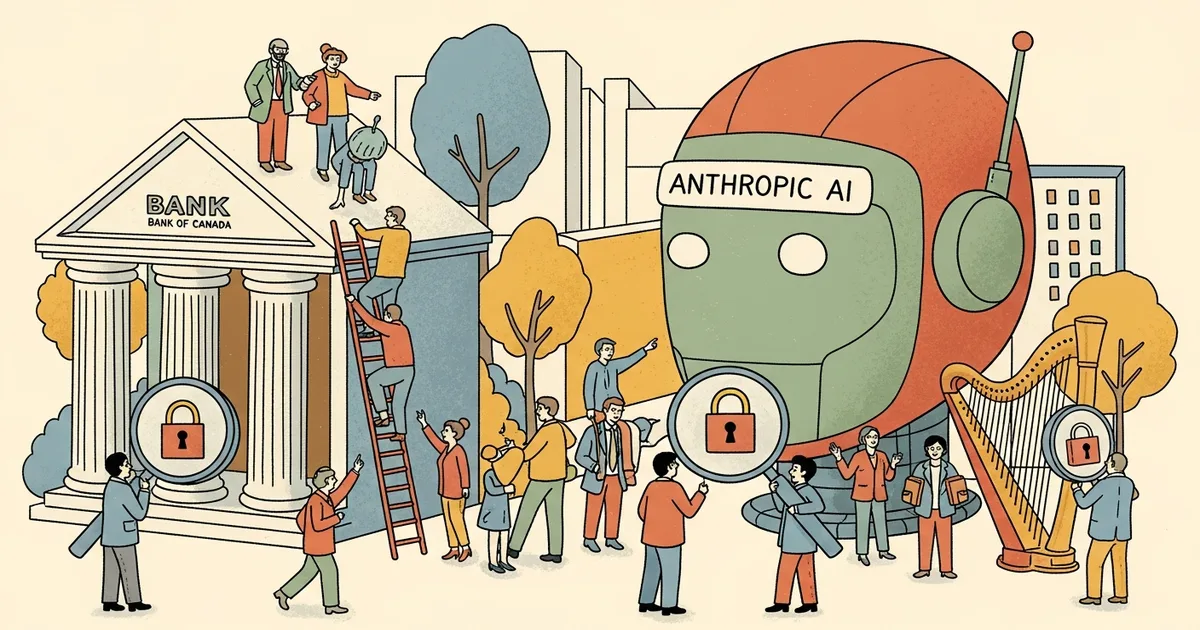
- The Bank of Canada met with Canada’s major banks and financial firms on April 10, 2026 to discuss cybersecurity risks linked to Anthropic PBC’s latest AI model, according to Bloomberg.
- The meeting is among the first publicly reported instances of a G7 central bank convening financial sector leaders around a specific AI company’s technology.
- Neither the specific Anthropic model under discussion nor the names of the attending financial institutions were disclosed in available public reporting.
- No public guidance or regulatory output from the meeting has been issued as of April 11, 2026.
What Happened
The Bank of Canada gathered representatives from the country’s major banks and financial firms on Friday, April 10, 2026, to discuss cybersecurity risks associated with Anthropic PBC’s latest artificial intelligence model, according to Bloomberg. The meeting is one of the first publicly reported instances of a G7 central bank convening financial sector leaders specifically around a named AI company’s technology.
Details available in public reporting are limited. Bloomberg’s full account — including the specific model under discussion, which institutions attended, and what conclusions were reached — is behind a subscription paywall. The Bank of Canada has not issued a public statement on the meeting as of this writing.
Why It Matters
Canada’s Office of the Superintendent of Financial Institutions (OSFI) updated its technology and cyber risk guidance for federally regulated institutions in 2023, flagging AI as a category requiring dedicated risk frameworks. A Bank of Canada-led meeting that names a specific AI company’s model signals that regulatory concern has shifted from general AI risk to model-level threat assessment — a meaningful escalation in specificity.
Anthropic, founded in 2021 by former OpenAI researchers including CEO Dario Amodei and President Daniela Amodei, has released a series of large language models under the Claude brand. The company has publicly committed to internal red-teaming and safety evaluation as standard practice before model releases, though regulators and financial institutions have increasingly sought to conduct independent assessments of such claims.
Technical Details
Advanced large language models present documented cybersecurity risks to the financial sector through several vectors. These include AI-assisted generation of targeted phishing content at scale, synthetic fraud communications that mimic institutional language with high fidelity, and automated social engineering that can defeat identity verification protocols designed around human-speed interaction. Security researchers have demonstrated in published red-team evaluations that models with built-in safety filters can be induced to produce harmful outputs through adversarial prompting — a class of attacks sometimes called jailbreaking.
Financial institutions are structurally exposed: customer-facing systems at large banks depend on identity verification and human judgment, both of which are vulnerable to AI-generated impersonation operating at machine speed and volume. The specific technical capabilities in Anthropic’s model that prompted the April 10 meeting have not been disclosed in publicly available reporting.
Who’s Affected
Canada’s six systemically important banks — Royal Bank of Canada, Toronto-Dominion Bank, Bank of Nova Scotia, Bank of Montreal, Canadian Imperial Bank of Commerce, and National Bank of Canada — maintain standing working relationships with the Bank of Canada and would be the most likely institutions represented in such a convening. The specific attendee list has not been confirmed publicly.
Anthropic was the subject of the discussions rather than a participant in them. The outcome of the meeting could set a precedent for how AI developers engage with financial regulators in other G7 jurisdictions, where similar conversations about AI-linked cyber risk are ongoing at the policy level.
What’s Next
The Bank of Canada had not issued public guidance or a formal statement stemming from the meeting as of April 11, 2026. Regulatory outputs, if any, would likely take the form of risk advisories issued through OSFI’s existing technology risk framework or updated supervisory expectations for federally regulated financial institutions. Bloomberg’s full reporting, which may contain additional technical and institutional detail, is available to subscribers at the primary source link above.
Related Reading
- Anthropic’s Revenue Chart Just Went Vertical — $9B to $30B in 4 Months Proves Enterprise AI Is Real [Charts]
- Anthropic CEO Apologized for a Leaked Memo — Pentagon Feud Is Hurting Both Sides
- A Son Used Claude and NotebookLM to Catch 3 Cancer Misdiagnoses — His AI Workflow Saved Her Life
- Notion, Asana, and Rakuten Just Bet on Claude Managed Agents — Anthropic’s New Platform Goes Production-Ready