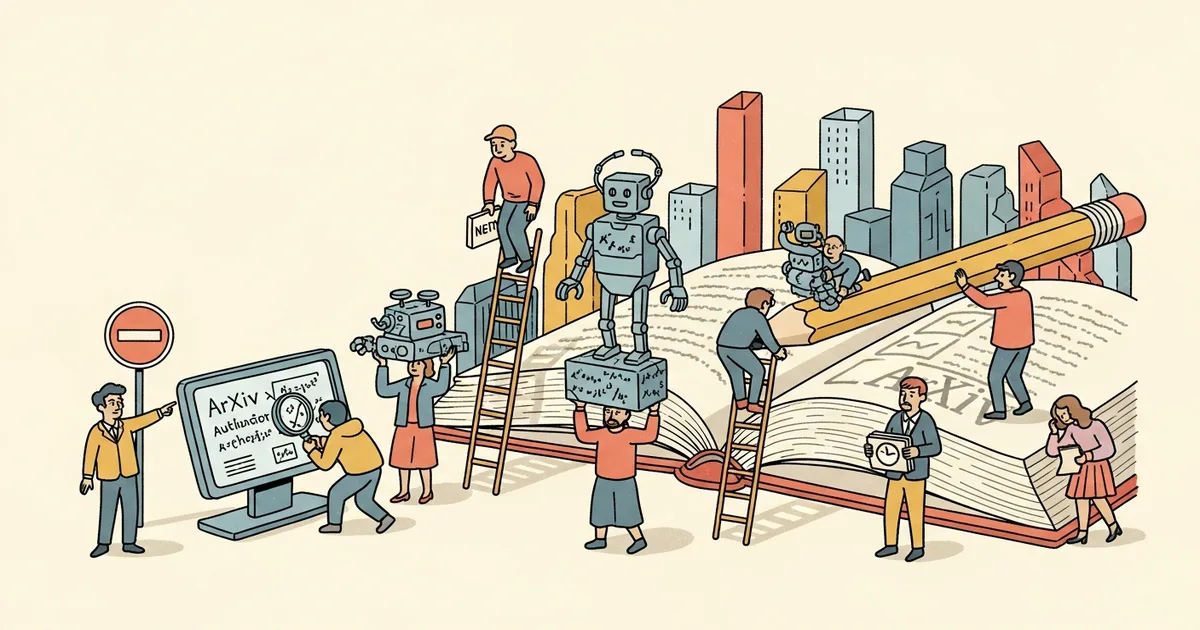
- ArXiv‘s computer-science section chair Thomas Dietterich announced authors will face a one-year ban if a submission contains incontrovertible evidence they didn’t check LLM-generated content.
- Evidence flagged includes hallucinated references, comments to or from the LLM, and similar artefacts left in the paper.
- After a one-year ban, subsequent arXiv submissions will require prior acceptance by a reputable peer-reviewed venue.
- The policy is ‘one-strike,’ but moderators must flag and section chairs must confirm the evidence before enforcement; authors can appeal.
What Happened
ArXiv, the widely-used open preprint repository, will impose a one-year ban on authors whose submissions show incontrovertible evidence of unchecked LLM output, TechCrunch reported on Friday. Thomas Dietterich, chair of arXiv’s computer science section, posted the policy on Thursday: “if a submission contains incontrovertible evidence that the authors did not check the results of LLM generation, this means we can’t trust anything in the paper.”
Why It Matters
ArXiv has become the central distribution channel for computer-science and AI research, despite hosting preprints before peer review. The site is also used as a data source for tracking research trends. Both functions are degraded when low-quality, AI-generated submissions accumulate. ArXiv had already required first-time posters to obtain endorsements from established authors; the one-year ban is a meaningful escalation. Recent peer-reviewed research has found fabricated citations on the rise in biomedical research, likely driven by LLM use.
Technical Details
Dietterich described the rule as a “one-strike” policy with procedural safeguards: moderators must flag the issue, section chairs must confirm the evidence, and authors are entitled to appeal before any ban is imposed. The triggering evidence categories include hallucinated references, embedded LLM comments or system prompts, and similar artefacts. After a one-year ban expires, subsequent arXiv submissions from that author must first be accepted by a reputable peer-reviewed venue.
Dietterich emphasised the rule is not a prohibition on LLM use — researchers can still use AI in their workflow — but rather a requirement that authors take “full responsibility” for content, “irrespective of how the contents are generated.” Inappropriate language, plagiarised content, biased content, errors, mistakes, incorrect references, and misleading content all fall under the author’s responsibility regardless of whether an LLM produced them. Dietterich confirmed the policy details to 404 Media.
Who’s Affected
The largest immediate population affected is the global community of computer-science and AI researchers who submit to arXiv. Established researchers gain a sharper standard for review and a stronger signal that arXiv-hosted preprints are author-vetted. Early-career researchers face higher friction if they relied on LLM assistance without thorough verification. Bad actors who have used LLMs to generate paper mills face direct exposure. Adjacent preprint servers — bioRxiv, medRxiv, ChemRxiv, and SSRN — will be watched to see whether they adopt similar policies.
What’s Next
ArXiv is also in the process of becoming an independent nonprofit, separating from Cornell after over 20 years of hosting. The independence should allow arXiv to raise additional funding to address the AI-slop problem at infrastructure scale. Expect adjacent preprint servers to either adopt arXiv’s framework or articulate alternative approaches. The one-year ban will be enforced going forward; arXiv has not specified retroactive enforcement against historical submissions.