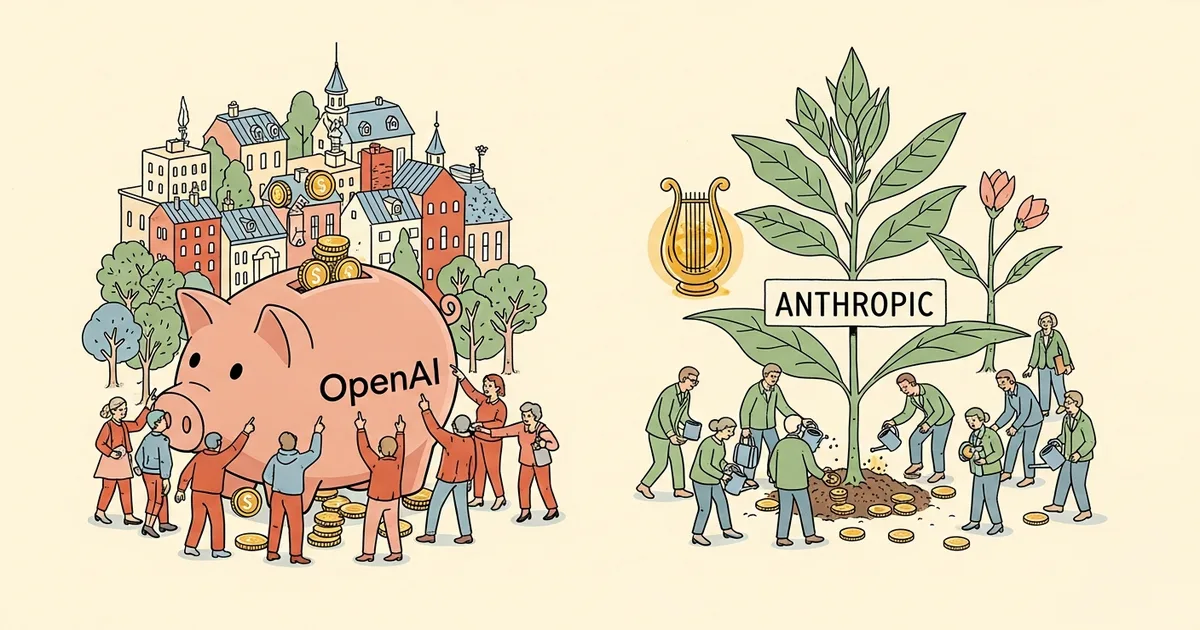
- About $600 million in OpenAI secondary shares went unsold in March 2026, days after the company closed a record $122 billion primary funding round at an $852 billion valuation.
- Secondary market platforms report nearly $2 billion in committed capital waiting to buy Anthropic shares, with Anthropic closing a $30 billion primary round at a $380 billion valuation in February 2026.
- OpenAI’s Pentagon deal, announced February 28, 2026, triggered a 295% spike in ChatGPT uninstalls the same day and gave rise to the QuitGPT boycott, which has drawn more than 1.5 million participants.
- Anthropic’s enterprise API market share climbed from 12% to 32% over the past year, while OpenAI’s dropped from 50% to 25%, according to PitchBook data.
What Happened
On March 31, 2026, OpenAI closed a $122 billion primary funding round led by Amazon ($50 billion), Nvidia ($30 billion), and SoftBank ($30 billion), setting the company’s valuation at $852 billion. Within 24 hours, Bloomberg reported that roughly $600 million in OpenAI shares placed on secondary markets found no buyers.
Ken Smythe, founder of secondary-market broker Next Round Capital, told Bloomberg: “We literally couldn’t find anyone in our pool of hundreds of institutional investors to take these shares.” The sellers included hedge funds and venture capital firms holding large existing stakes who had approached his firm looking to exit.
At the same time, secondary market platforms Augment and Hiive reported approximately $2 billion in cash sitting ready to purchase Anthropic shares. Adam Crawley, co-founder of Augment, told Bloomberg: “It’s just better risk-reward right now. People are betting that Anthropic’s valuation will catch up with OpenAI’s.”
Why It Matters
The divergence between primary and secondary markets is unusual. In most pre-IPO fundraising cycles, strong primary demand correlates with secondary demand. The fact that OpenAI raised a record sum from institutional anchors while separate holders rushed to exit points to a split in how different investor classes are pricing the company’s risk profile.
Anthropic closed its own $30 billion round at a $380 billion valuation in February 2026, more than doubling its September 2025 valuation of $183 billion. The valuation gap between the two companies — $852 billion versus $380 billion — is a central argument among secondary buyers. Where OpenAI would need to reach roughly $1.5 trillion to justify a 2x return, Anthropic at $380 billion has more room to appreciate before an IPO, which both companies are reportedly targeting for late 2026.
Technical Details
OpenAI’s own metrics are large in absolute terms. The company reported 900 million weekly active users and 50 million paying subscribers as of February 27, 2026, with monthly revenue crossing $2 billion. Enterprise revenue now accounts for more than 40% of the total and is on track to reach parity with consumer revenue by end of 2026.
Anthropic’s trajectory on the enterprise API market is steeper. According to Ramp’s AI Index for March 2026, nearly one in four businesses on the Ramp platform now pays for Anthropic, compared to one in 25 a year ago. Anthropic’s business software subscriptions grew 4.9% month over month in February 2026, while OpenAI’s fell 1.5%. Among companies purchasing AI services for the first time, Anthropic now wins approximately 70% of head-to-head evaluations against OpenAI. Anthropic derives approximately 80% of its revenue from enterprise contracts, compared to OpenAI’s more consumer-heavy mix.
OpenAI is projected to lose $14 billion in 2026, burning approximately $150 million per day, according to PitchBook estimates. The company made $13.1 billion in 2025 revenue.
Who’s Affected
The secondary-market rotation follows two concrete events that shifted institutional perception. On February 28, 2026, OpenAI announced a classified contract with the Pentagon allowing deployment of its models within Department of Defense networks for uses including intelligence synthesis and cybersecurity. The deal came after Anthropic had publicly declined to remove model guardrails in response to Pentagon requests. ChatGPT uninstalls spiked 295% on the day of the announcement.
The announcement accelerated a pre-existing user movement. The QuitGPT campaign, which calls on users to cancel ChatGPT subscriptions in response to OpenAI’s Pentagon contract and political donations, had drawn more than 1.5 million participants by early March 2026, according to Cybernews. Caitlin Kalinowski, who led OpenAI’s robotics division, resigned from the company and cited the Pentagon deal as a factor, according to NPR. Claude subsequently ranked as the most downloaded free app on the U.S. Apple App Store.
OpenAI CEO Sam Altman acknowledged the handling of the deal was poor. “It just looked opportunistic and sloppy,” he told reporters at CNBC, adding that the company “shouldn’t have rushed” the announcement. OpenAI subsequently amended the contract to add language regarding surveillance limits, though critics including the Electronic Frontier Foundation said the revisions left significant carve-outs intact.
What’s Next
Both companies are preparing for IPOs. Anthropic has engaged law firm Wilson Sonsini, and prediction market Polymarket currently prices a $500 billion-plus Anthropic valuation by end of 2026 at 93.5% implied probability. OpenAI has also signaled a public offering target of late 2026, and the $122 billion round included $3 billion raised from individual retail investors through bank channels for the first time.
The secondary-market signal does not indicate OpenAI is at risk of losing its primary funding pipeline — Amazon, Nvidia, and SoftBank committed a combined $110 billion in the March round. What it does indicate is that a subset of existing holders, specifically those who cannot access the primary round and are looking at secondary liquidity, are pricing Anthropic’s safety positioning and enterprise growth rate as a more attractive near-term bet than OpenAI’s larger but more contested valuation. Whether that calculus holds through an IPO process depends substantially on whether either company’s enterprise market share trajectory shifts before it reaches public markets.